Your website speaks in one voice, the newsletter in another, your managers write to clients in a third, and the texts from contractors and AI tools sound like everyone else. Customers do not remember the company, and the team argues about every phrase. Brand voice guidelines for small business do not need a month of workshops. This one-day method needs ten real texts, three or four traits, a list of words and a blind test. It covers words and manner only: no logos, no colours.
Brand voice guidelines for small business: why one company sounds like several
A voice splits when people write without a shared reference. The founder writes warmly, sales write like a contract and the freelancer copies a competitor. In a small business nobody is wrong, yet the reader meets three different companies. A short document fixes this because it replaces taste with rules the team can check. For a small business it is cheaper than a rebrand and works faster, and brand voice guidelines for a small business of ten people fit on two pages.
Step 1: collect ten real texts that sound like you
In a small business, gather ten texts in which you recognise yourself: a good email to a client, a page of the site, a post, a reply to a complaint. Read them aloud. Mark the sentences you would be proud to sign and strike the ones that could belong to anyone. This is your raw material, and it is better than any abstract values list because it is already yours.
Step 2: choose three or four traits as «we are X, but not Y»
Turn the marks into traits, each with a limit: «we are direct, but not blunt», «we are expert, but not academic», «we are warm, but not casual». The «but not» part stops a trait from sliding into its extreme. Nielsen Norman Group’s four dimensions of tone help to place each trait: funny or serious, formal or casual, respectful or irreverent, enthusiastic or matter-of-fact.
How to define brand voice without long adjective lists
Three or four traits are enough. Ten adjectives are a wish list, and nobody can write by them. A good test: can a new employee tell, from the trait alone, which of two sentences is right?
Step 3: a list of words we say and words we avoid
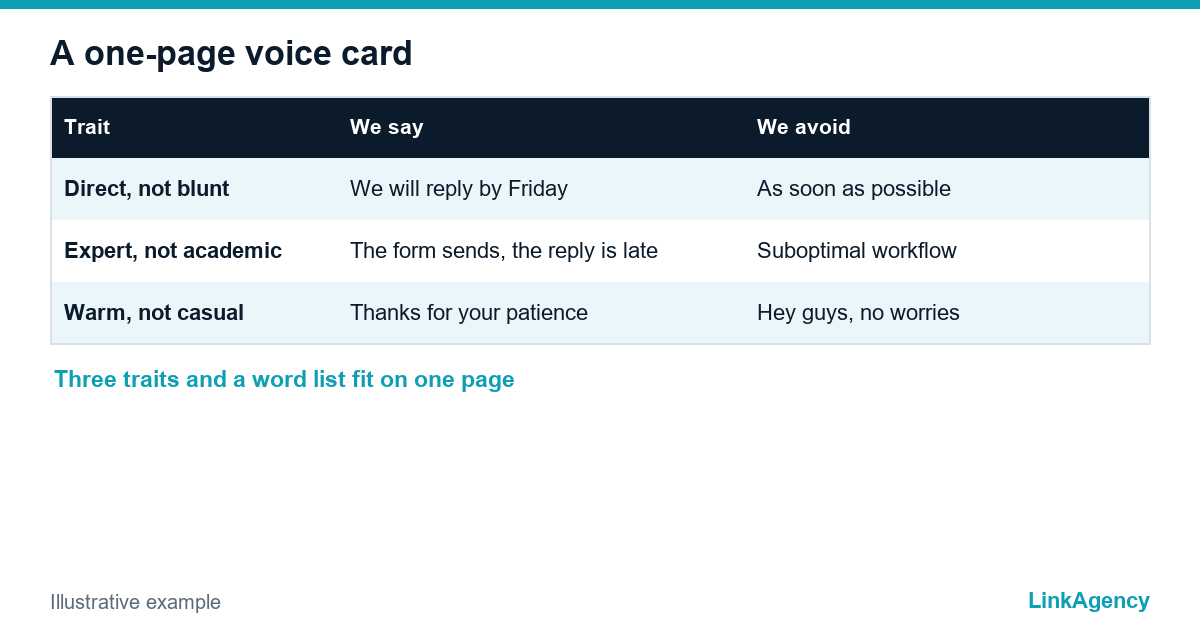
Write two columns. In the first, the words you use for your product, your customers and your process. In the second, the words you avoid: filler, jargon and promises you cannot keep. This word list is the part that people actually use every day, so keep it on one page. Add a note on pronouns: «you» for the customer, «we» for the company. Give the team the words, and the voice stays steady when five people write.
| Trait | We say | We avoid |
|---|---|---|
| Direct, but not blunt | «We will reply by Friday» | «As soon as possible» |
| Expert, but not academic | «Your form sends, but the reply is late» | «Suboptimal conversion workflow» |
| Warm, but not casual | «Thanks for your patience» | «Hey guys, no worries!» |

Step 4: rules for sentences, address and terms
A small business can keep four rules, no more: the usual sentence length, how you address the reader, how you name key terms and what you never write, such as exclamation marks in a complaint reply. Short rules get followed. A tone of voice guide that runs to forty pages ends in a drawer.
Step 5: three before-and-after examples
Take three real sentences and rewrite each in your voice. Show the old and the new side by side, as a before and after pair: «We value your feedback and strive to improve» becomes «Tell us what went wrong, and we will fix it this week». These b2b brand voice examples teach faster than any rule, because they show the result.
The blind test: can people recognise you without a logo
Remove the logo from three of your texts, mix them with three competitor texts and ask five colleagues or customers to point out yours. If they cannot, your voice is not distinct yet, and you should tighten the traits. This blind test takes thirty minutes and gives a small business a first honest score; the same words matter on the front page, see homepage messaging for small business.
How to pass the tone to AI tools and contractors
Give a contractor the one-page document, the before-and-after examples and two texts to imitate. For brand voice for ai writing tools, paste the traits, the word list and the examples into the prompt, then ask for a draft and check it against the blind test. An AI tool follows a clear template well and a vague mood badly. Our SEO copywriting services work from such a document.
How to store, update and who owns the document
Treat brand voice guidelines as a living page, not a launch poster.
- Name one owner, usually an editor or the head of marketing.
- Keep the style guide in a shared place, linked from the onboarding page, and list each channel it covers.
- Review it twice a year and after any large change in audience or product.
- Collect corrections from the team and add the best as new examples.
When the voice is ready, our branding services can extend it into the full identity, and our Instagram marketing services help to apply it to posts and replies. The Mailchimp voice and tone guide is a public example of how short such a document can be.
Brand voice guidelines for small business: a free text review
Send us three to five of your texts: a page of the site, an email, a post. We will show where the voice splits and how to bring it together. If you want the document written, our branding services and SEO copywriting services prepare it for you.
- a note on where your voice differs across texts;
- a short plan to bring the voice together.
Leave a request and we will reply within one working day.

Frequently Asked Questions (FAQ)
What are brand voice guidelines for small business?
A short document that describes how your company writes: three or four traits, a list of words you say and avoid, rules for sentences and examples. It helps everyone from the founder to freelancers write in the same voice.
How long should a tone of voice guide be?
Two or three pages are enough. Long documents are not read. Keep the traits, the word list, four rules and three before-and-after examples on a page or two.
How do I define brand voice if we are a new company?
Collect ten texts you are proud of, mark what sounds like you and turn the marks into three traits in the form «we are X, but not Y». Test them with a blind test.
How do I teach an AI writing tool our brand voice?
Paste the traits, the word list and the before-and-after examples into the prompt, ask for a draft and compare it with your document. Check the result with a blind test.
What is a blind test for brand voice?
You remove the logo from several texts, mix yours with competitor texts and ask people to pick yours. If they cannot, the voice is not distinct enough yet.
Who should own the brand voice document?
One named person, usually an editor or the head of marketing. They keep the document in a shared place, review it twice a year and add new examples from the team.
How can LinkAgency help with brand voice guidelines?
We read three to five of your texts, show where the voice splits and prepare the document with examples for your team and contractors. The first review is free. Leave a request and we reply within one working day.