A customer, an insurer or a security questionnaire asks for a «pen test report», and the owner is not sure what that means or whether the automatic scan already run is enough. Penetration testing for small business is not a ritual to buy once a year. It is one of two checks that answer different questions, and choosing the wrong one wastes money or leaves a gap. Below is a plain decision table, a way to set the scope and a list of what a good report contains.
Penetration testing for small business: two checks, two different jobs
Scanning is automatic: a vulnerability scan has a tool crawl your site and compare what it sees with a list of known problems. Penetration testing is manual work by a person who tries to break in the way an attacker would. The first is quick and repeatable. The second is slower and goes deeper. They complement each other, and the question of vulnerability scan vs penetration test is really a question of what you need to prove and to whom.
What an automatic scanner finds
A scanner is good at known issues: outdated software, missing security headers, weak TLS settings and common injection patterns. It can run weekly at low cost, which makes vulnerability scanning for small business a sensible baseline, and a vulnerability scan is often the first thing an insurer asks about. Its weakness is context. It reports false positive findings and cannot judge whether a flaw matters for your business. The OWASP Top 10 is a useful map of what such tools look for.
What a human tester finds
A person finds what a tool cannot reason about. Logic flaws are the typical case: a customer who can open another customer’s order by changing a number in the address, a discount that stacks when it should not, a password reset that skips a step. A tester also chains small issues into one real attack path. For web application penetration testing, the OWASP Web Security Testing Guide describes what such a test covers.
When regular scanning is enough
For a small business with a brochure site, a contact form and no accounts, penetration testing is rarely needed. Regular scans, updates and sensible hosting settings cover most of the risk. A scanner also helps between tests, because new flaws appear whenever code or plugins change. A simple vulnerability scan after each update does more here than an annual test. So, how often should you pen test a website of this kind? When something big changes, not on a fixed date.
When you need a pen test
Order penetration testing when any of these is true for your small business:
- the site has a customer area with personal data;
- it takes payments or handles orders;
- you are about to launch a major feature;
- a client, an insurer or a questionnaire asks for a report.
Some regulations and card-payment rules mention security testing. Read the original text or ask a lawyer what applies to you, rather than trusting a summary.
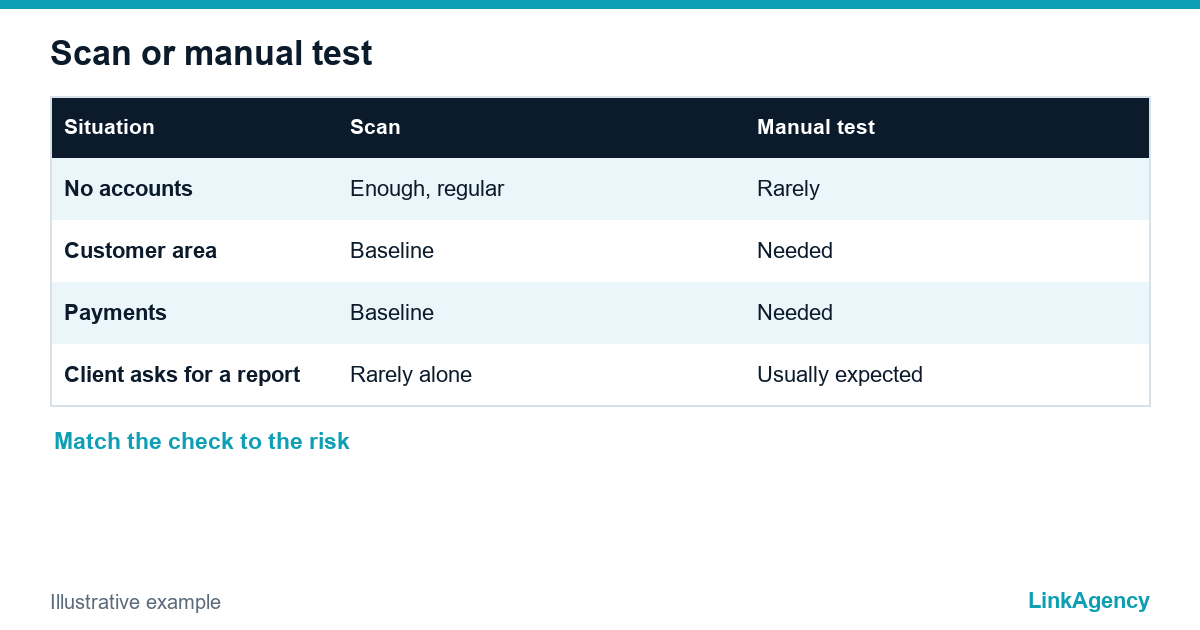
| Situation | Scan | Pen test |
|---|---|---|
| Brochure site, no accounts | Enough, run regularly | Rarely needed |
| Customer area or payments | Baseline between tests | Needed |
| Before launching a big feature | Yes | Yes |
| Client or insurer asks for a report | Rarely accepted alone | Usually expected |

How to set the scope and prepare the site
Agree the scope
The scope says what is tested: which addresses, which roles, which features, and what is excluded. Write it down together with the tester. In web application penetration testing, include every role and every payment step.
Prepare staging, accounts and permission
Prepare a staging copy where possible, so that tests do not touch live orders, and create test accounts for each role. Get written authorization from whoever owns the system and the hosting, because testing a site without permission can be illegal. Name a contact who can be reached during the test.
What a good report contains
A scanner lists problems, and a tester explains them in a report you can act on. For penetration testing for small business, that report is what your client or insurer will read. The report should give a short summary for the owner and, for each finding, the risk level, steps to reproduce, the affected page and a fix. Scores such as CVSS help to compare severity, but the explanation matters more than the number. A report with only a tool export and no remediation advice is a poor deal for any small business.
What to do after: priorities and a retest
- Fix the highest risks first, especially anything touching payments or personal data.
- Plan the rest by effort and risk.
- Ask the tester for a retest of the fixes.
- Keep the report and the retest note for the next client or insurer.
Fixes often touch infrastructure and code, which is where DevOps services help to harden the pipeline, cloud hosting services to set up safe environments, and a web application development service to repair the weak spots in the code.
Penetration testing for small business: choose the right check
Tell us what the client or insurer asked for. We will help you decide whether a scan or a manual test fits, define the scope, prepare the environment and plan the fixes. We do not run penetration tests ourselves, so we point you to the right kind of check and then help to fix what it finds.
- advice on scan or pen test for your site;
- a scope outline and a fix plan.
Leave a request and we will reply within one working day.

Frequently Asked Questions (FAQ)
What is the difference between a vulnerability scan and a pen test?
A scan is automatic and compares your site with a list of known problems. A pen test is manual work by a person who tries to break in like an attacker, and it finds logic flaws a tool misses.
Do small businesses need penetration testing?
It depends on the site. A brochure site with no accounts usually does well with regular scans. A customer area, payments or a client request for a report usually call for a manual test.
How often should you pen test a website?
Not on a fixed date by default. Test when something big changes, such as a launch or a new payment feature, or when a client or insurer requires it. Scan regularly in between.
What should a pen test report include?
A short summary for the owner and, for each finding, the risk level, steps to reproduce, the affected page and a fix. Scores like CVSS help compare severity, but a clear explanation matters more.
How do I prepare my site for a test?
Agree the scope in writing, prepare a staging copy, create test accounts for each role and get written authorization from the system and hosting owners. Name a contact for the test period.
Is a scan report enough for a client or insurer?
Sometimes, but a manual test report is usually expected for sites with accounts or payments. Check the exact wording of the request, and ask a lawyer about any regulatory duty.
Can LinkAgency help with penetration testing for small business?
We do not run penetration tests ourselves. We help you decide between a scan and a manual test, define the scope, prepare the environment and fix what the report finds. Leave a request and we reply within one working day.