Texts are written fast now, but the site starts to fill with generic phrases, shaky facts and articles that look like everyone else’s. Many owners ask whether this hurts customer trust and Google rankings. This guide treats ai generated content for business website pages as a process question: who writes the brief, who checks facts, who adds company examples and who signs the text off.
AI generated content for business website pages: where it helps and where it hurts
Neural networks help with drafts, outlines, headline options, summaries of your own notes and first versions of routine pages. They hurt when nobody checks the result: hallucination, meaning invented numbers and confident wrong claims, and the same neutral tone as every competitor. Plagiarism of other sites is another risk, and scaled content, meaning many near-identical pages, is the one Google calls abuse. Is ai content bad for seo? Google’s own guidance on using generative AI content does not ban the tool. It asks for accurate, high-quality, relevant text. It also warns against mass-producing pages that add no value. For a business website this means one thing: publish fewer pages, and make each one earn its place.
So the risk sits in how the text is made and checked. A business owner who reads the website content before it goes live removes most of it.
| Step | Who does it | Output |
|---|---|---|
| Brief | Marketing lead | Task, audience, facts to use |
| Draft | Neural network | First version |
| Fact-check | Editor | Verified numbers, names, dates |
| Company input | Subject expert | Examples and opinions |
| Sign-off | Named owner | Approved text |

A good prompt for AI content: task, audience and facts
How to edit AI generated content starts with the brief
A weak prompt gives a weak page, and a brand voice guide helps the model sound like you. Write a brief that names the reader, the page’s goal, the tone of voice and the facts the model may use. Paste your own notes and say what it must not claim. A prompt that says “use only the facts below” is the simplest guard against invention. Keep the brief with the text, so the next editor sees what the model was told.
Fact-check: numbers, names, dates and links
Models predict words and do not look facts up, so every number, name, date and link needs a human check. Open each source and delete any number you cannot find. Check product names and prices first. Those are the lines readers remember. Any ai content review process starts here, since a single wrong claim costs more trust than ten good paragraphs earn.
What only your company adds: examples, experience, opinion
The same prompt, run by your competitor, gives a similar draft. The difference is what your team adds: a customer case, a mistake you made, a number from your own work, a view that you can defend. Google’s guide to generative AI search speaks of non-commodity content for this reason. Ask the subject expert for ten minutes. Record the answers, add an original example and weave them in. This is also how E-E-A-T signals, meaning experience and trust, reach the page.
An 8-point editor checklist
This ai content quality checklist takes about twenty minutes per page, and the same human review applies to every business website page, big or small.
- Does the opening answer the reader’s question in the first lines?
- Is every number, name and date checked against a source?
- Are there company examples that a competitor could not copy?
- Are empty phrases and repeated sentences removed?
- Does the tone match your brand and your other pages?
- Do the title, description and image text match the page?
- Is each claim free of promises you cannot keep?
- Has a named person read the final version?
Texts better not given to a neural network
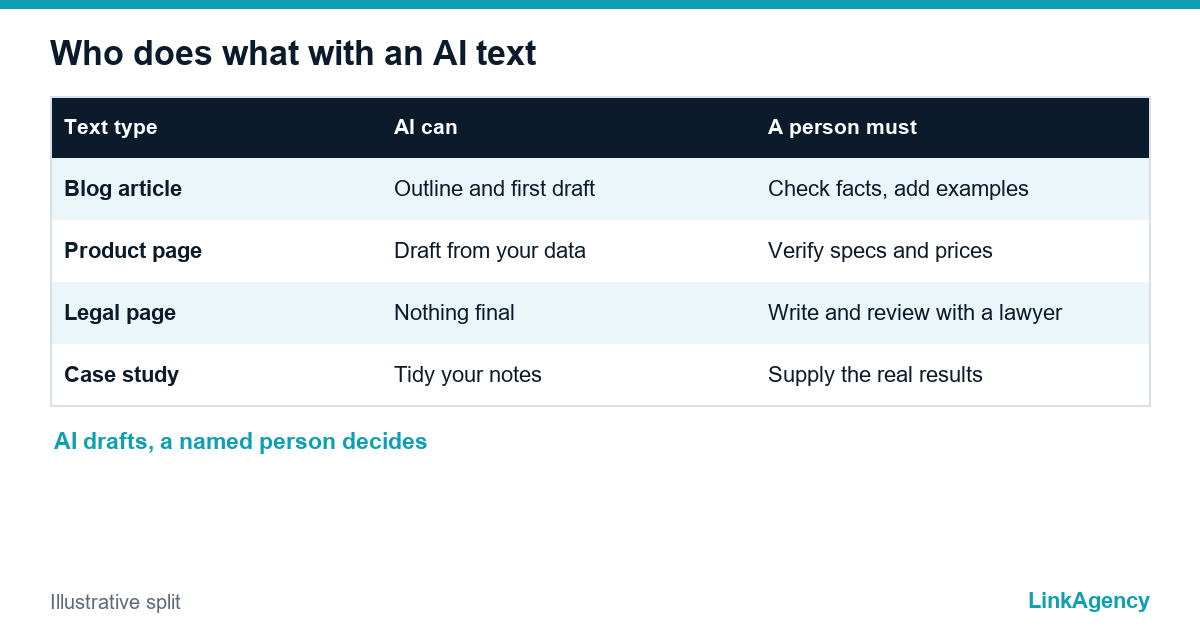
- Legal texts: terms, privacy notices, contracts.
- Medical, financial or safety advice.
- Prices and guarantees; delivery and return conditions.
- Promises, case results and customer quotes you did not collect.
If a mistake here can cost money or harm a person, a human writes it and a legal review follows. For routine pages, use AI for the first draft only.
Who is responsible and how to fix it in the process
Name an owner for every published page: a person, not a tool. In the EU, the AI Act adds transparency duties for some uses; Article 50 covers AI-generated text published to inform the public, with an exception where a person has editorial responsibility. Most company pages will not fall under that rule directly, but the direction is clear: keep human editorial control and ask a lawyer about your case. Put the roles into a short written procedure. The whole team can reuse it for every page. Our AI integration services set up this workflow inside your tools, and our content creation services and SEO services carry it into your blog.
AI generated content for business website: help with a safe workflow
Tell us which tools you use now and who writes your pages. We will help set up a safe process for AI texts: briefs, fact-checks, sign-off and a checklist for your editor. If you want it built, our AI integration services and content creation services handle it.
- a short process map with roles;
- an editor checklist adapted to your pages.
Leave a request and we will reply within one working day.

Frequently Asked Questions (FAQ)
Is ai content bad for seo on a business website?
Google’s guidance does not ban ai generated content. It focuses on accuracy, quality and relevance, and warns against producing pages in bulk that add no value. A checked page with real company input carries less risk than a raw draft.
How do I edit AI generated content before publishing?
Check every fact, remove empty phrases, add company examples and match the tone of your brand. Then a named person reads the final version. The eight-point checklist in this guide covers each step.
Can I use ChatGPT for website copy?
Yes, for drafts and outlines, with a clear brief and a human review. Avoid it for legal texts, prices and guarantees. Never paste confidential data into a public tool.
Who is responsible for ai generated content on our business website?
Your company is responsible, not the tool. Name an owner for each page who approves the text. Put the roles into a written procedure so the check does not depend on one person.
Do I need to label AI-generated content?
Rules depend on the use and the country. In the EU, the AI Act has transparency duties for some cases, with an exception where a person has editorial responsibility. Ask a lawyer about your pages.
How can LinkAgency help with ai generated content for a business website?
We design the workflow: briefs, fact-checks, sign-off and a checklist, and connect it to your tools. The first consultation is free. Leave a request and we will reply within one working day.