You need more developers. Hiring in-house takes months, and two offers sound almost the same: rent a few specialists or take a whole team. The staff augmentation vs dedicated team choice looks like a question about words, but it is really a question about who manages the work and who answers for the result. This guide compares both models by the questions a manager asks, and ends with a five-question test.
Staff augmentation vs dedicated team: the two models in plain words
With this first model, a vendor supplies individual engineers who join your team and take tasks from your manager. You run the process, the backlog and the priorities. With a dedicated team, the vendor assembles a group around your product, often with its own lead, and you agree on outcomes and a working rhythm. Think of a dedicated development team as closer to a small department you rent than to extra hands. Extra staff join your team; a dedicated lead runs it.
| Manager’s question | Staff augmentation | Dedicated team |
|---|---|---|
| Who sets daily tasks? | Your manager | The team lead, with your product owner |
| Who answers for the result? | You | Shared, as agreed in the contract |
| How fast can it start? | Usually faster, one or two people | Slower, a team must be assembled |
| What when tasks end? | Release people quickly | Team keeps knowledge, cost continues |

Who manages the work and who is accountable
Management load on your side
This model needs a manager with time. If nobody can write tasks, review code and unblock people every day, extra engineers will sit idle. Waiting is expensive. The Scrum Guide is a useful reference for the roles you must fill yourself, whatever model you pick.
Accountability for the outcome
Under augmentation, the vendor is accountable for people showing up and being qualified, and you are accountable for what they build. A dedicated team takes more of the delivery risk. Write down which results it owns. Never assume this from the model name.
When to use staff augmentation
When to use staff augmentation? When you already have a product, a lead and a working process, and you lack hands in one skill, such as a mobile or data engineer. A short peak, such as a launch, is another case where hiring a permanent person would be too slow, and a quick start matters more than a long relationship with the vendor. Our staff augmentation services follow this logic: a defined role, a trial period and a clear way to release the person.
When a dedicated team fits better
The dedicated team model suits a longer product with a roadmap, when you have a product owner but no engineering lead, or when you want delivery handled end to end. The dedicated development team model costs more to start and to stop, so it pays off when the work will last for many sprints. For new products, our custom software development services use this setup, and for browser-based products our web application development services do.
Risks of each model: knowledge transfer, turnover, dependency
- Knowledge sits in people’s heads: ask for documentation and weekly demos, so a departure does not stop the work.
- Turnover at the vendor: agree on a notice period and an overlap week for any replacement.
- Dependency: if one vendor holds all the context, vendor lock-in follows and moving later is expensive, so keep repositories and accounts in your name.
- Retention: a good engineer who leaves takes onboarding time with them, so ask how the vendor keeps people.
Same logic as in our guide to outsourced software development for non-technical owners: the owner keeps access, priorities and acceptance.
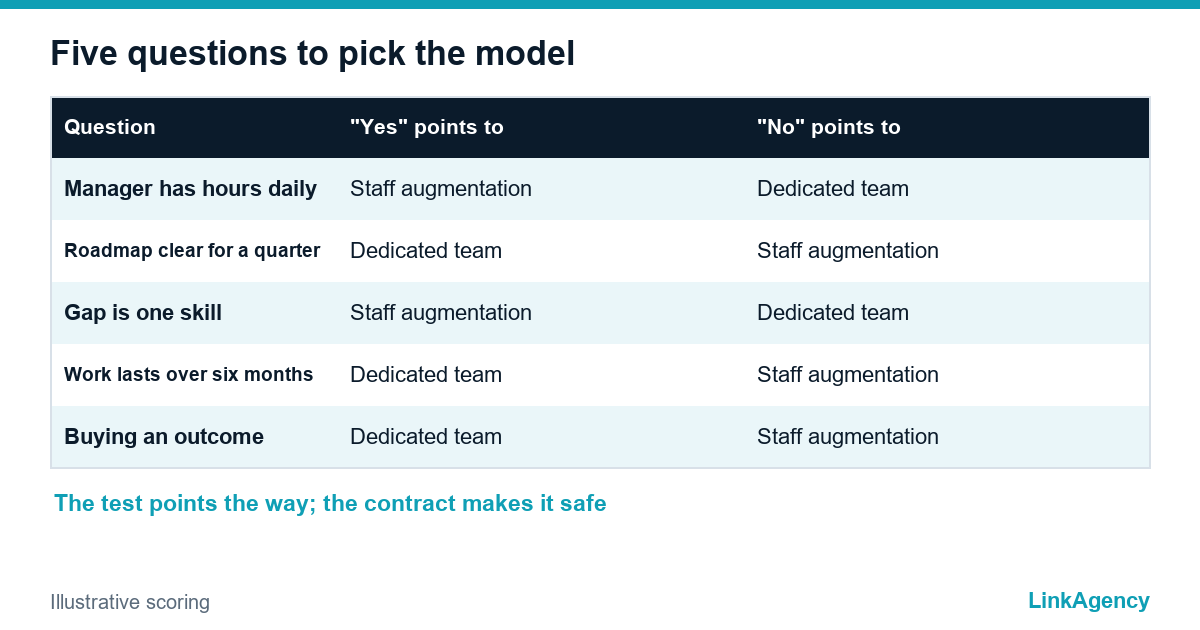
A five-question test for choosing the model
- Do you have a manager who can spend hours every day on tasks and reviews?
- Is the roadmap clear for at least the next quarter?
- Is the gap one skill or a whole function?
- Will the work last longer than six months?
- Do you want to buy hours or an agreed outcome?
Count your answers. Mostly “yes” to the first and third questions points to augmentation. Mostly “yes” to the second, fourth and fifth points to a dedicated team. If you hire developers for a project with a fixed end date, lean towards augmentation and a short contract. Keep the scope fixed in writing.
What to fix in the contract before you start
Write down who owns the code and the intellectual property, the notice period, the replacement rule, and whether you pay by time and materials or for a fixed scope. Add an NDA and, if personal data is touched, a processing agreement under Article 28 of the GDPR. Ask a lawyer. Wording differs by country.
Staff augmentation vs dedicated team: a free consultation on the right model
Describe your product, your current team and the gap you want to close. We will recommend a model and a team composition for your situation, with no prices in the first call. If you decide to go ahead, our staff augmentation services and custom software development services cover both options.
- a recommended model and team composition;
- a short list of contract points to agree first.
Leave a request and we will reply within one working day.

Frequently Asked Questions (FAQ)
What is the difference between staff augmentation and a dedicated team?
In staff augmentation, individual engineers join your team and follow your manager. A dedicated team is a group built around your product, usually with its own lead. The first gives you control over tasks; the second hands over more of the delivery.
When should we use staff augmentation?
Use it when you already have a product, a manager and a process, and lack hands in one skill. Short peaks, where a permanent hire would take too long, are another good case.
Is a dedicated development team more expensive?
Starting and stopping costs more, because a team has to be assembled and kept together. Over a long roadmap the price can even out, because the team keeps the knowledge. Compare total cost for your timeline, not hourly rates.
Who owns the code in both models?
The contract decides, so write it down. The agreement should say that code and intellectual property belong to your company, and that repositories and accounts stay in your name.
How do I hire developers for a project with a fixed end date?
Staff augmentation with a short contract and a clear notice period is usually the simpler choice. Define the role, the trial period and how the person is released when the project ends.
How can LinkAgency help me choose?
Describe your product, your team and the gap, and we will recommend a model and a team composition. The first consultation is free and does not include prices. Leave a request on the site and we will reply within one working day.