New customers keep arriving, but some leave a few months later, and nobody can say whether the product, the price, support or a failed card is to blame. This guide shows how to reduce saas churn in a practical order: first split the losses into types, then fix six causes, then watch a simple weekly dashboard.
How to reduce SaaS churn: first split it into types
One churn rate number hides four different problems, and saas churn reasons differ for each of them. Voluntary churn means the customer decided to leave. Involuntary churn means the payment failed and the customer never meant to go. Early churn happens in the first weeks, before the product proved useful. Late churn happens after months of use, usually because the product stopped fitting the work.
Each type needs its own action. A cancellation survey helps with voluntary churn, retry rules help with failed payments, onboarding fixes help with early losses, and account reviews help with late ones. Without the split, a team usually tries discounts for everything. To reduce the damage from churn in a small saas, split first and act second.
| Churn type | What to look at | What to change |
|---|---|---|
| Early, voluntary | Share of new accounts reaching a first result | Onboarding steps and first value |
| Involuntary | Failed payments and expired cards | Retries, emails, card updates |
| Late, voluntary | Usage drop before cancellation | Account reviews, workflow fit |
| Silent | Paying accounts with no logins | Check-in, training, pause option |

Cause 1: the customer never reached the first value
Many early cancellations are really onboarding failures, and to reduce saas churn you fix them first. The user signed up, got stuck on the third step and never saw the result they paid for. Define the first value in one sentence, such as “first report created”. Measure how many new accounts reach it. Then remove steps, add templates and reach out to anyone who stalls. Your customer success person, or the founder, can send one personal message.
Cause 2: failed payments and expired cards
Involuntary churn: failed payments
A card expires, a bank declines a charge, and the subscription ends without the customer ever deciding to leave. This is involuntary churn failed payments territory, and it is the cheapest loss to fix. Set up dunning: automatic retries, a reminder before the card expires and a clear way to update billing details. Payment platforms document the mechanics, for example Stripe’s guide to smart retries.
Why customers cancel subscription: the reasons to ask
Add one question to the cancel screen. Why customers cancel subscription is rarely what you guess, so offer a short list: too expensive, missing feature, not using it, switching tool, project ended. Offer a pause or a smaller plan. Never hide the cancel button.
Cause 3: nobody owns the task on the customer side
If the person who bought the product is not the person who uses it, the account drifts, and saas churn grows quietly through those accounts. Ask in onboarding who owns the task the product solves, invite a second user and send that person the weekly result. Accounts with one named owner and several users are harder to lose.
Cause 4: the product is not part of the customer’s workflow
A tool that lives outside the daily routine gets cancelled at the next budget review, which is one more way to reduce saas churn if you fix it early: build it into the routine. Look for integrations, imports and notifications. Custom features are a product decision, and our web application development services and custom software development services exist to build exactly these connections.
Cause 5: support answers too late
Slow answers turn a small question into a cancellation and raise saas churn month after month. Track the time to first reply, the share of tickets solved without a second round and a health score per account. Put the most common answers into the product itself. Automation can draft replies and route urgent cases to a person, and our AI integration services can connect the helpdesk to the product data.
Cause 6: customers do not see the result
If the value is invisible, the invoice is the only thing the customer notices, and the monthly MRR line grows slower than it should. Send a short monthly summary: what was done, what was saved, what is next. Show it inside the product too. The first weeks shape that perception, and our guide to choosing between freemium, a free trial and a demo covers it. Stripe also publishes a short overview of how to reduce churn in SaaS.
A simple weekly dashboard for saas retention strategies
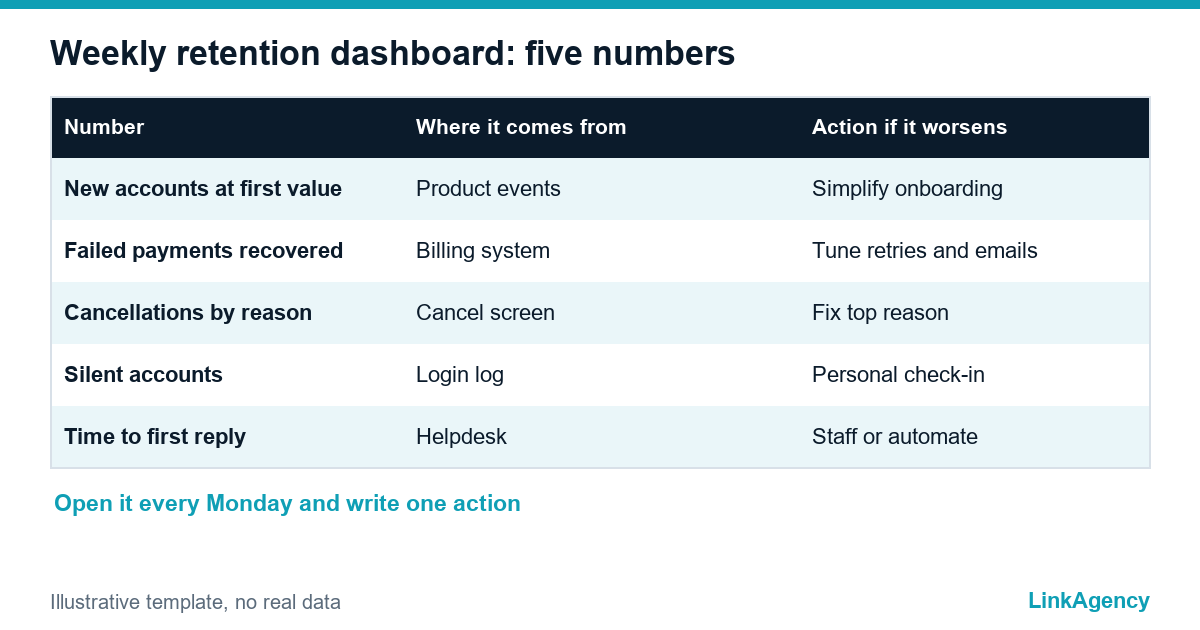
Saas retention strategies start with a page you open every Monday. Put on it five numbers: new accounts reaching first value, failed payments recovered, cancellations by reason, accounts with no logins for two weeks, and time to first support reply. Compare cohorts by sign-up month and write down one action for the next week. That is how a team learns how to reduce churn without guessing.
- Pick the first-value event and the failed-payment report.
- Add the cancel reason field and read the answers every week.
- Flag accounts with no logins and contact them.
- Review the dashboard in a fifteen-minute meeting.
How to reduce SaaS churn: a free review of where customers drop off
Describe your product and your funnel. We will look at where customers are lost, from the first login to the cancel screen, and tell you which product changes to make first. If you want the work done, our web application development services and AI integration services handle it.
- a short map of where accounts are lost;
- a list of product changes ranked by effort.
Leave a request and we will reply within one working day.

Frequently Asked Questions (FAQ)
How do I reduce SaaS churn quickly?
Start with the cheapest losses: failed payments and expired cards, then the cancel screen. Add retries, reminders and a one-question survey. These changes need little development and show results within a billing cycle or two.
What is the difference between voluntary and involuntary churn?
Voluntary churn is a customer decision to leave. Involuntary churn failed payments happen when a card is declined and the subscription ends without that decision. They need different fixes, so track them separately.
Why customers cancel subscription plans: what are the main reasons?
Common reasons are no first value, too high a price for the result, a missing feature, slow support and a project that ended. Ask on the cancel screen and read the answers every week instead of guessing.
Which saas retention strategies should a small SaaS track every week?
Track new accounts reaching first value, recovered failed payments, cancellations by reason, silent accounts and the time to first support reply. Five numbers are enough to start.
Can discounts reduce saas churn?
Sometimes, for price-driven cancellations, but they treat the symptom. If customers leave because they never saw value, a discount only delays the loss and teaches people to ask for one.
How can LinkAgency help reduce churn?
We review your funnel, find where accounts are lost and propose product changes, from onboarding to billing flows. The first consultation is free. Leave a request and we will reply within one working day.