The app worked well in one language, but sales in the new country do not come. The interface is half translated, dates and prices look wrong, emails arrive in English and support cannot understand customers. Every extra language turns into an expensive rewrite. App localization for european markets is cheaper and faster when the order of work is right: prepare the code first, translate second, and enter countries one at a time. This guide explains the difference for a founder or a CTO, lists what to localize besides text and suggests a pilot plan.
App localization for european markets: internationalization versus localization
The two words are often mixed up. That costs money. Internationalization, or i18n, is the engineering step that makes a product able to support many languages: text moved out of the code, flexible layouts, correct handling of dates, numbers and plurals. Localization, or l10n, is the adaptation for a specific market on top of that. The W3C gives a short explanation of internationalization and localization that engineers can share with managers.
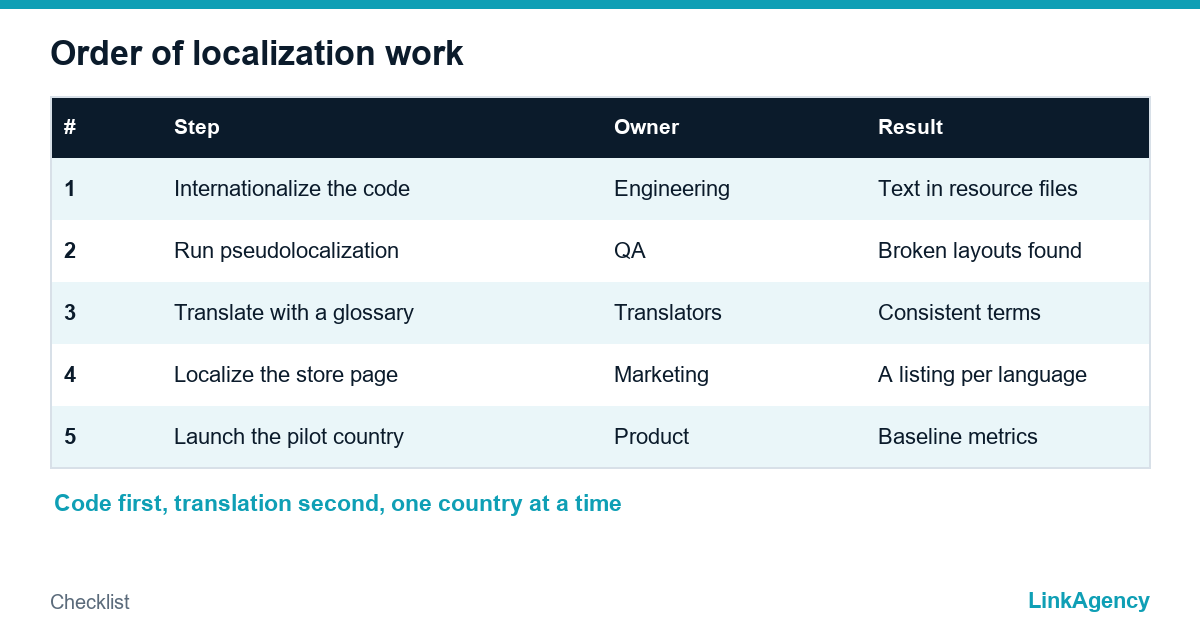
Strings in the code, the layout design and the budget all need one early decision that the founder, the product owner and the engineers sign off together before the first translator receives a single file. The internationalization vs localization question is a budget question, and app localization costs far less when the code is ready. If strings are hard-coded into screens, every new language means editing the code again, and every locale needs its own formats on top of the translation. If they are stored in resource files, a new language is mostly translation work plus testing.
Signs your product is not ready for new languages
The internationalization vs localization gap shows up in a few clear symptoms. Run through this list before you hire translators:
- Interface text is typed directly into the code or into images.
- Buttons break when a label becomes longer, which German text often does.
- Dates, prices and phone numbers use one fixed format.
- Plurals are built by adding an “s” to a word.
- Emails and push notifications are written in one language only.
- Support has no process for tickets in other languages.
Two or more of these mean the saas localization checklist should start with engineering, not with a translation agency. Mobile app localization strategy without that step produces a translated product that still breaks in the new country.
What to localize besides the interface: eight things teams forget
Formats, money and tax
Text is only the visible part. Most of the work is elsewhere. A realistic mobile app localization strategy covers these eight items:
- Date, time, number and address formats for each country.
- Currency, price display and the VAT rules of the market.
- Payment methods that local customers actually use.
- Emails, push notifications and invoices.
- Error messages and the empty states of the interface.
- Screenshots, icons and images that contain text.
- Legal texts: terms of use and the privacy policy.
- Support: help articles, chat templates and working hours.
Design deserves a separate note. Layouts must tolerate text that grows by about a third in some languages, and the budget for design review should be planned in advance, not discovered after release. Strings in images cannot be translated at all, so keep text out of pictures.
Translation methods for app localization: machine, AI or professional
Choose the method by the cost of an error, not by price per word. A mobile app localization strategy sets the method for each type of text.
| Method | Good for | Risk |
|---|---|---|
| Machine translation | Internal drafts, help articles of low risk | Wrong tone, literal errors |
| AI translation with review | Interface text and notifications | Inconsistent terms without a glossary |
| Professional translator | Legal texts, store page, marketing | Higher cost and slower turnaround |
Whatever you choose, keep a glossary and a translation memory so the same term is translated the same way across the product. Test with pseudolocalization first: it replaces text with longer accented strings and exposes broken layouts before a single real word is translated.
App store localization: the product page on App Store and Google Play
For many products, app store localization decides whether people find the app at all, so plan app store localization together with the first release in each country. The store listing is translated separately from the app: name, subtitle, description, keywords and screenshots, and every store has its own limits that change over time. Apple describes the process on its app localization page for developers. App localization for the store page is a separate task for each of the european markets. Do not copy keywords from one language into another, because people search differently, and check that the website has matching language pages. Our guide on multilingual SEO mistakes covers the web side of the same rollout.
Legal part: GDPR, terms and accessibility
In Europe the privacy policy and the consent texts must be available in the language of the user, and the data processing must follow GDPR in every country you enter. Accessibility is a second legal topic. The European Accessibility Act, Directive 2019/882, covers a range of consumer digital services, and it contains an exemption for microenterprises that provide services. Whether it applies to your product, and from which date, you should confirm with a lawyer. An accessible interface also tends to survive translation better, because it avoids text in images and fixed sizes.
Rollout order for european markets: one pilot country and the metrics
App localization for european markets pays back once the first pilot works, so pick one pilot market rather than five. Choose a country where you already have some demand, where the language is shared with a neighbour, and where the legal setup is not exotic. Then measure before you add the next one:
- Store page conversion in the new language.
- Activation and week-one retention compared with your home market.
- Support tickets per user and the share that needed translation help.
- Revenue per user after the local price and payment methods.
A saas localization checklist should end with these four numbers, not with a list of translated files.
If the numbers hold, the next language costs far less, because the engineering step is already done. Founders also ask how to localize a web app: the steps are the same, with a browser in place of a store. If you need a team for the engineering side, our mobile app development services prepare the code for new languages, and web application development does the same for web products.
App localization for european markets: a free readiness audit
Send us the product. We will check which parts of the code and design must change before translation and recommend an order of countries. Our mobile app development services team can then make the changes and support the first launch.
- a list of code and design fixes before translation;
- a pilot country and a metrics plan.
Leave a request and we will reply within one working day.

Frequently Asked Questions (FAQ)
Internationalization vs localization: what is the difference?
Internationalization prepares the code to support many languages and formats. Localization adapts the product to a specific market on top of that. Doing the first step first keeps each new language cheap.
What should app localization cover besides interface text?
Dates, numbers, currency and tax, payment methods, emails and notifications, error messages, screenshots, legal texts and support. Text inside images cannot be translated, so keep it out of pictures.
Is machine translation good enough for app localization?
It can work for drafts and low-risk help articles. Interface text needs review and a glossary, and legal texts and the store page deserve a professional translator.
Does app store localization mean translating the listing separately?
Yes, separately from the app. Name, subtitle, description, keywords and screenshots are localized per store and per language, and each store has its own limits.
Which of the european markets should I enter first?
Choose one pilot market with existing demand, a language shared with a neighbour and a familiar legal setup. Measure store conversion, activation, support load and revenue per user before the next country.
Does the European Accessibility Act apply to my app?
It covers a range of consumer digital services and has an exemption for microenterprises that provide services. Confirm with a lawyer whether it applies to your product and from which date.
Can LinkAgency audit our app localization for european markets?
Yes. We check what in the code and design must change before translation and suggest an order of countries. The audit is free. Leave a request and we reply within one working day.