During the sale season, new customers who do not know you arrive at your store. They open a product page, look at the site and leave, because they are not sure the order will arrive or that a return will be possible. The owner sees page views. Not the reason for leaving. These ecommerce trust signals are checked at the level of the whole store, not one product card, in eight steps you can run before the rush. This is general information, not legal advice, and requirements differ by country.
Ecommerce trust signals: why a new buyer leaves without writing a word
A new buyer opens the shop, feels a doubt and leaves without a word. Nobody says why. The doubts are the same in most stores: who is behind it, what delivery costs, can I send it back, will anyone answer. Each trust signal answers one of those questions before it is asked, and each trust signal in an online store counts, and a store that answers all of them looks like a business, not a risk.
Signal 1: who is behind the store: company details, address, legal data
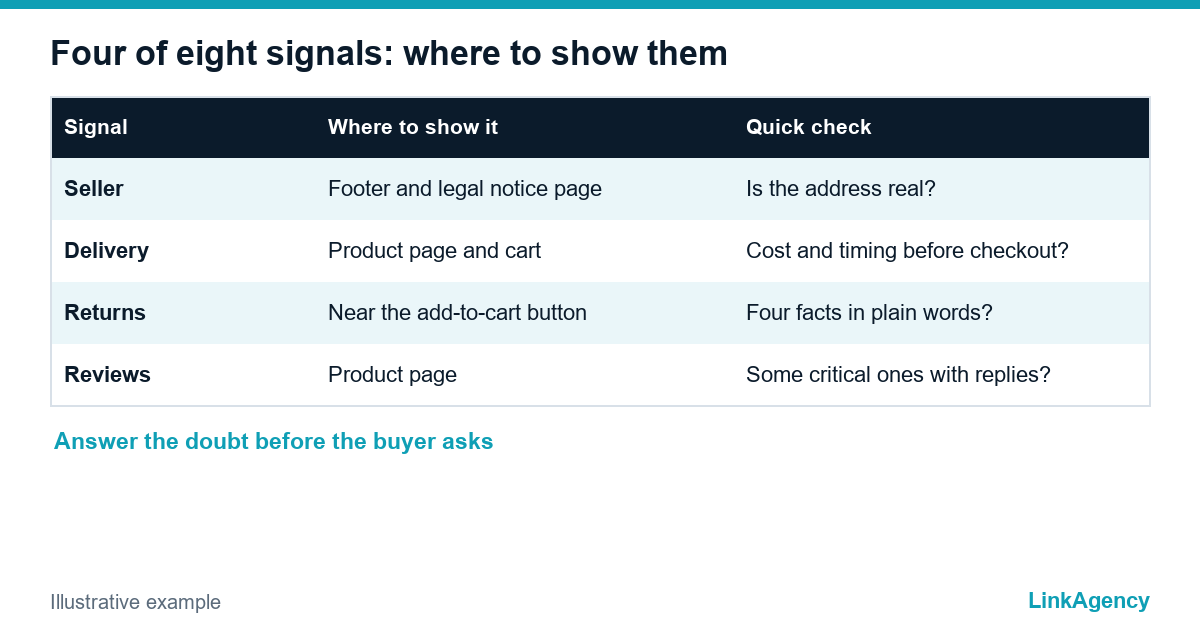
Show the company name, address, registration data, VAT number and contact details on a page the buyer can find from the footer. In many EU countries, seller information is a legal requirement for online shops, and Your Europe describes the information a seller must give. Ask a lawyer to confirm what applies in each market where you sell. A legal notice with a real address is the first trust signal a cautious buyer looks for.
Signal 2: delivery: price and timing visible before the cart
Show delivery cost and timing for new customers on the product page and in the cart, not for the first time at checkout. A surprise at the last step is a top reason for leaving. Name the carriers, the countries you ship to and the free delivery threshold, if any, in two or three clear lines.
| Signal | What the buyer wants to know | What to show |
|---|---|---|
| Seller | Who am I paying? | Company data, address, legal notice |
| Delivery | How much and when? | Cost and timing before the cart |
| Returns | Can I send it back? | A short policy in plain words |
| Contact | Will anyone answer? | Email, phone or chat with real answers |
| Payment | Is it safe and familiar? | Known methods and honest badges |
| Reviews | Do others trust you? | Real reviews, including critical ones |

Signal 3: returns: a policy in plain words, not a five-screen page
A return policy that buyers read, on a returns policy page ecommerce shops keep short, states four things: how many days, who pays for shipping back, how the refund is made and how to start. Put a short version near the add-to-cart button and link to the full page. For distance sales in the EU, consumer contract law from the European Commission sets rules on the right to withdraw, so check the wording with a lawyer.
Signal 4: contact: an email, phone or chat that really answers
List a contact detail that works, and answer it fast. A chat widget that never replies is worse than none. State the working hours and the usual reply time, and test it yourself with a real question from a phone once a month.
Signal 5: payment: familiar methods and honest badges
Offer the payment methods buyers in each market already use, and back the purchase with a clear guarantee, and show their logos near the payment fields. Trust badges ecommerce stores use should be real: do not show a badge or certificate you do not hold. Keep the number of badges small, and place them where the doubt appears, at checkout.
Signal 6: genuine customer reviews in the online store, with criticism and replies
Genuine customer reviews online store visitors trust include a few critical ones, and the store answers them politely. A page of only five-star reviews looks staged. Show the number of reviews and the date, and never publish or buy reviews that are not from real customers. Ask a lawyer about the rules on reviews in your markets.
How to build trust in an online store with one reply
A calm, specific reply to a critical review shows more than ten praise lines. It says that real people run the shop and fix what goes wrong.
Signal 7: site speed and security
A slow or insecure page makes a buyer doubt the store. Fast. Use SSL on every page of the online store, keep the checkout fast on a phone and check Core Web Vitals on web.dev for the main pages. Our ecommerce development services speed up and secure the checkout.
Signal 8: emails and tracking after the order for new customers
The trust is not finished at payment. A confirmation email that arrives at once, order tracking and a clear next step tell the buyer the store is alive. Silence after payment is a reason to ask for a refund. Keep the messages short and put the support contact in each of them. New customers judge the whole online store by this first order.
- Walk the path from product page to payment as one of your new customers.
- Write down each moment of doubt.
- Fix the cheapest ones first: delivery text, returns text, contact details.
- Repeat the walk after changes and before every sale.
Our ecommerce SEO services make these pages easy to find, and our UI/UX design services place the signals where the buyer’s doubt appears.
Ecommerce trust signals: a free store review through a new buyer’s eyes
Send us your store address. We will walk the path from the product page to payment and list what causes doubt. If you want it fixed, our ecommerce development services and UI/UX design services take it on.
- a walk through the store as a new buyer;
- a list of what causes doubt, in priority order.
Leave a request and we will reply within one working day.

Frequently Asked Questions (FAQ)
What are ecommerce trust signals?
They are the visible facts that answer a new buyer’s doubts: who the seller is, what delivery costs, how returns work, whether anyone answers, which payments are safe and what other customers say.
How do I build trust in an online store quickly?
Walk the path from a product page to payment as a new buyer and fix the cheapest doubts first: delivery text, returns text and contact details. Then add real reviews and honest badges.
What should a returns policy page include?
How many days, who pays for return shipping, how the refund is made and how to start a return, in plain words. Put a short version near the add-to-cart button. Ask a lawyer to check it for each market.
Do trust badges increase sales?
They can help when they are real and placed where the doubt appears, for example near the payment fields. Never show a badge or certificate you do not hold, and keep their number small.
Should an online store show negative reviews?
Yes, a few critical reviews with polite replies make the page look real. A page of only five-star reviews looks staged. Do not publish or buy reviews from people who are not customers.
Do EU rules require seller information in an online store?
In many EU countries online sellers must show information such as company name, address and contact details. This is general information, not legal advice, so confirm what applies in each market.
How can LinkAgency help with ecommerce trust signals?
We walk the path from a product page to payment as a new buyer, list what causes doubt and fix it. The first review is free. Leave a request and we reply within one working day.