You need a website built, then promoted, then kept alive, and every agency offers you either a project price or a monthly fee. The wrong choice shows up later: a site launched and abandoned, or a monthly invoice with no clear result. This guide compares an agency retainer and project work by the kind of task, not by price. It covers when each fits, the hybrid that many teams end up with, what the agreement must say and how to judge the work after three months. Numbers come from published agency articles and are named as examples, not as market rules.
Agency retainer vs project: the difference in plain words
A project has an end. You agree on the scope, the date and the price, and the work finishes with a delivery. A retainer has a flow of work. You pay a fixed monthly amount for access to a team or for a set number of hours, and the tasks change from month to month. Put simply, a project ends with a delivery, and a retainer buys hours. One studio’s guide defines a retainer as a format where the client reserves a number of team hours for the month. That is why the label matters less than the contract: one agency guide argues that a retainer without a numeric goal is only a subscription, and a project without a closed scope is a retainer in disguise.
When to choose a project: a clear result, a date and limits
Choose project work when you can say what “done” looks like. A new website, a brand kit, a migration, an integration with a payment provider: each has a result you can check. The benefits are a known price and a known end, and you can try an agency on a small job first. The risk is scope drift. Published guides call it scope creep: the list of tasks grows while the price stays. Protect yourself with a written scope, a list of what is not included and a rule for changes.
What a good project scope contains
A deliverable list with formats and dates, the number of revision rounds, who approves each stage and what counts as acceptance. If you cannot write these, the task is not ready to be a project.
When to choose a retainer: SEO, ads, support and constant improvements
Choose a retainer when the work never finishes. SEO and paid advertising need weekly decisions. Site support, small fixes and content need someone who already knows your system. A monthly retainer gives the agency a stable team for you and gives you faster reactions, because the priorities are set at the start of each month. The weak points are real: published guides warn that unused hours often do not carry over, and that a fee without goals turns into a subscription. Ask about both before signing, and keep a clear scope of work for the month.
The hybrid: a project to launch and a retainer to grow
Many teams do both. A project builds the site, and a retainer develops it. FunctionFox describes a hybrid as a baseline monthly fee, projects with a defined scope and agreed rates for extra work. This also answers a common worry: after a launch you do not lose the team, and you do not pay for idle time. If you need people inside your own team rather than a studio, our staff augmentation services give you dedicated specialists, and our custom software development services cover the launch project itself.
- Run the launch as a project with a closed scope and a date.
- Agree on the retainer before the launch ends, so the team stays.
- Set a baseline of hours and a rate for extra work.
- Review the mix every quarter and move tasks between the two formats.

What to put in the agreement: scope, priorities, reports, hours and exit
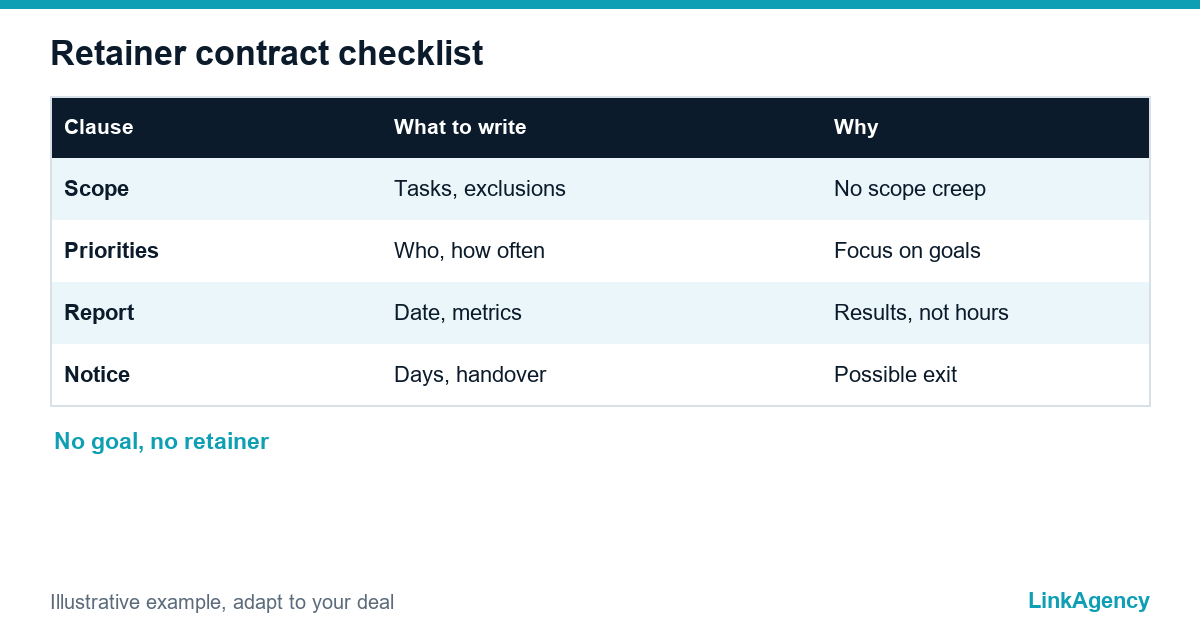
A retainer agreement should answer five questions. What is included, and what is not? Who sets the priorities each month? What does the monthly report show, and when do you get it? What happens to unused hours? And how can either side leave? One published guide notes that notice periods of 30 to 90 days are common and suggests an exit clause of about 60 days tied to agreed goals. Treat this as an example, not a standard, and agree your own period. Put a measurable goal, a list of deliverables with dates and a date for review into the contract. Check who owns the result: in one vendor’s terms, all intellectual property of the code belongs to the client from the start.
| Clause | What to write | Why it matters |
|---|---|---|
| Scope of work | Tasks, channels, what is excluded | Stops silent growth of the work |
| Priorities | Who decides and how often | Keeps the team on your goals |
| Monthly report | Format, date, metrics and conclusions | Shows results, not activity |
| Unused hours | Carry over, expire or refund | Avoids a dispute at month end |
| Notice period | Days, form, handover duties | Makes leaving possible |
Warning signs: vague promises, reports without conclusions, no owner
Be careful when the proposal talks about “ongoing optimisation” and names no goal. Be careful when reports list activity and never say what changed. And be careful when nobody on the agency side is responsible for your account. Published guides on retainers suggest controls such as regular reports, checkpoints, a shared task tracker, joint meetings and retrospectives. If none of them is offered, the monthly fee buys access, not progress.
How to judge after three months whether to continue
Return to the numbers you wrote at the start. Did the agreed metric move? Were deliverables on time? Did the priorities you set get done? Did the reports lead to decisions? If the answers are mostly yes, keep the retainer and review the hours. If not, switch to a project for the part that has a clear end, or leave using the notice period. For help to decide which of your tasks fit which format, see our business services consulting.
Agency retainer or project: free consultation on your tasks
We help you sort your tasks into projects and ongoing support, and draft the clauses to agree. No obligation.
- split of tasks into project and retainer formats;
- checklist of terms for the agreement.
Send a request and get a reply within one working day with a free consultation plan.

Frequently Asked Questions (FAQ)
What is the difference between a retainer and a project?
A project has a scope, a date and a price and ends with a delivery. A retainer is a monthly fee for access to a team or a set number of hours, with tasks that change. The retainer vs project choice depends on the kind of work.
When is an agency retainer the better choice?
When the work never finishes: SEO, advertising, site support and constant improvements. A monthly retainer keeps a team that already knows your system, but needs goals and reports.
What should a retainer agreement include?
Scope of work, priorities, the monthly report, the rule for unused hours, a notice period and a measurable goal with a review date. Published examples show notice periods of 30 to 90 days, but agree your own.
Can I combine a project and a retainer?
Yes. Many teams launch with project-based work and then keep a retainer for development. A baseline fee plus defined projects and agreed rates for extra work is a common hybrid.
What are the warning signs of a bad retainer?
Vague promises with no goal, reports that list activity without conclusions and no named person responsible for your account. A retainer without a goal is only a subscription.
How do I judge a retainer after three months?
Compare the agreed metric, deliverables and deadlines with what you wrote at the start. If the reports did not lead to decisions, change the format or use the notice period.
How can LinkAgency help?
Leave a request with a list of your tasks. We run a free consultation, split them into project and retainer work and prepare the terms for the agreement.