The bot answers simple questions, then gets stuck on a hard one. The customer walks in circles, gets annoyed and leaves, and the manager receives a chat with no context. An AI customer service bot needs a rule for when to stop and pass the chat to a person. This guide gives six rules for that handoff: which signals count, which topics the bot must not settle alone, how to pass context, what to promise the customer and how to behave out of hours. Most sources I read are vendors, so I name them and treat their thresholds as their own examples.
Why an AI customer service bot without a handoff hurts sales and service
A bot without a way out turns every hard case into a dead end. The customer who most needs help, with a refund, a complaint or a large order, meets the weakest part of the system. OpenSense Labs frames AI chatbot human handoff as three design decisions that belong together: the trigger, the context and the queue. Get one wrong and the other two cannot save the conversation. The aim is not to hide the bot but to let it do the easy work and step back at the right moment.
Rule 1: hand off on clear signals, not on a hunch
Decagon lists five trigger types: low confidence, an explicit request, a sentiment threshold, policy-based rules and a watch on the escalation rate. I add one practical rule from OpenSense Labs, which gives escalation after two consecutive fallbacks as an example, and I treat it as an example, not a standard. Typical signals are:
- the customer asks for a person in any words;
- the bot fails to understand twice in a row;
- the tone turns angry or the customer repeats the same question.
Write these signals down as chatbot escalation rules, with a customer support chatbot reading them at every turn, and keep them in one place, so support and developers read the same list.
Rule 2: topics the bot must not settle alone
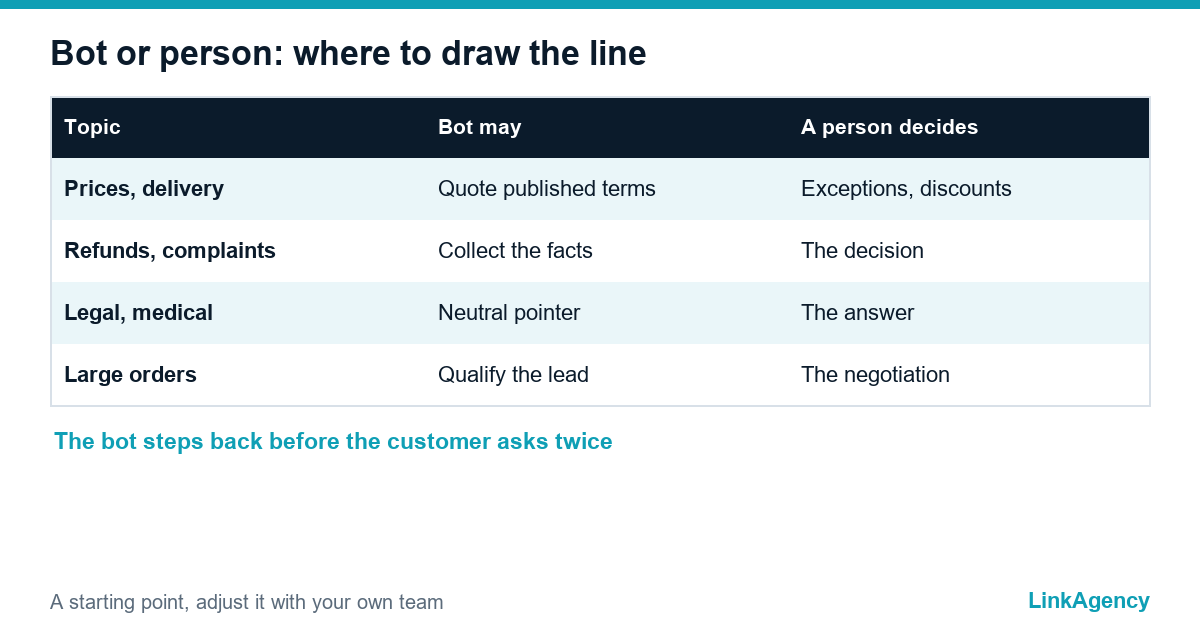
Some topics should go to a person even when the bot is confident. Human handoff for these topics is a design choice, not a failure. The table is a starting point for a customer support chatbot, to be adjusted with your own team.
| Topic | Bot may | Hand to a person |
|---|---|---|
| Prices and delivery terms | Quote the published ones | Any exception or discount |
| Refunds and complaints | Collect the facts | The decision |
| Legal and medical questions | Give a neutral pointer | The answer itself |
| Large or strategic orders | Qualify the lead | The negotiation |

Rule 3: pass the context so the customer never repeats it
Any chatbot customer service flow lives or dies here. The worst handoff makes the customer start again. Pass a short summary, the transcript, the reason for the handoff and the customer’s contact data, and put them into the ticket or the CRM. Twilio’s developer docs describe the same idea in technical form, with a summary for the virtual agent handed to the live agent. An ai customer service bot that passes a bare transcript has half done the job. A human agent who opens the chat should see in ten seconds what was asked, what the bot answered and why it stepped back.
What the summary must hold
Four items are enough:
- The question in the customer’s words.
- What the bot already tried.
- The customer’s mood.
- The promised next step.
Skip the rest.
Rule 4: tell the customer what happens next, also out of hours
Human handoff works only if the customer hears a plain promise. Say that a person will take over, and give a time. Outside working hours, say when the first reply will come and collect the contact in the chat. Quickchat reports two failures in its own tests: a handback that returned the chat to the unassigned queue, and an out-of-hours reply that promised a human answer nobody was assigned to give. Both are the kind of promise a bot should never make without a queue behind it. A live chat that nobody watches is worse than no handoff. Pass the chat to a person only if a person is there.
Rule 5: transparency and data in the EU and the US
In Europe the customer should understand that they are talking to an AI, and personal data in the chat needs careful handling under GDPR and your privacy notice. In the US, state rules and sector rules differ. I am not a lawyer, so confirm the exact duties with your lawyer. Keep the consent text short, store only what the handoff needs and set a retention period for transcripts.
Rule 6: review the handed-off chats once a week
Every week read a sample of chats that were passed to people. Ask whether the trigger fired too early or too late, whether the summary was enough and whether the customer got an answer. Track three metrics: the share of chats passed, the time to the first human reply and the share of customers who had to repeat themselves. A healthy ai customer service bot shows a steady share of handoffs. A high share can mean the bot knows too little, and a very low one can mean it hides hard cases. Our AI agent development builds these checks into the agent from the start.
If you connect the bot to your CRM and helpdesk, our AI integration services cover the transfer of context, and AI chatbot development covers the bot itself. For the wider question of whether a bot pays off, see our guide on AI chatbot for customer service.
AI customer service bot: free review of your handoff rules
We go through your typical requests and tell you which the bot can close alone and which it must pass to a person. If you then need AI chatbot development, we scope it after the review.
- a list of requests with a decision for each: bot or person;
- a draft of handoff signals and a context summary.
Send a request and we will reply within one working day.

Frequently Asked Questions (FAQ)
When should a chatbot pass the chat to a person?
For a customer support chatbot, on clear signals: an explicit request for a human, repeated failure to understand, an angry tone or a topic from your list of cases the bot must not settle alone. Write the signals down as rules so support and developers use the same list.
What context should the bot pass to the human agent?
A short summary, the transcript, the reason for the handoff and the customer’s contact data, saved in the ticket or CRM. The human agent should see the whole picture, so the customer never repeats the question in chatbot customer service.
What should the bot say during a handoff?
That a person will take over, and when. Outside working hours, live chat should give the time of the first reply and collect contact data, and never promise an answer that nobody is assigned to give.
Does the customer need to know they are talking to an AI?
In the EU the customer should understand that they are talking to an AI, and personal data in the chat needs careful handling under GDPR. Confirm the exact duties for your case with a lawyer.
How do I check the quality of handoffs?
Read a sample of handed-off chats every week and track, for the whole chatbot customer service, the share passed, the time to the first human reply and how often customers had to repeat themselves.
How does LinkAgency help with chatbot handoff?
Send us your typical requests. Our AI agent development team reviews them, marks which the bot can close and which go to a person, and drafts the signals and the summary. The review is free and comes with a short plan.