Black Friday falls on 27 November 2026. Before every sale, stores strike through an «old» price and draw a big discount, and then some of them meet a regulator’s question or a customer who no longer trusts the page. The owner is often unsure which price may be shown as the original and what the platform does automatically. These black friday discount pricing rules are a checklist, not a legal lecture: what counts as the prior price in the EU, what changed in the UK, five common mistakes and how to keep the price on the site, in the feed and in ads the same.
Black friday discount pricing rules: why the struck-through price became a risk
A struck-through price is a promise to the customer: it was this much before. If the promise is false, the customer feels cheated and the regulator has a reason to look. The discount may be real in your head and still fail the test, because the rules ask which price you applied before, not which one you wish you had. This is general information, not legal advice, and the rules differ by country.
The EU rule: what counts as the prior price when you announce a discount
The Omnibus Directive, Directive (EU) 2019/2161, changed how a price reduction announcement works under the omnibus directive price indication rule. In summary, a seller who announces a reduction must show the prior price, and that is the lowest price applied during a period of not less than 30 days before the reduction. A price you raised for a week and then cut does not become the original price. Ask a lawyer to confirm the exact wording in each country where you sell.
What changed in the UK and what it shares with the EU
In the UK, the Digital Markets, Competition and Consumers Act 2024 (DMCC Act) strengthens the ban on misleading practices, including pricing, and the CMA can enforce it. According to a Pricerest summary, the UK has no fixed number of days like the EU, so the safer path is the same: compare against a real price that the product held. Treat the 30-day logic as your default for both markets.
| Mistake | Why it fails | What to do |
|---|---|---|
| Permanent «sale» | The reference price was never really paid | Use a time-limited offer with a real prior price |
| Price raised before the sale | The lowest price in 30 days is lower | Compare with the lowest price of the last 30 days |
| Promo code stacked on a sale | The shown discount is not what the customer pays | State the final price clearly |
| Bundle with a «saving» | The sum of parts is not a real price | Show the price of each part honestly |
| Different prices in ads and on site | The customer sees two prices | Make the feed, ad and page match |

Five typical mistakes behind fake discounts in ecommerce
The table lists the mistakes that look like fake discounts ecommerce regulators and shoppers notice most. Endless sales, a raise before the promotion, promo codes, bundles and different prices in ads and on the site all break one rule: the customer cannot see the real price history. Fix them one by one. Start with the products that carry the largest discount, then move to the rest of the catalogue as time allows before the sale opens.
How to store price history and where the price before the discount comes from
What the record should hold
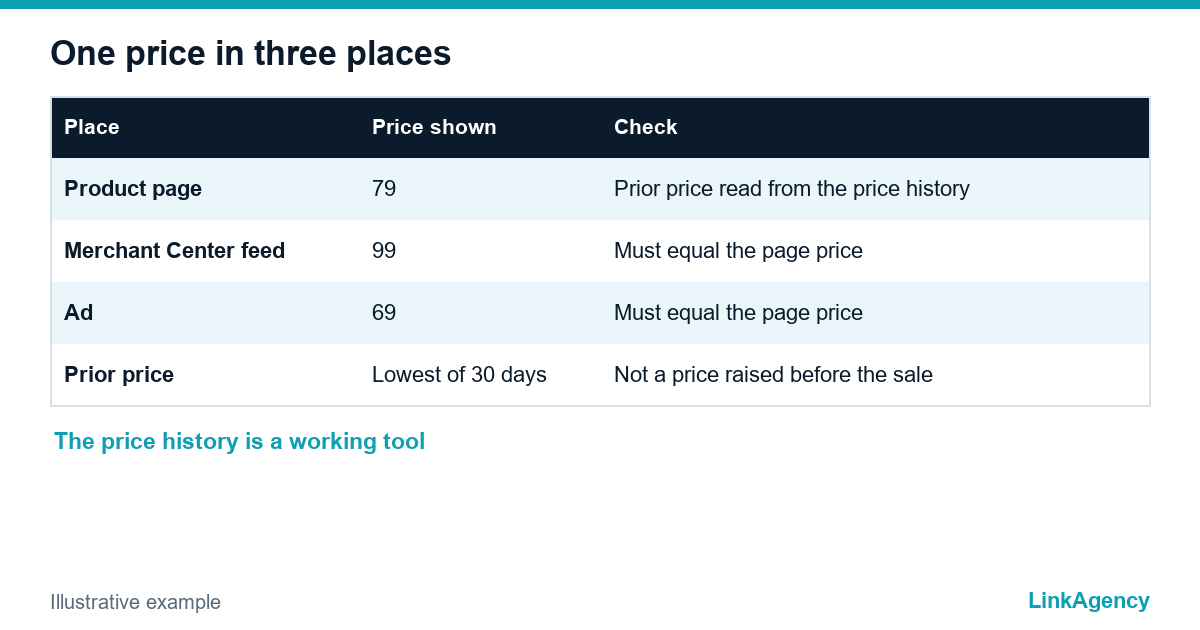
Keep the price history where the team can read it, not in one person’s head. Each time a price changes, record the date and the new price in the platform or a simple table. The prior price on the product page should be read from this record, not typed by hand. A shop with such a record can answer how to show sale prices legally in one minute.
One price across the site, the Google Merchant Center feed and ads
If the page says 79, the feed says 99 and the ad says 69, the customer sees three prices and Google may disapprove the product. Check the same product in three places before the sale: the page, the Merchant Center feed and the ad. Our ecommerce development services connect the price history to the page and the feed, so the numbers match by design.
What to give to the platform and what to the team: a checklist before launch
- Ask your platform or CMS what it stores about past prices and for how long.
- Pick the list of products in the sale and check each prior price.
- Check promo codes and bundles for the final price the customer pays.
- Compare the page, the feed and the ad for ten top products.
Our ecommerce SEO services check that product pages and the feed show the same price, and our custom software development services build the price history where the platform has none.
When to show it to a lawyer and how not to lose conversion
Show the sale plan to a lawyer when you sell in several countries, use bundles or run many promotions a year. Short, clear labels such as «Lowest price in the last 30 days: 79» build trust and often help conversion rather than hurt it. Price history is a working tool. It is not only a shield.
Black friday discount pricing rules: a free store review before the sale
Send us your store address. We will check where the old price comes from, whether the page, the feed and the ads match and whether a price history exists. If you want it built, our ecommerce development services and custom software development services take it on.
- a check of the prior price on key products;
- a list of places where prices do not match.
Leave a request and we will reply within one working day.

Frequently Asked Questions (FAQ)
What are the black friday discount pricing rules in the EU?
In summary, when you announce a price reduction you must show the prior price, meaning the lowest price you applied in the period of not less than 30 days before the reduction. Ask a lawyer to confirm the wording in each country where you sell.
Can I raise a price before a sale and then cut it?
That does not create a valid original price. The reference is the lowest price you actually applied in the previous 30 days, so a short raise before the sale does not help and can look like a fake discount.
Do the same rules apply in the UK?
The UK has its own law, the DMCC Act 2024, which strengthens the ban on misleading pricing. There is no fixed number of days like the EU, so the safe approach is to compare with a real price the product held.
How should I show a promo code discount?
State the final price the customer pays. A promo code stacked on a sale should not make the displayed discount look bigger than what the customer really receives.
Why must the price match in the Merchant Center feed and in ads?
If the page, the feed and the ad show different prices, customers see conflicting offers and Google may disapprove the product. Check ten top products in all three places before the sale.
Where should the prior price come from?
From a price history record kept by your platform or a simple table with the date and the new price. Do not type the old price by hand on the product page.
How can LinkAgency help with black friday discount pricing rules?
We check where the old price comes from, whether the page, the feed and the ads match and whether a price history exists, and we build what is missing. The first review is free. Leave a request and we reply within one working day.