A developer goes on holiday, falls ill or ends the contract, and it turns out nobody else knows how the system works, where the logins are or how to ship an update. The project becomes hostage to one person. This guide lists the software documentation requirements from developers that an owner may ask for and can check without technical knowledge: eight documents, a one-day test and a few lines for the contract. It is about key person risk, not about who owns the code.
Software documentation requirements from developers: why a project lives in one head
Many projects work because one developer remembers everything, and that is key person risk in its plainest form. It is fast at first, and it is invisible until that person is away. A short, current set of documents turns memory into something the business owns. Developer documentation does not have to be long; it has to answer where things are, how they run and what to do when they break.
Document 1: the list of access and account owners (domain, hosting, repository, services)
Ask for a list of every system with the name of the account owner: domain, hosting, code repository, email service, payment provider, analytics. Each account should belong to the company, with the developer added as a user. Credentials go into a password manager, not into a chat. This single page removes the largest part of key person risk and shows what developer documentation is for.
Document 2: a system diagram in plain words
This is the document owners ask about when they wonder what documentation should a developer provide first.
One page that shows the main parts and how they connect: the site, the database, the admin panel, the external services. It can be a drawing. A reader who is not technical should see where the customer data lives and which parts talk to each other.
| Document | What it answers | How the owner checks it |
|---|---|---|
| Access list | Who owns each account | Log in as the owner |
| System diagram | What the parts are | Explain it to a colleague |
| Run and deploy guide | How to start and update | A new developer follows it |
| Services and subscriptions | What is paid and by whom | Match to card statements |
| Data and backups | Where data is and how to restore | See a restore test record |
| Change log | What changed and when | Read the last ten entries |
| Failure instruction | What to do when it breaks | Read it as a non-expert |
| Handover plan | How another specialist takes over | Run the one-day test |

Document 3: how to run and deploy the project
A step-by-step guide, often a README, explains how to install the project on a clean computer and how deployment works. Developer handover documentation starts here, and any project handover checklist software teams use should include it.
What the guide must name
It names the tools, the versions and the commands. The test is simple: someone who has never seen the project can follow it. Developer documentation that fails this test is not finished.
Document 4: services and integrations with their subscriptions
List every external service the project uses: hosting, email, payments, maps, analytics. For each, write what it does, who pays for the subscription and when it renews. This stops the surprise of a service that quietly expires. Technical documentation for small business website projects often skips this list, and key person risk grows when only one developer knows the subscriptions.
Document 5: data, backups and restore
Describe what data the system stores, where it lives, how often a backup is made and where it is kept. Ask for a record of one real restore test. A backup that was never restored is only a hope, and the document should say who can restore it. Software documentation requirements from developers should always include this record.
Document 6: a changelog and a list of versions for developer handover documentation
A changelog says what changed, when and why. The Write the Docs guide explains why current, short documents beat long outdated ones. Combined with a version list in the repository, it lets a new developer see how the system reached its current state. Ask for entries with dates and short plain sentences. Documentation requirements like this cost little when written during the work and a lot when rebuilt later.
Document 7: what to do when something breaks
A one-page runbook for the first hour: who to call, where to look first, how to switch a feature off and how to restore the last good version. It should be readable by an operations manager at night.
Document 8: a plan for handing the project to another specialist
A short plan, the core of developer handover documentation, says what a new developer needs, in what order and in what time. It lists the documents above and names who explains the parts that are not written down. The owner asks the developer for documents in the contract, not after a crisis. When a dedicated team joins, hire dedicated developers and use this plan on day one.
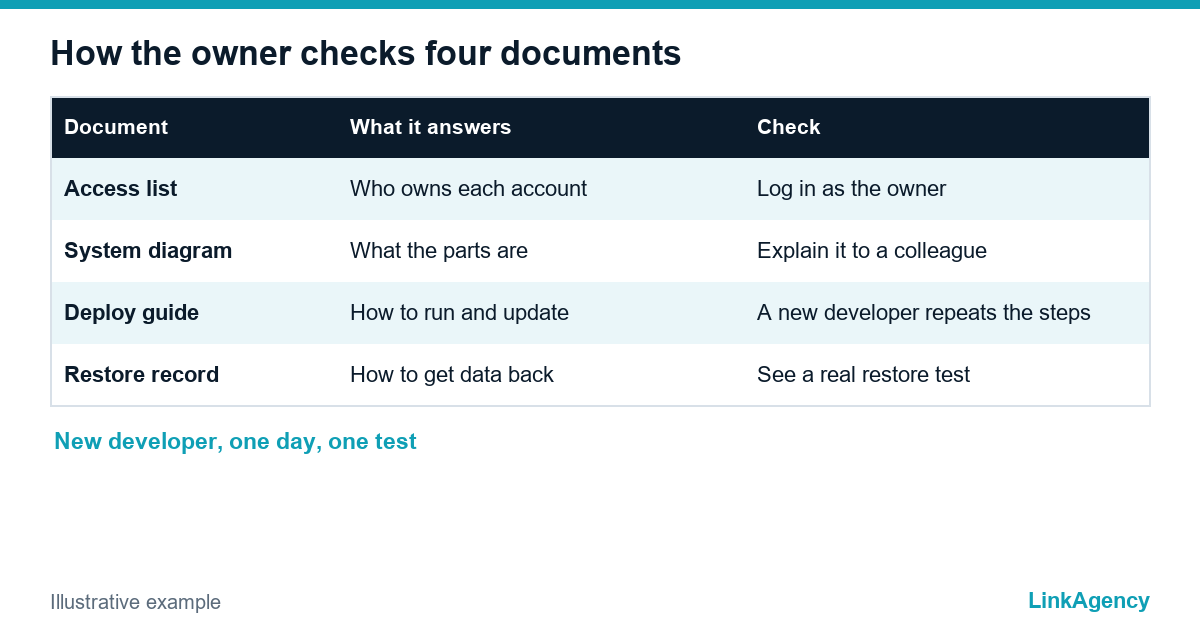
The «new developer in one day» test and documentation requirements in the contract
- Give the developer documentation to a developer who has not seen the project.
- Ask them to run the project from the description in one day.
- Write down every step they could not finish, as a project handover checklist software-free and honest.
- Add the eight documents to the contract as part of acceptance, with the owner’s right to run this test.
Our custom software development services deliver these documents with every project, and our guide to outsourced software development explains how to manage a vendor without technical skills. Practical advice on structure is in Atlassian’s documentation best practices.
Software documentation requirements from developers: a free project check
Send us a short description of your project. We will look at which of the eight documents already exist, where access is missing and give you a list of what to ask for. If you want it written, our custom software development services and dedicated developers cover it.
- a check of the eight documents;
- a list of missing access and documents.
Leave a request and we will reply within one working day.

Frequently Asked Questions (FAQ)
What documentation should a developer provide to a client?
At least eight documents: an access list with account owners, a system diagram, a run and deploy guide, a list of services and subscriptions, a data and backup description, a change log, a failure instruction and a handover plan.
What is key person risk in software projects?
It is the risk that only one developer knows how the system works. If that person leaves or falls ill, nobody else can run or update the project. Documents that the company owns reduce it.
How can an owner check documentation without technical knowledge?
Log in with the access list, ask a colleague to read the system diagram and, most of all, run the new developer in one day test: someone new tries to run the project from the description.
Who should own the accounts for domain and hosting?
The company, with the developer added as a user. Credentials belong in a password manager. This one rule removes the largest share of dependence on a single person.
Is a project handover checklist enough?
A checklist helps, but the documents behind it must exist and be tested. Keep the eight documents current and repeat the one-day test after major changes.
Should documentation be part of the contract?
Yes. List the documents as part of acceptance and give the owner the right to run the one-day test. Ask a lawyer to review the wording for your country.
How can LinkAgency help with software documentation requirements from developers?
We check which of the eight documents already exist, where access is missing and write or complete them. The first project check is free. Leave a request and we reply within one working day.