A freelancer looks cheaper and faster, an agency looks safer and costs more, and the owner who orders a site for the first time is afraid of choosing wrong. This guide treats freelancer vs agency for website development as a choice between risks, not between prices. You get five risks to compare, a table you can use in a meeting, the situations where one person is enough, the signs that a project needs a team and the questions to ask both sides before you sign. Every source I read sells something, so I name them and treat their figures as their own estimates.
Freelancer vs agency for website development: two options, five risks
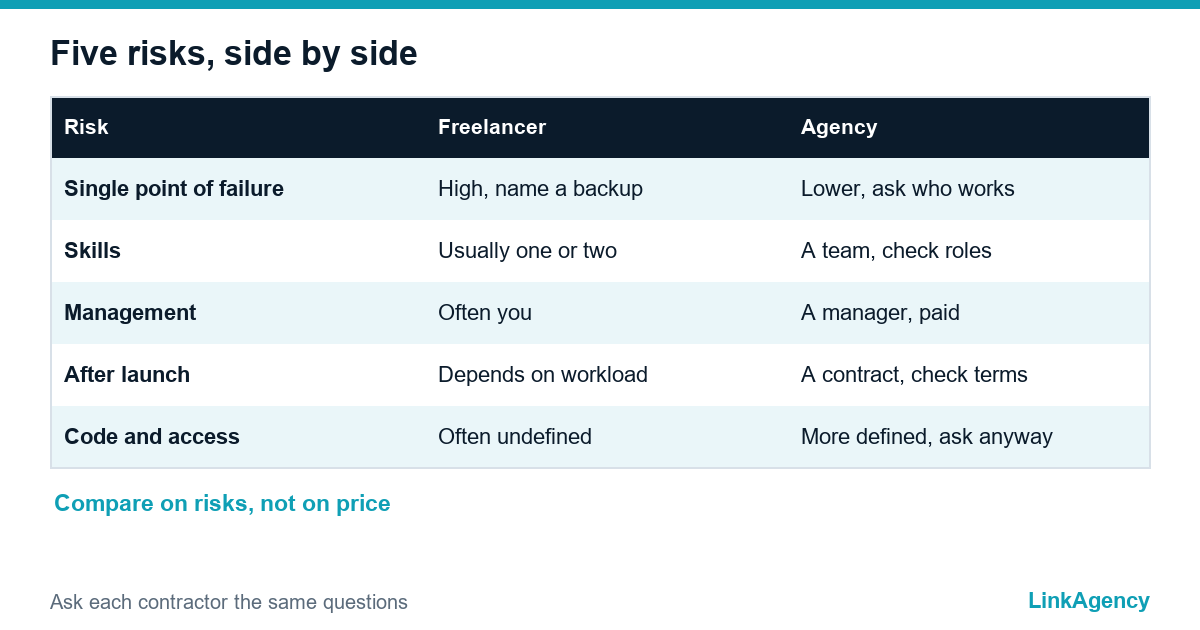
Do not start with the price list. A low price is only attractive if the person is still there in a year and the site still works. Compare the options on five risks: the person who becomes a single point of failure, the range of skills, who manages the project, what happens after launch and who owns the code and the logins. A fair comparison also admits that an agency can fail the same tests, for example when the junior who did the work has left.
| Risk | Freelancer | Agency |
|---|---|---|
| One person is the single point | High, you need a named backup | Lower, but ask who really works |
| Skills: design, code, SEO, security | Usually one or two | A team, check the roles |
| Management and accountability | You often act as the manager | A manager, at a price |
| Support after launch | Depends on availability | A contract, check terms |
| Code, logins, documents | Often undefined | Often defined, still ask |
Risk 1: one person, while the project lives for years
The freelancer vs agency question starts here. A website is not finished at launch. Someone must fix it, update it and explain it to the next person. ZTABS lists a single point of failure among freelancer risks and suggests a written handover clause and a weekly check-in in the statement of work before the first commit. Ask a freelance web developer who would take over if they were ill for a month, and ask for the answer in the contract. The same question to an agency is who exactly will do the work and who covers them.
Risk 2: who covers design, code, SEO, security and content
A site needs several skills at once. One person rarely does all of them well, so either you accept limits or you add specialists. Flair describes the work to assign as strategy, UX, responsive design, the CMS build, testing and support. Count which of these your project needs. Each skill in this website project needs a plan. If a freelancer handles code and you separately hire a designer and an SEO, someone must coordinate them, and that someone is you. For a larger build, staff augmentation services give you a dedicated developer inside your own process, which sits between the two options.
Risk 3: deadlines, responsibility and reporting
An agency may cost more, yet the wrong freelancer is the costly choice for a website. In any freelancer vs agency choice the schedule is the first thing to slip. With a freelancer it depends on their other clients. With an agency the dates and the manager are written into the contract. In both cases ask for milestones, what counts as accepted, how many revision rounds are included and what an extra change costs. Flair notes that the client often becomes the project manager when the scope grows. If you do not have time for that role, the cost of a manager is part of the agency price and not a luxury.
What to ask about progress
Ask how progress is shown. A staging link, a weekly note or a board will do. A page you can open and click beats a promise.
Risk 4: support and updates after launch
Launch does not end the website project. Plugins, the server and the browser keep changing, so a site needs care, and the website project owner must know who provides it. Decide before the contract who fixes errors, in how many hours, for what monthly fee and what is covered. A freelancer may agree to a retainer, an agency usually offers a maintenance plan. Whichever you pick, put the response time in writing. Short and clear. because a vague promise of support means nothing during an outage. Our web development services include a handover and a support plan.
Risk 5: rights to the code, logins and documentation
This is where owners get held hostage, whether they hire freelance website developer time or a whole team. Ask who owns the code after payment, whose name the domain and hosting are registered in, and who holds the admin logins. Insist that the domain, hosting and analytics sit in accounts under your company name, and that the contractor receives access rights from you, not the other way round. A web development contractor who will not name the owner is a red flag. Ask for a short document with the structure of the site, the plugins and the passwords policy. The Dribbble decision list does not cover this, so add it yourself.
When a freelancer is enough, and when you need a team
A website project with a narrow, clear brief suits a freelancer: a landing page or a small brochure site, a short timeline, one skill gap, and someone on your side who can manage the work. Teams fit a project with several disciplines, a CMS and integrations, payments or accounts for customers, a fixed deadline, or a site that is the main source of enquiries. When the code is custom, custom software development services keep the architecture and the documentation consistent as the product grows.
Questions to ask both sides before you sign
Any web development contractor, large or small, should answer these in writing.
- Who exactly does the work, and who covers them if they are unavailable?
- What are the milestones, the revision rounds and the price of a change?
- Who owns the code, the domain and the logins after the final payment?
- What happens after launch: response time, fee and what is included?
- Where is the documentation, and how is the handover done if we leave?

Compare two or three written proposals against the same brief. This freelancer vs agency test is simple. If the freelancer answers all five questions clearly, you may not need an agency. If nobody answers the code and login question, treat that as a warning.
Freelancer vs agency for website development: a free consultation
We will look at your task and say whether one person is enough or a team is needed, without obligation.
- a comparison of your options by the five risks;
- a list of questions and clauses for your contract.
Send a request and we will reply within one working day with a plan for the consultation.

Frequently Asked Questions (FAQ)
In a freelancer vs agency comparison, is a freelancer cheaper for a website project?
Often the hourly rate is lower, but sources differ and every one of them sells a service, so treat prices as estimates. Count the manager’s time, the backup plan and support after launch before you compare totals.
When is a freelancer enough in the freelancer vs agency choice?
For a narrow, clear brief such as a landing page or a small brochure site, with a short timeline and someone on your side who can manage the work.
What are the signs that a project needs a team?
Several disciplines at once, a CMS with integrations, payments or customer accounts, a fixed deadline, or a site that is the main source of enquiries.
Who should own the code and the domain of a website project?
Your company. Register the domain, hosting and analytics under your company name, and get the ownership of the code written into the contract.
What happens if a freelance web developer disappears?
Without a backup plan, the project stops. Ask for a written handover clause, documentation and access under your control before the work starts.
What should a support agreement include?
Who fixes errors, the response time, the monthly fee and what is covered. A vague promise of support does not help during an outage.
How can LinkAgency help me choose?
Send us your task. We assess whether one person is enough or a team is needed, compare the options by the five risks and prepare questions for your contract.