A small B2B service gets traffic, yet few visitors reach the first useful moment. Or the free plan fills the support queue and the hosting bill while almost nobody pays. The cause is often the entry model chosen on instinct. This guide compares the freemium model, the free trial and the demo, gives four questions for the choice, shows the hybrid that many teams end up with and lists what to build in the product. Benchmarks come from named sources and are examples with their own caveats, not rules. If you want a rule, measure your own time to value first.
Freemium model, free trial and demo: three entry models and how they differ
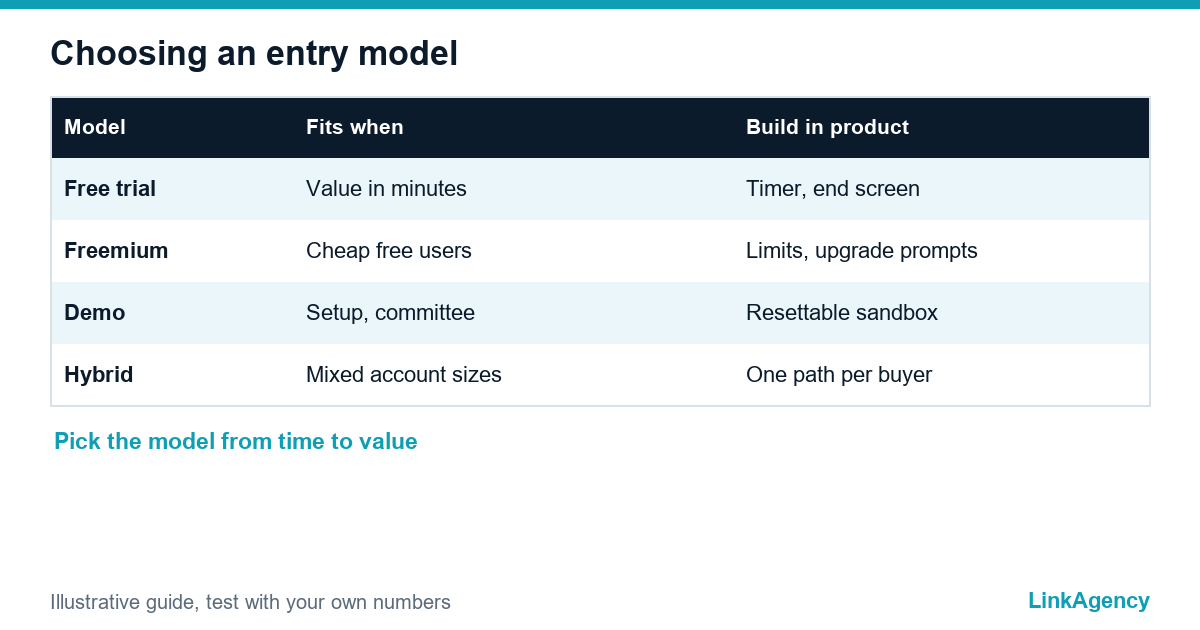
Start with the trial. It gives full or near-full access for a limited time, often 7, 14 or 30 days, and then asks for payment. Freemium offers a limited version for free with no end date, and the user upgrades when needs grow. The third path is a guided look at the product, live, recorded or as an interactive demo, usually before any account exists. A trial suits quick setup, a demo suits committees, and freemium suits cheap free users. It is a sales-led or PLG choice, and it sets your paywall. They are not three sizes of the same thing. They answer three different questions: can I try it myself, can I live with the free part, and will someone show me how it works.
When a free trial fits and how to choose its length
Trials fit when a new user can reach value alone and quickly. Anyday suggests a trial when time to value is under an hour and one person can set the product up. Pick the trial length from your own data: the GTM Playbook rule of thumb is the usual time to the first result plus two to four days of buffer. A 14-day window is only an example. Decide whether to ask for a card up front, because opt-out trials convert more of the people who start but reduce sign-ups.
When the freemium model fits and what it really costs
It fits when value grows with usage or with teammates, and when a free user costs you almost nothing. Altosight reports benchmarks from the 2023 Poyar and Rachitsky data on more than a thousand products: good self-serve freemium converts three to five percent, while good trials convert eight to twelve percent. These are benchmarks, not promises. The hidden support cost, hosting and a roadmap pulled toward people who never pay, so work out the cost per free account before you commit. A freemium plan also needs a clear limit that tells people when to upgrade.
Costs to estimate before launch
Support hours per free user, infrastructure per account and the share of free users who reach the first result.
When you need a demo: setup, integrations and a buying committee
Demos fit when the product needs configuration, integrations or sensitive data, or when several people decide. The rule of thumb in Userpilot’s article is a trial under $10K annual value, a hybrid between $10K and $50K and a demo first above $50K. Treat the thresholds as one author’s view and test your own. Formats vary: a call, a recorded tour or an interactive demo in a sandbox. The last one often serves buyers who do not want to talk to sales yet.
Four questions that choose the model
Answer in writing. Use numbers from your own product.
- How long until a new user gets a first result, in minutes, days or weeks?
- Does the product need setup, integrations or data before it shows value?
- Who pays: the person who uses it, or a committee?
- Can your team support free users, and what does one free account cost?

The hybrid: self-serve for small accounts, a demo for large ones
Many teams do both. Teams that sell by ACV tier often split the path. Small accounts start a free trial or a freemium plan on their own, while larger ones get a demo and a guided setup. Userpilot describes opt-in or reverse trials for low-value self-serve plans and demos for high-value accounts. In a reverse trial the user gets premium features for a window and then drops to a free plan. Anyday warns that offering all three with equal weight on the pricing page tends to reduce conversion, so show one clear path for each type of buyer.
Activation: how to measure the first moment of value
Find the aha moment. Pick one event that proves the product worked for the user, such as the first report, the first invite or the first imported file. Track the share of new users who reach it and the time they take, and read the activation rate before the sign-up rate. Trial length and the upgrade prompt should follow that event, not the calendar. If most users never reach it, no entry model will fix the product. Be honest about that.
| Model | Fits when | Main risk |
|---|---|---|
| Free trial | Value in minutes, self-setup | Clock runs out before value |
| Freemium | Value grows with use, cheap free users | Support and cost for non-payers |
| Demo | Setup, integrations, committee | Slow, needs sales time |
| Hybrid | Mixed account sizes | Confusing pricing page |
What to build in the product for the chosen model
The entry model is a product feature, not a marketing page. Trials need a timer that can start after the first key step, a trial-end screen and a reminder before expiry. Freemium needs usage limits, upgrade prompts at success moments and a cost report per free account. For demos, build a resettable sandbox with sample data. All three need event tracking for the activation step. If your product lacks these, our custom software development services can build them, our web development services can rebuild the sign-up and pricing pages, and a performance marketing agency can then measure the funnel.
Freemium model, trial or demo: free consultation on your user path
We will review sign-up, onboarding, product events and the changes needed for the model you choose.
- review of sign-up, onboarding and events;
- list of product changes by effect.
Send a request and we will reply within one working day with a free consultation plan.

Frequently Asked Questions (FAQ)
What is the difference between a free trial, a demo and freemium?
A free trial gives full access for a limited time, a freemium plan gives a limited version with no end date, and a demo is a guided look at the product. They answer three different questions about how a buyer wants to evaluate.
When should a B2B SaaS choose a demo over a free trial?
When the product needs setup, integrations or sensitive data, or when several people decide. For high-value accounts, one published rule of thumb puts the demo first above about $10K to $50K annual value, so test your own threshold.
How long should a free trial be?
Base it on your measured time to the first result plus a few days of buffer. Seven, 14 and 30 days are common examples, but the right length is the one that lets most users reach value.
Does the freemium model work for a small team?
Only if free users cost little and value grows with usage. Count support, hosting and the share of free users who never pay before you commit, and set a clear upgrade limit.
What is a reverse trial?
A reverse trial gives premium features for a window and then moves the user to a free plan. It combines the speed of a trial with the reach of freemium, but it needs feature flags and a clear downgrade path.
How do I measure activation?
Choose one event that proves value, such as the first report or invite, and track the share of new users who reach it and how long it takes. Read it before the sign-up rate.
How can LinkAgency help with the entry model?
Send a request with your product address. We run a free consultation on sign-up, onboarding and product events, and list the changes needed for the model you choose.