A service business with a busy season usually fixes its site, its ads and its inquiry handling in the middle of the rush. By then the phone rings unanswered, the form sends requests into a shared inbox and the advertising budget goes to a slow page. This guide gives a seasonal marketing plan for small business that joins all three parts in a six-week order. It is written for services such as travel, education, clinics, repairs, events and logistics, not for shops, and it does not repeat the Black Friday checklist for stores. Numbers from sources are quoted as examples of those sources, not as rules.
Seasonal marketing plan: why a service business loses inquiries exactly at the peak
The peak does not create new problems. It exposes old ones. Ads bring people, the inquiries pile up unanswered, and the weak site loses them. Inquiries arrive in bursts, the team is busy delivering, and nobody owns the inbox. A quiet-month site fails fast. Ten times more people use the form. Ads then buy more clicks for the same weak page. A seasonal marketing guide from Squarespace lists planning steps such as goals, audience, channels and measurement, but it says little about what happens after the inquiry arrives. That gap is where service businesses lose money, so the plan below follows the inquiry from click to first reply.
Weeks 6 and 5: what last season’s data showed
Open last season’s figures first. Change nothing before you have read them. Look at the weeks when demand rose, where visitors came from, how many forms and calls arrived, how long the first reply took and how many inquiries became bookings. Agency research reported by AdIndex states that people begin to study a purchase four to eight weeks before buying, so search interest rises before sales do. Treat that as a reason to start early, not as a fixed rule. Write down three numbers: inquiries per week, first reply time and the share that booked. Those are your baseline for the season.
Questions to answer in week six
Which channel brought the best inquiries, which pages lost people, and which requests went unanswered for more than a day.
Weeks 4 and 3: site, inquiry form and speed on a phone
Most visitors in a rush use a phone, so check the page on one first. Open the main service page, tap the form, fill it in and send it. Count the fields, check the button text and make sure the thank-you message tells people what happens next. The U.S. Chamber of Commerce advises updating hours and contact details before the season, and asking for customer reviews early. If the site needs deeper work, our web development services can handle the form, the landing page and the speed.
- Test the form and the phone number on a real phone.
- Cut the form to the fields you need to reply.
- Update opening hours, prices, dates and capacity on every page.
- Add a landing page for the main seasonal offer.

Weeks 3 and 2: ads, gradual budget growth and remarketing
Do not switch the budget on the first day of the season. A seasonal marketing plan ties spend to seasonal demand, so the money follows the weeks when people actually decide, and it stops when your team is full. Start with a modest increase, watch the cost per inquiry and raise spend in steps while the reply time holds. Keep a reserve. Move money between channels as the numbers show. Build remarketing lists from the visitors of the service pages so you can reach people who looked and left. A performance marketing agency can set the budget steps and the reporting, but give it the figures from week six so it does not guess.
Weeks 2 and 1: who answers, how fast, the auto-reply and the capacity limit
This is the part most plans leave out. Name one person for each channel: phone, form, messenger and email. Set a response time you can keep, for example the same working day, and write it on the site. Prepare an auto-reply that confirms the request and says when someone will answer. Decide in advance what happens when you are full: a waiting list, a later date or a referral. Tools that route requests into one place help, and our business process automation can send each inquiry to the right person with a reminder.
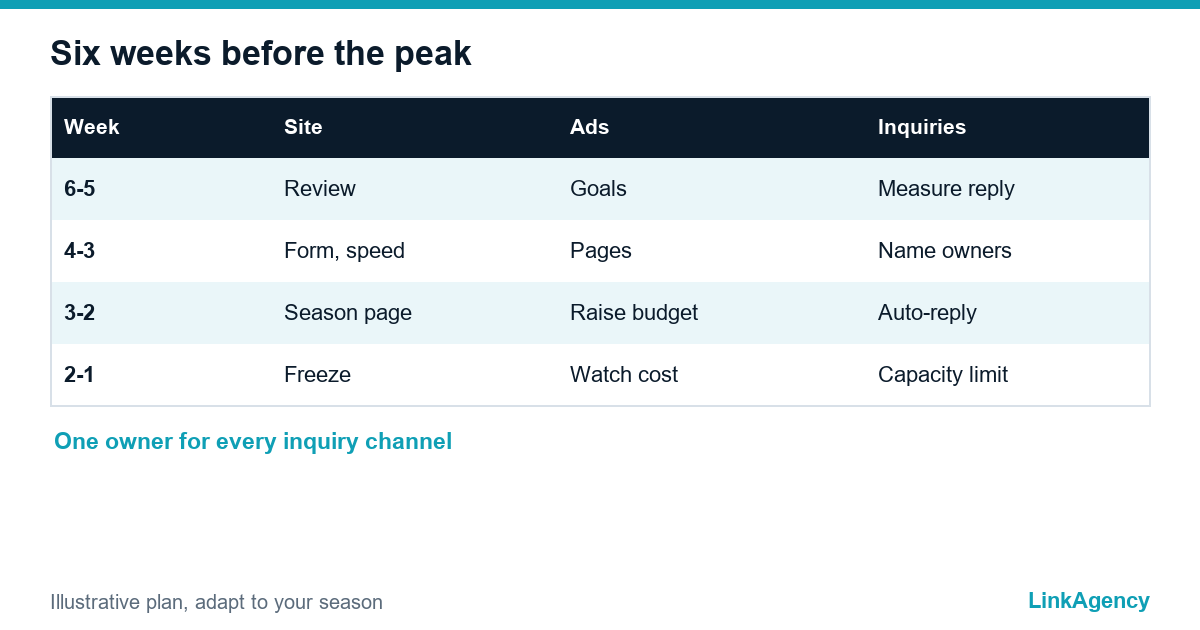
| Week | Site | Ads | Inquiries |
|---|---|---|---|
| 6 to 5 | Review last season | Set goals and a reserve | Measure reply time |
| 4 to 3 | Fix form and speed | Prepare pages and lists | Name owners |
| 3 to 2 | Launch seasonal page | Raise budget in steps | Write auto-reply |
| 2 to 1 | Freeze changes | Watch cost per inquiry | Set capacity limit |
After the peak: returning clients, reviews and lessons for next year
When the rush ends, ask every completed client for a review and invite them back with an offer for the next season. Then repeat week six: compare the new numbers with the baseline and write down what to change. Keep the notes. The next plan starts from them, and a team that writes down what went wrong in November will not repeat it when the next busy month arrives and nobody remembers the details. A short review of lost inquiries is often the most valuable page of the report.
How to split the work between your team and contractors
Give each part one owner. Your team keeps the replies and the capacity decisions, because only they know the real calendar. A contractor can take the site fixes, the ad setup and the automation, provided each task has a date and a measure of success. Keep it short. Agree on who approves changes and who watches the numbers during the season, so nothing waits for a meeting.
Seasonal marketing plan: free consultation for your business
We will look at your site, your ads and your inquiry handling and prepare a six-week plan for your season. The first call is free.
- review of site, ads and reply process;
- week-by-week plan with owners.
Send a request and we will reply within one working day with a free consultation plan.

Frequently Asked Questions (FAQ)
When should a seasonal business start preparing?
About six weeks before the peak is a workable start for a service business: review last season, fix the site, raise ad spend in steps and set up reply handling. Start earlier if your service takes longer to decide on.
What should a seasonal marketing plan include?
Goals, last season’s numbers, site fixes, an ad budget with steps and a reserve, and an owner and reply time for every inquiry channel. Add a capacity limit and a review after the peak.
How do I prepare my website for peak season?
Test the form and the phone number on a real phone, cut the form to the fields you need and update hours, prices and dates. Add a landing page for the main seasonal offer.
How fast should I answer inquiries in peak season?
Set a time your team can keep, for example the same working day, and state it on the site and in the auto-reply. A promise you keep is worth more than a fast one you break.
How should I raise the ad budget before the peak?
Raise it in steps while you watch the cost per inquiry and the reply time. Keep a reserve to move money between channels and build remarketing lists from service page visitors.
What should I do when I am fully booked?
Decide in advance: a waiting list, a later date or a referral to a partner. Tell people in the auto-reply so they do not wait for an answer that cannot come.
How can LinkAgency help with a seasonal plan?
Send a request with your site address and season dates. We run a free consultation, review the site, ads and inquiry handling and prepare a six-week plan with owners.