An AI project is promised “in a couple of weeks” and then drags on for months. It is unclear what the timeline is made of and who is to blame for the delay. So how long does it take to implement AI? There is no single figure, and a contractor who gives one before seeing your process is guessing. This guide builds an AI project timeline from four factors: the process, the data, access and approvals, and testing on real cases. It uses qualitative ranges and signs that a project is on track, not invented numbers, and adds the regulatory context for the EU.
AI project timeline: why there is no single number
The phrase “AI project” covers very different work. A helper that drafts answers to common emails is a small pilot. A system that reads orders, updates the CRM and triggers payments across several tools is a different job. The same question, how long AI implementation takes, therefore has different answers for different projects. The AI implementation time of a pilot and of a full rollout cannot be compared. Anyone quoting a fixed period, even a precise one, without asking which process, which data and which systems is describing a hope, not a plan. Pilots do not take the time of rollouts. A small pilot on one process is usually measured in weeks (the time to implement AI in a small business starts here), which is the honest answer to how long to implement AI at the pilot level. A rollout across several systems and teams takes longer, and the honest answer comes only after scoping.
What the timeline depends on: process complexity, data and integrations
Three things drive most of the schedule.
- The process: how many steps, exceptions and people are involved, and whether the rules are written down.
- The data: where it lives, how clean it is and who is allowed to use it.
- Integrations: how many systems the solution must read from and write to.
Every business asks about the time, but the work to implement a pilot starts with scope. A clear process with clean data and one integration moves fast. A vague process with scattered data and five integrations does not, whatever the tool is. Our AI readiness checklist helps you check these three things before you ask for a quote.
AI project timeline: what published estimates say and why they disagree
Published estimates vary because they measure different things. NisonCo puts a focused single-workflow automation on off-the-shelf tools at roughly 2 to 6 weeks, and Mesh Flow says a well-scoped single workflow should be in production in 4 to 8 weeks. AliceLabs lists 6 to 10 weeks for a chatbot and 8 to 12 weeks for document processing. For a whole function, NisonCo and Mesh Flow both give 3 to 6 months, and AliceLabs gives 6 to 12 months as the average for enterprise projects. These are vendor figures, not measurements, and none comes from an independent study of small businesses.
| Scope | Range quoted | Quoted by |
|---|---|---|
| One workflow on off-the-shelf tools | 2 to 6 weeks | NisonCo |
| One well-scoped workflow in production | 4 to 8 weeks | Mesh Flow |
| Chatbot, document processing | 6 to 10, 8 to 12 weeks | AliceLabs |
| One function or several workflows | 3 to 6 months | NisonCo, Mesh Flow |
| Enterprise average | 6 to 12 months | AliceLabs |
Two details move the numbers most. AliceLabs puts data assessment and preparation at 4 to 12 weeks and EU AI Act documentation at 4 to 8 weeks, so ask a contractor about both before you accept a quote.
Project stages: choosing a process, preparing data, pilot, launch with a human in the loop, scaling
How long does it take to implement AI across these stages? An AI implementation timeline looks similar in most companies, even if the names differ.
- Choose one process with a measurable result.
- Prepare the data and write down the rules and exceptions.
- Build and run a pilot on real cases.
- Launch with a human checking the output.
- Scale to more cases or processes once the results hold.
The AI project phases overlap, but skipping one is the most common reason projects fail. Planning the time to implement AI in a small business means giving each stage its own checkpoint. A launch without a human in the loop, for example, trades speed for risk. Never skip it.
Where projects stall: access, security and approvals
The code is rarely the slow part. Waiting is. Delays come from waiting, from approvals that nobody scheduled, from access that was promised for Monday and arrives on Friday, and from data that turns out to be in three places. Someone has to grant access to systems, security has to review what data leaves the company, and a manager has to approve the process. If personal data is processed by an outside provider, you need a data processing agreement under the GDPR. Check the law early. Where the system talks directly to people, the EU AI Act sets transparency duties, for example telling a person that they are dealing with a machine. Check the details for your case with a lawyer before the start, not at the end.
Why these waits grow
Each approval has an owner, and when the owner is unknown, the request waits. Name the owners in week one. Simple.
How to speed it up: one process, a clear metric, a responsible person
When someone asks how long it takes to implement AI faster, the answer is rarely a bigger team. Time matters. You cannot cut the physics of data and integrations, but you can remove self-inflicted delay. Start with one process, not five. Short, clear, owned. Agree one metric, such as time saved per request or share of answers accepted without edits. To implement the first pilot in less time, name one person at your company who owns the project and can say yes quickly. Small choices. Big effect. These three choices shorten an AI pilot project for a small business more than any tool, and they are free.
How to see that the contractor is on track: checkpoints
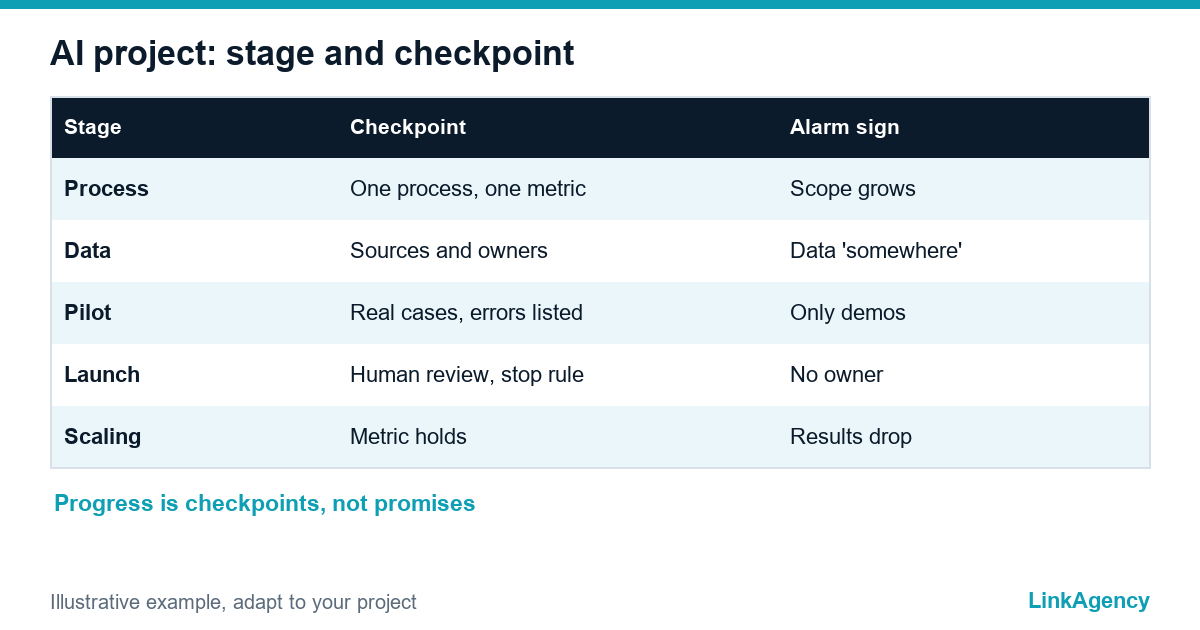
A good contractor shows progress as checkpoints, not as “we are working on it”.
| Stage | Checkpoint you should see | Sign of trouble |
|---|---|---|
| Process choice | One process, one metric, written scope | Scope keeps growing |
| Data | List of sources, owners and access | Data still “somewhere” |
| Pilot | Results on real cases, with errors listed | Only demos on selected examples |
| Launch | Human review and a stop rule | No one owns the output |
| Scaling | Metric holds on more cases | Results drop outside the pilot |
AI project phases need proof. Ask for these checkpoints in the contract. Without them, an AI implementation timeline is only a promise. They also answer why AI projects fail: most failures show up as a missing checkpoint weeks before the deadline.
A checklist before the start
So how long does it take to implement AI in your case? Answer these points first.
- One process and one metric are chosen.
- Data sources, owners and permissions are listed.
- The security and legal review is scheduled, including the data processing agreement.
- A person on your side owns the project.
- Checkpoints and a stop rule are in the contract.
If you want a second opinion on the plan, our AI consulting team reviews it, and our AI integration services build the pilot and connect it to your systems.
AI project timeline: free consultation on your pilot
Together we will choose one process for the pilot and draw a map of stages and checkpoints. No obligations.
- choice of one process and one metric;
- map of stages, checkpoints and approvals.
Leave a request and we will reply within one working day with a free consultation plan.

Frequently Asked Questions (FAQ)
Why can no one name a single timeline for AI?
Because AI projects differ in process, data and integrations, and how long it takes to implement AI depends on each. How long AI implementation takes is known only after scoping, so a fixed period named before it is a guess.
What do published estimates say about an AI project timeline?
Vendor guides quote 2 to 8 weeks for one workflow and 3 to 6 months for a whole function, but none is an independent study. Use them as ranges to test, and ask each contractor which stages their number includes, because how long AI implementation takes depends on that.
How long does an AI pilot take?
A pilot on one well-defined process is usually measured in weeks, so the AI implementation time of a pilot is short, while a rollout across systems takes longer. An AI pilot project for a small business should start with one process and one metric.
What are the stages of an AI project?
The AI project phases are: choosing a process, preparing data, a pilot on real cases, a launch with a human checking the output and scaling. The AI project phases overlap, but none should be skipped.
What delays AI projects most often?
Waiting for access, security review and approvals, not the code itself, which makes the AI implementation timeline longer than planned. Name the owner of each approval in week one, and the time to implement AI in a small business shrinks.
Do I need a data processing agreement?
If an outside provider processes personal data, yes, under the GDPR. Where the system talks to people, the EU AI Act may require transparency. Confirm the details with a lawyer.
Why do AI projects fail?
Usually, as the AI implementation timeline slips, because scope grows, data is not ready, nobody owns the project or there is no stop rule. Missing checkpoints show the problem weeks before the deadline.
How can LinkAgency help?
Leave a request with a description of your process and ask how long AI implementation takes for it. We give a free consultation, choose one process for the pilot with you and draw a map of stages and checkpoints.