The Google Ads budget is being spent, but it is not clear what Performance Max actually buys and whether to keep ordinary search. Part of the result comes from brand queries, and the number of new customers does not grow. This guide on performance max vs search campaigns is not a definition of PMax. It is a decision based on the state of the account: how much data you have, how reliable the tracking is and what counts as a good lead. It also shows how to read the channel and search term reports and how to separate new customers from brand demand.
Performance max vs search campaigns: the difference in simple words
A search campaign shows your text ads when people type queries that match your keywords. You choose the keywords, you see the queries and you control the message. Performance Max is a different tool. Google describes it as a goal-based campaign type that accesses all Google Ads inventory, including YouTube, Display, Search, Discover, Gmail and Maps, from a single campaign, and says it can complement keyword-based search campaigns. In short, search is control over demand that already exists, and Performance Max is automation across channels. Choosing PMax or search campaigns is a question of data, not of loyalty to a tool. The official help on Performance Max explains the setup, and the page on choosing the right campaign type shows where each type fits.
| Question | Search campaign | Performance Max |
|---|---|---|
| Where ads appear | Search results | All Google channels from one campaign |
| What you control | Keywords, ads, queries | Goals, assets, signals, exclusions |
| What it needs | Good keywords and landing pages | Reliable conversions and creative assets |
| Main risk | Narrow reach | Paying for demand you already had |
When to start with search and when to add PMax
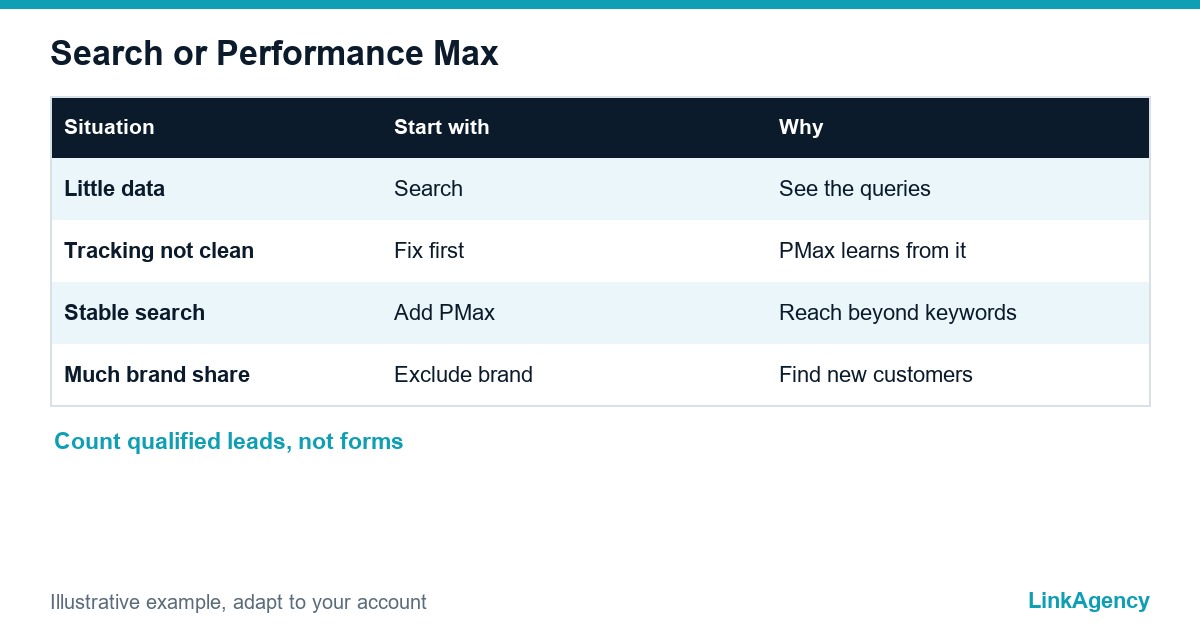
Performance Max or Search is not a fashion choice. It depends on the account. If you have little data, a narrow service and tracking you do not trust yet, search campaigns for lead generation are the safer start, because you see exactly which queries bring enquiries. Add PMax when search campaigns for lead generation are stable, conversions are recorded correctly and you want reach beyond keywords. For performance max for small business, and for any search vs performance max decision, the practical rule is to run search first, learn which queries convert and only then let automation expand. The performance max vs search campaigns choice also depends on priority rules: Google also notes that a search campaign with an exact match keyword is prioritised over Performance Max when a query matches it, so keeping search keeps control of your most valuable queries.
Search vs Performance Max: how much data is enough
For a small business, search vs performance max often comes down to one question: is there enough conversion data? There is no official minimum number of conversions, and the sources disagree. TNT Growth uses more than 50 clean qualified conversions per month as its own operator rule, not as a Google requirement, and other agency guides name 30 to 50. Treat these numbers as a starting point to test. TNT Growth also describes two lead-generation accounts where Performance Max ran about four times and two times cheaper per conversion than search, and one account with only seven conversions where it lost. Those examples show a pattern, not a guarantee. Automated bidding usually needs one to two weeks to learn, so judge a test over weeks, not days.
| Qualified conversions per month | Practical starting point |
|---|---|
| Under 30 | Search first, fix tracking |
| 30 to 50 | Keep building search, small PMax test |
| 50 and more, clean data | Search as the base, PMax test with a set budget |
The table is a rule of thumb from agency guides, not a Google rule.
Overlap and the auction: PMax or search campaigns
Adalysis analysed search term data, and Search Engine Land published the results. About 45% of the Performance Max search terms also appeared in Search campaigns, and for overlapping terms Search had the higher click-through rate 65% of the time. The article restates Google’s order: an exact match keyword is prioritised, and otherwise the highest Ad Rank wins. It is one vendor’s dataset, so read it as a pattern and check the overlap in your own search term reports.
What the account needs before launching PMax: tracking, assets and signals
Performance Max learns from conversions, so wrong conversions teach it the wrong thing. Before launch, check three things.
- Tracking: only real enquiries count as conversions, not every click or page view.
- Assets: texts, images and video that match your offer and brand.
- Signals: audiences and search themes that tell the system whom you want.
If a form fires twice or counts spam, the campaign will optimise for spam. This is also why lead quality deserves its own attention, and our guide to Google Ads lead quality shows how to feed real results back into the account.
How to see what you pay for: channel and search term reports
You cannot judge Performance Max or Search by one number. Open the channel report to see how the budget is split across Search, YouTube, Display and other surfaces. Then open the search term insights to see which queries triggered the ads. Brand queries hide in the search report, so read the reports before you decide. If most results come from searches for your own name, the campaign may be collecting people who already knew you.
What to look for in the reports
Compare the share of brand and non-brand queries, and look at which queries lead to qualified enquiries, not just to forms. A healthy account shows new customers, not only returning ones.
Brand traffic: brand exclusions and negative keywords
Brand demand is cheap, and it is easy to mistake it for the success of automation. Performance Max brand traffic is the most common surprise in a first report. Google’s help lists brand exclusions and negative keywords among the controls that prevent overlaps and block unwanted queries. Use brand exclusions to keep Performance Max away from your own name, and run a separate brand search campaign so you can see and cap that spend. Add negative keywords for terms that bring the wrong people, such as jobs or free tools.
Which conversion to count: from any form to a lead that reached a sale
The conversion you choose teaches the system what to find, and Performance Max lead quality follows it. A button click is the weakest signal, a form submission is better, and a lead that your sales team marked as qualified is best. If your tracking can send qualified leads back to Google Ads, use that as the goal. If not, start with form submissions that pass a spam check and improve step by step. Setting an optional ROAS or CPA target only makes sense after the conversion is reliable.
A four to six week test plan and criteria to keep or stop
- Week one: check tracking, set the conversion goal, exclude your brand and prepare assets.
- Weeks two and three: launch PMax with a limited budget next to the existing search campaign.
- Weeks four and five: compare qualified enquiries, brand share and cost per qualified lead.
- Week six: decide to keep, adjust or stop.
Any performance max vs search campaigns test ends with a decision. Keep the campaign if it brings qualified enquiries from non-brand queries at an acceptable cost. Stop it if results come mostly from brand demand or from low-quality forms. Our Google Ads management team runs such tests, and our performance marketing work connects them with your sales results.
Performance max vs search campaigns: free audit of your Google Ads account
We will check the campaign structure, the share of brand traffic and the quality of lead tracking. No obligations.
- review of channels, search terms and brand share;
- check of conversions and a plan for a four to six week test.
Leave a request and we will reply within one working day with a free audit plan.

Frequently Asked Questions (FAQ)
Should a small business start with search or Performance Max?
Usually with search, because you see which queries bring enquiries, and that makes performance max for small business safer later. Add Performance Max when conversions are reliable. When to use Performance Max is a question about data and tracking, not fashion.
How many conversions does Performance Max need?
There is no official minimum. Agency guides quote 30 to 50 conversions per month as a rule of thumb, so for performance max for small business a search first plan is safer. Search campaigns for lead generation can build that history, and a search vs performance max test should then run for weeks.
Does Performance Max replace search campaigns?
No. Google says it can complement keyword-based search campaigns, and a search campaign with an exact match keyword is prioritised when a query matches it. Search campaigns for lead generation and PMax usually work side by side, so search vs performance max is rarely either or.
Why does Performance Max bring so much brand traffic?
Because brand demand converts easily and automation finds it. Performance Max brand traffic can hide the fact that few new customers arrive. Use brand exclusions and read the search term insights.
Which conversion should I use?
The one closest to a sale, which also answers when to use Performance Max. A qualified lead is best, a clean form submission is acceptable, and a button click is the weakest. Performance Max lead quality depends on this choice.
How long should a test last?
Four to six weeks with a limited budget, next to the existing search campaign. Compare qualified enquiries, brand share and cost per qualified lead before you decide. A test of Performance Max or Search needs a clear end date.
When should I stop Performance Max?
When results come mostly from brand queries or low-quality forms and no new customers appear. A PMax or search campaigns comparison should end with a clear keep, adjust or stop decision.
How can LinkAgency help?
Leave a request with access to your Google Ads account or screenshots. We run a free audit of the structure, brand share and lead tracking, and say whether to start with search or add Performance Max for small business goals.