You have a modest ad budget and two channels to choose from. Google Ads vs Meta Ads is the question every owner asks, and the usual answer is to split the money in half, which is the weakest one. This guide gives five questions that pick your first channel, three business scenarios, a rule for a small budget and a way to decide after six to eight weeks whether to add a second channel. Most comparisons I read come from agencies, so I name them and treat their figures as their own estimates.
Google Ads vs Meta Ads: two channels, two different jobs
Marketing Handled, a UK agency, puts the difference as intent against discovery. Leacon Digital says the same in other words: one channel serves demand that already exists, the other creates demand. A person who types a query is already looking. A person who scrolls a feed is not, so search intent is the first thing to weigh. So Google Ads and Meta Ads are not rivals for the same click, they do different jobs, and your first choice depends on which job your business needs done now.
Five questions that decide your first channel
Answer these before you open any ad account. Google ads or Meta ads first is a question about your own business, not about the platforms. Each answer moves the choice towards one side.
- Do people already search for what you sell, with words you could name?
- How long does a deal take, from the first contact to payment?
- Do you have images, video or a clear offer that works without a search query?
- Can you count a lead, a call and a sale, and tell which ad brought it?
- Is the budget enough for one channel to collect data in a few weeks?
Yes to the first and fourth question points to search. In many local business advertising cases that is the quicker start. Weak search demand and strong visuals point to social. A long sales cycle means you must measure qualified leads, not clicks, in either channel. Meta ads vs Google ads is then a question about your CRM, not about the cost per click.
When to start with Google Ads for small business
Google ads vs Facebook ads is easy to settle for urgent work. Start with search when people already ask for your service: a plumber, an accountant, a software audit, a repair that cannot wait. Google Ads for small business works well for urgent services and for any offer with a clear query, because the click arrives from someone who is ready to compare. Google’s own help for small businesses names accurate tracking and clear business goals as the foundation and warns that the system needs time to learn. For setup and weekly control our Google Ads management follows the same order.
When to start with Meta Ads
Start with Meta when the product is visual, the category is new or the purchase is an impulse. Nobody searches for a thing they do not know exists. You must show it. Meta Ads for small business also suits a local offer with a strong photo and a short form. One more point from Marketing Handled: this channel needs good creative, and I agree: a weak image wastes the budget faster than a weak keyword. Our Facebook Ads management starts with the creative, not with the audience.
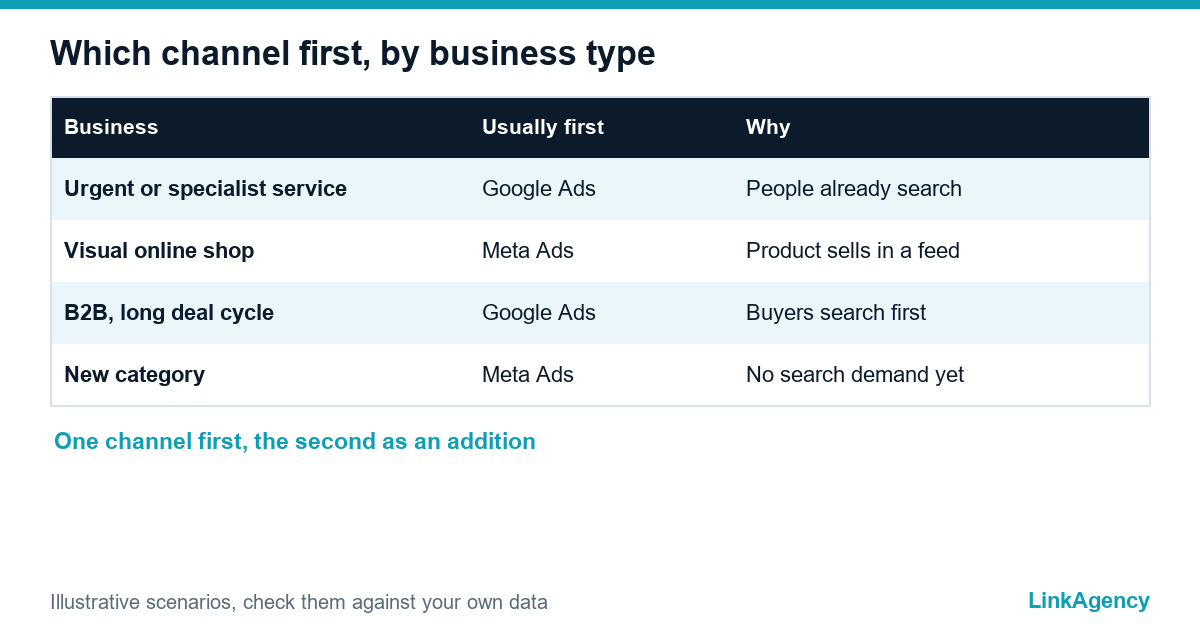
| Business | Usually first | Why |
|---|---|---|
| Urgent or specialist service | Google Ads | People already search |
| Visual online shop | Meta Ads | The product sells itself in a feed |
| B2B with a long deal cycle | Google Ads | Buyers search before they call |
| New category | Meta Ads | No search demand yet |
Why you should not split a small budget in half
A small budget needs data, and half of a small budget collects too little in each channel. A Google campaign and a Meta campaign cannot both learn on one small budget. Marketing Handled gives a worked example of £400 a month on each platform and labels it illustrative, which is the right way to treat any such figure. The same page says Google limits monthly spend to 30.4 times the daily budget, a figure it does not source. Paid search vs paid social is a test of two hypotheses, and the budget decides how many you can afford, so run one hypothesis until it gives an answer. One channel first. Meta ads vs Google ads can wait. The second comes once the first has a stable cost per lead.
What a fair test looks like
Meta ads for small business need patience too. Give the channel enough weeks and enough budget to gather conversions, and do not change the offer midway. Judge it on the cost of a qualified lead, not on CPC. Google ads or Meta ads, pick one.
What to prepare before launch: conversions, form, lead log
Set up conversion tracking first: a form, a call and a booking must each be a recorded event. Add a lead form with few fields and attribution by source. Check that the landing page loads fast on a phone and that the form asks for the minimum. Keep a simple lead log with the source, the date and the outcome, because the ad platform sees only the click. If deals close offline, see our guide on Google Ads offline conversions so closed sales reach the account. An analytics gap makes both Google Ads and Meta Ads look worse than they are.
How to decide after 6 to 8 weeks whether to add a second channel
Google Ads vs Meta Ads is not a one-time choice. Retargeting can wait. After six to eight weeks look at three things: the cost of a qualified lead, the share of leads that turn into deals and whether the channel can take more budget without the cost rising. If all three are stable, a second channel can add reach, for example remarketing to search visitors with a Meta campaign. Cost per click matters less than the cost of a deal, and the learning phase ends within weeks. If not, fix the offer and the page before spending more. Fix the page first. When you want a team to run both, a performance marketing agency can set the order and the targets. Local business advertising rewards patience and a clean lead log, and Google Ads for small business rewards the same.
Google Ads vs Meta Ads: free channel review
We look at your offer, your site and your tracking and tell you which channel to start with, with no obligation. If you then need Google Ads management or a launch plan, we scope it after the review.
- an answer to the five questions for your business;
- a check of whether your site and analytics can take traffic.
Send a request and we will reply within one working day with a review plan.

Frequently Asked Questions (FAQ)
Which should a small business start with, Google Ads or Meta Ads?
Start with the channel that matches your demand: search if people already look for your service, social if the product is visual or the category is new. Answer the five questions in this guide before you open an account.
Can I run Google Ads and Meta Ads together from the start?
You can, but a small budget split in half collects too little data in each channel. Run one channel until the cost of a qualified lead is stable, then add the second as an addition. Paid search vs paid social is a test, not a verdict.
How much budget does a first test need?
There is no universal figure. Marketing Handled shows a £400 monthly example and calls it illustrative. Judge the budget by whether paid search or paid social can collect conversions within a few weeks.
What should I set up before launching ads?
Conversion tracking for forms, calls and bookings, a fast landing page, a short form and a lead log with source and outcome. Without them meta ads for small business and search alike cannot be judged fairly.
When is the right time to add a second channel?
After six to eight weeks, if the cost of a qualified lead and the deal rate are stable and the channel can take more budget. If not, fix the offer and the page first.
How does LinkAgency help me choose a channel?
Send us your offer, site and tracking. We settle Google Ads vs Meta Ads for your local business advertising: we review them, say which channel to start with and what to fix before launch. The review is free and comes with a short plan.