The September 2026 Google spam update began on 24 September and rolled out for 13 days and 16 hours, according to the Google Search Status Dashboard. Google has not said what the Google spam update targeted. If your leads or visits slipped in that window, the first job is to establish whether you have a real organic traffic drop at all.
Panic is the expensive reaction. Sites get rewritten, vendors get fired and bulk redirects go live, all before anyone knows the cause. This guide gives a business owner a short, ordered check, from confirming the numbers to deciding when an outside review is worth paying for. A traffic drop after Google update announcements looks alike on every chart, but the causes differ.
How to confirm an organic traffic drop is real
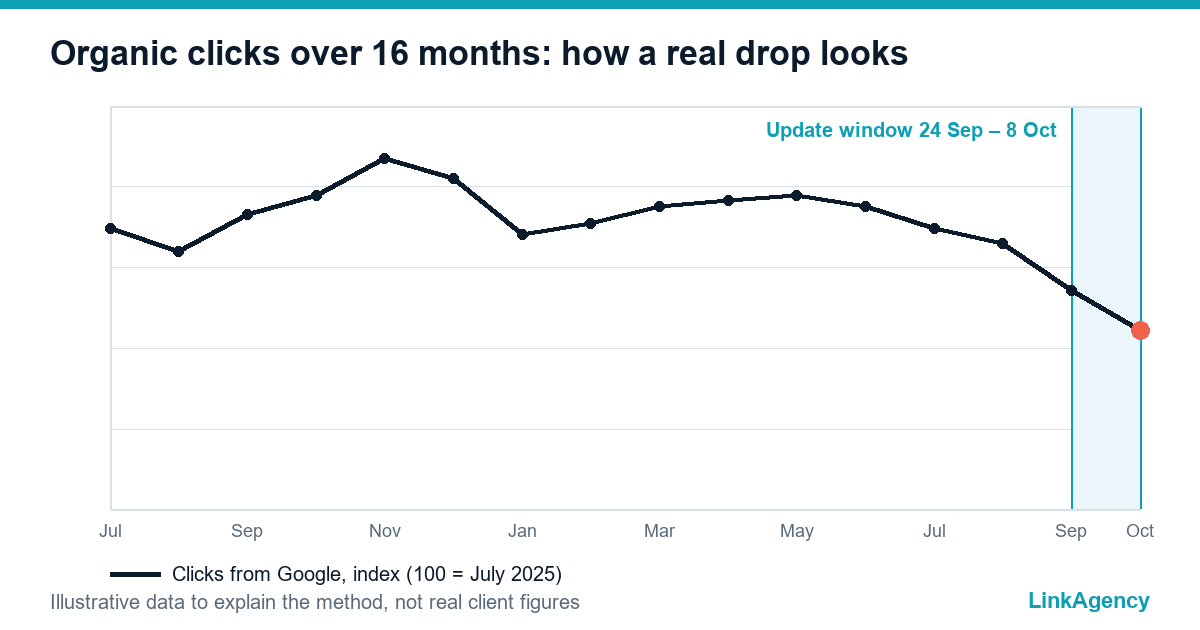
A single bad week proves nothing, and a drop in organic traffic needs context before it needs a fix. Google’s own guidance on debugging drops in Search traffic starts with context, and four checks do most of the work.
- Open the Performance report in Search Console and set the date filter to the last 16 months, so a yearly dip does not pass for a crisis.
- Compare the drop period with the same weeks a year earlier, not with the previous month.
- Split web search from images, video and Discover, because each can move on its own.
- Watch average position next to clicks: falling clicks with steady position point to CTR or demand, falling position points to ranking.
Then check revenue, not rankings. A website traffic drop that leaves qualified leads untouched is a different problem from one that cuts them by a third, and the question is whether organic search still pays for itself, or whether a small drop is just noise. Match Search Console with GA4 and your CRM before drawing conclusions.
Match the drop to a cause
Dates alone rarely settle an organic traffic drop, so use a simple table. Each row names a cause Google lists in its documentation and the quickest way to test it.
| Likely cause | What it looks like | First check |
|---|---|---|
| Algorithm update (spam or core update) | Sharp drop that starts on the rollout date, across many pages | Compare the start date with the status dashboard |
| Technical issue | Sudden fall in indexing, errors in coverage, blocked pages | Index coverage, robots.txt, canonical tags, server logs |
| Spam or security issue | Manual action message, hacked pages, odd URLs in results | Manual actions and security reports in Search Console |
| Seasonality | Same dip every year in the 16-month view | Year-over-year comparison |
| Site move or redesign | Drop right after launch, lost redirects | Redirect map, URL changes, internal links |
If the drop does not line up with the update dates, a technical cause is more likely. Redirect chains, a stray noindex and a changed canonical are common culprits. Once organic traffic dropped for a technical reason, the fix is often quick, sometimes a matter of days. Our technical SEO services cover exactly that layer.
What a spam update can and cannot explain
A spam update tunes how Google treats pages that break its published rules. Read the full text of the Google spam policies once, and note that the list includes scaled content abuse, site reputation abuse, expired domain abuse, link spam, thin affiliation and sneaky redirects. A drop that matches an update window is a reason to check your site against these rules. It is not proof that you broke them, and when organic traffic drops in step with a rollout, the honest answer is still “we need to look at the pages.”
Be careful with confident claims about who was hit and why. Without Google’s explanation, that is guesswork, and when the drop is steep, organic search is the channel to protect first, because lost traffic from it is hard to buy back with ads. Check your own pages against the Google spam policies for the patterns above, such as mass-produced pages, paid links or reused expired domains.
Find the pages where organic traffic dropped
Read clicks and impressions together
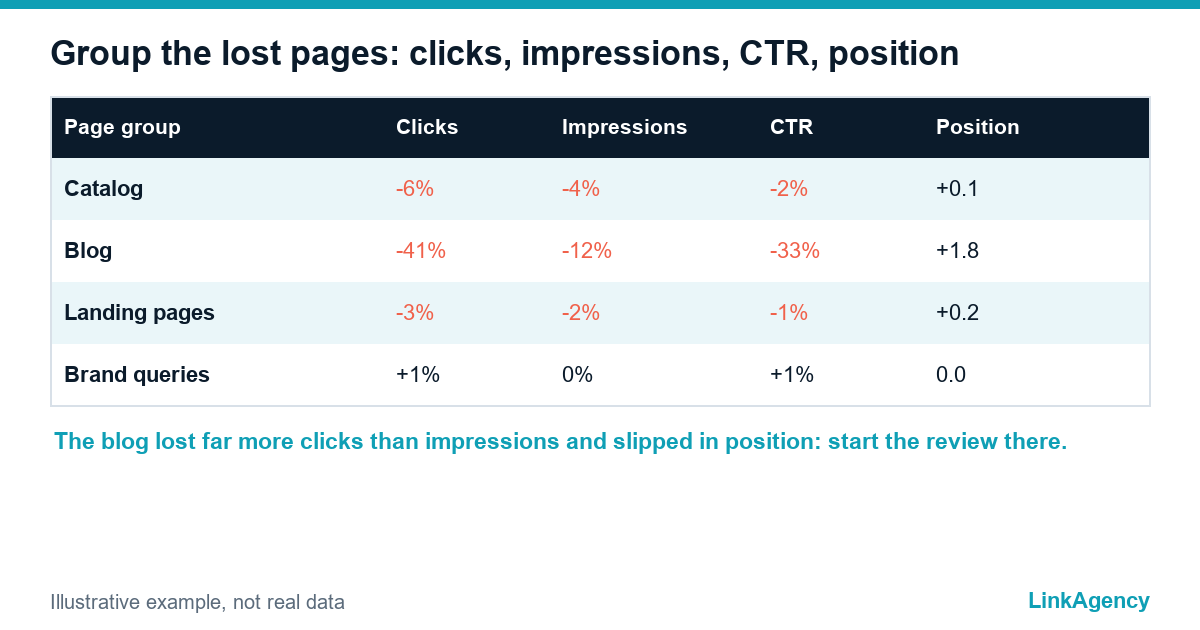
Group the affected URLs before changing anything. The pattern across groups usually points to the cause.
- One section of the site: a catalog, a blog or landing pages.
- One type of query: brand terms, product terms or informational questions.
- One device or country, which suggests a template or localisation fault.
- Pages that kept impressions but lost clicks, which points to snippets and AI answers rather than ranking.
How to recover lost traffic: the audit, step by step
A focused audit after a drop follows the evidence, not a generic 200-point list. We run it in this order.
- Freeze bulk changes and record the current state: sitemaps, templates, redirects, robots rules.
- Date the drop and tie it to events: updates, releases, migrations, content pushes.
- Check indexing and crawling for the lost pages, including canonical tags and Core Web Vitals.
- Review content on the affected pages for thin content, duplicates and scaled production.
- Audit the backlinks and outreach history for patterns that resemble link spam.
- Produce a ranked fix list with owners, effort and the expected effect on leads.
The deliverable is a prioritised plan, not a data dump. For a mid-sized site the work usually takes from several days to two weeks, depending on how many templates and countries are involved.
Mistakes that make recovery harder
- Rewriting half the site before the cause is known, when nobody can yet recover lost traffic by guessing.
- Disavowing links in bulk without evidence that they hurt.
- Switching agencies mid-recovery and losing the change history.
- Judging success by rankings while qualified leads are not tracked.
Recovery from an algorithmic drop is not instant, and a drop in organic traffic can take more than one update cycle to reverse. Whenever organic traffic drops, keep a dated log of every change you make. Google’s systems reassess pages over time, so traffic recovery is measured in monthly trends and a change log, because every website traffic drop has its own recovery curve and no two sites follow the same one. If you need a second opinion, SEO consulting can sit between your team and the audit.
Order an SEO audit after a traffic drop
If your organic traffic drop followed the September update, we will date it, find the cause and help you win back visits with a ranked fix list.
- Review of Search Console, GA4 and the affected URL groups.
- Technical, content and backlink checks tied to the drop date.
- A written plan with priorities, owners and expected effect on leads.
Send us the site and the dates. Our SEO audit services start with a free first look, and we reply within one business day.

Frequently Asked Questions (FAQ)
How long does an organic traffic drop after a spam update last?
There is no fixed timetable. Google reassesses pages continuously, so traffic recovery can start within weeks or wait for the next update. Fix confirmed problems first, then track clicks and leads monthly instead of daily.
Is my traffic drop caused by the September spam update?
Only if the drop starts inside the 24 September to 8 October window and affects many pages at once. Any traffic drop after Google update dates needs the 16-month view and a same-period comparison first, then technical and security checks.
Should I rewrite my content after losing traffic?
Not before you know the cause. Rewriting everything hides the evidence and can cost more traffic. Start with the pages that lost the most clicks and review them against Google’s spam policies and helpful content guidance.
What data does an audit after a traffic drop need?
Read access to Search Console and GA4, a list of recent releases or migrations, and your sitemap and redirect map. Lead data from the CRM helps us judge impact on revenue, not only on rankings.
When is it worth hiring an outside team?
When the drop is large, the cause is unclear after the basic checks, or your team lacks technical SEO time. An external review gives an independent timeline and a ranked list instead of competing opinions.
How do I get this audit from LinkAgency?
Use the contact form on this page and name the site, the drop dates and your main markets. We confirm scope and send a written plan with a fixed price, usually within one business day.