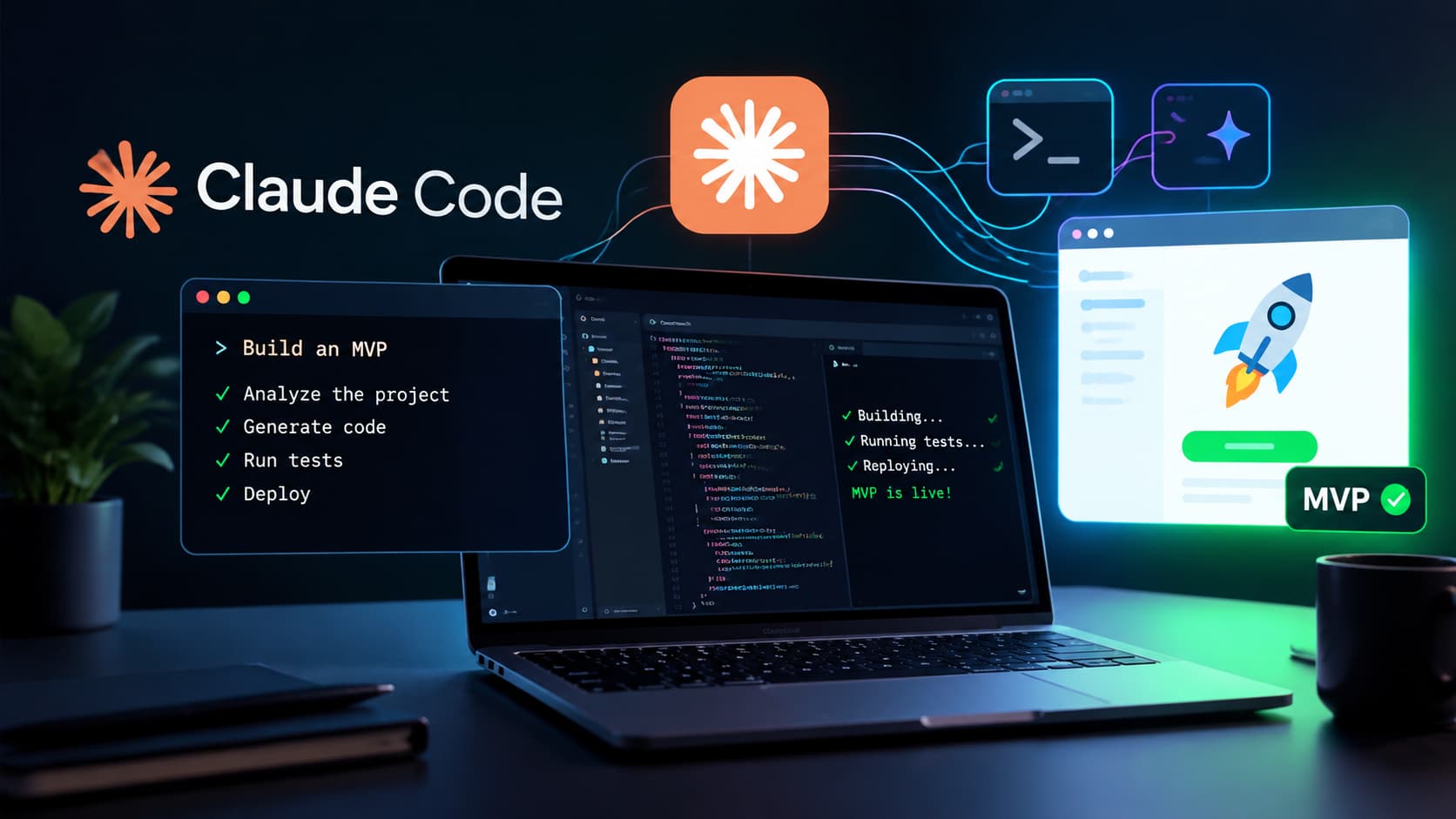
Founders used to wait a quarter for a first working release. Now plenty of teams demo one within a month. AI terminals such as Claude Code read the repository, edit files and run tests straight from the command line, and that changes the maths of AI MVP development: hours get cheaper, while wrong decisions get costlier.
Below we cover which stages really speed up, where the gain disappears, and how to keep speed from turning into technical debt.
AI MVP development with a terminal agent: what gets faster
Cursor and GitHub Copilot suggest code inside the editor. A terminal agent goes further because it keeps the whole project in context. It scaffolds a backend, wires up a payment gateway, writes migrations and tests, runs them and fixes the failures. Routine work benefits most: forms, authentication, third-party integrations, CI/CD setup, and the refactoring that used to wait for a quiet sprint.
One caveat matters. In a randomised trial by METR, experienced open-source developers using early-2025 AI tools took 19% longer on tasks in mature repositories, yet believed they had been faster. A greenfield product has no legacy code to confuse the agent, so conditions are friendlier. The lesson still holds: measure speed instead of feeling it.
Where the gain is biggest
| Stage | Classic build | With an AI terminal | What stays human |
|---|---|---|---|
| Scaffold and authentication | 1 to 2 weeks | 1 to 3 days | Stack and data model |
| Integrations and payments | 1 to 2 weeks | 3 to 5 days | Keys, test scenarios |
| Frontend | 2 to 3 weeks | 1 to 2 weeks | Design and usability |
| Automated tests | Often postponed | Written alongside code | Acceptance criteria |
| Code review and security | Squeezed in last | A separate stage | All accountability |
These ranges are rough estimates for a typical mid-complexity product, so treat them as a guide rather than a promise.
[IMAGE: loop diagram of task, code, tests and code review with an AI terminal at the centre | ALT: AI MVP development loop with an AI terminal and human review]
How long an MVP takes now: timeline and bottlenecks
A first version used to take three to four months. With AI terminals a simple product can reach its first users in three to six weeks. The MVP timeline shrinks thanks to a short loop of build, show, adjust, with AI doing the typing, and the narrower the scope of the first version, the shorter the loop. Stricter review adds days to the MVP timeline, yet AI still leaves a net saving of weeks.
Only the coding share gets smaller. Until the founder knows who the product is for, AI MVP development simply builds the wrong thing faster. Bottlenecks sit elsewhere: clarifying requirements, approvals, first-user feedback. A sprint can be accelerated. A customer’s reply cannot. If time is tight, AI will cover the code, but the MVP still waits for decisions you have not made.
What an AI terminal does not replace
The Stack Overflow 2025 survey found that 84% of developers use or plan to use AI tools, yet 46% distrust their accuracy and 66% complain about answers that are almost right, but not quite. An AI coding assistant is only as reliable as the tests and reviews around it, and those near misses are what break a product in production.
Then there is vibe coding, which means accepting generated code without reading it. That is fine for a throwaway demo. An MVP prototype with real users deserves better, and a product that holds customer data cannot afford it.
- Architecture and data model: the agent executes, it does not choose for you.
- Security: secrets in the repository, gaps in authorisation, outdated dependencies.
- Technical debt: the code runs, but nobody wants to change it two months later.
- Data and licences: what may be sent to an external model, and what may not.
A six-step workflow that keeps speed safe
- Write down one hypothesis and one key user scenario, and choose the format: web app, mobile app or PWA.
- Turn acceptance criteria into tests, because an agent follows them better than a long prompt.
- Fix the stack, repository layout and project rules in a context file.
- Work in short sprints: task, tests, human code review.
- Run CI/CD with dependency and secret scanning on every commit.
- Show the product to users weekly, compare metrics with the hypothesis and draw up a website launch plan early.
For step five, the NIST SSDF (SP 800-218) offers a ready frame, and its practices apply to people and agents alike. AI coding tools stay inside that process as instruments. With this discipline, developing an MVP with AI in a month stops being a slogan, because every step carries a check.
MVP development cost and how to choose a team
MVP development cost still depends on scope and integrations, as well as security requirements. AI-assisted MVP development cuts coding hours but keeps the analyst and the reviewer on the payroll. A good estimate shows where money was saved and where it went into verification. MVP development with AI works best when the vendor is willing to show that split line by line, because vague totals hide the review work.
AI amplifies a team’s existing strengths and weaknesses, so practices matter more than the tool. Ask any vendor three questions. Who reads and approves every commit? What does test coverage include? How does the team handle your data, and which agentic coding setup does it use? A confident answer to all three says more than a portfolio.
AI MVP development at LinkAgency
One team takes the product from prototype to first users. We deliver AI-powered MVP development: we write code with AI terminals, while review and tests stay with engineers, and so does security. You get a working first version, a roadmap and a list of technical debt.
Tell us about your idea. We scope it after a short brief, quote MVP development services by stage, and send a plan within one business day.

Frequently Asked Questions (FAQ)
How much faster does Claude Code make a first release?
For a simple product, timelines often shrink from several months to three to six weeks. The gain lands on routine work such as scaffolding and integrations, plus tests. Requirements and design do not speed up, and neither does user feedback.
Can I build an MVP with AI and no developers?
You can build a demo that way. A product with users and data needs a person who reads the code, owns security and makes architecture decisions. Without one, technical debt grows faster than features.
What does AI-assisted development cost?
Price depends on the number of features and integrations, plus data-protection requirements. AI lowers coding hours, so estimates are often smaller than in a classic build, but part of the budget goes to review and tests.
Is it safe to send project code to an external model?
Only with rules in place. Secrets and personal data stay out of prompts, retention and training settings are checked in advance, and the agent gets access only to the folders it needs.
How is vibe coding different from supervised AI development?
In that style the code is accepted unread. In supervised work every change passes tests and a human review. The first approach suits experiments, while the second lets you keep building on the product.
What should I prepare before the project starts?
A description of the problem, a profile of the first user and one main scenario are enough. Mockups and a spec help, but a team can start without them, and the first sprint usually clarifies requirements.
How do I order an MVP from LinkAgency?
Send a request with a short description of the idea. We clarify the task, estimate the scope and reply with a staged plan and a cost range within one business day. After approval we start with a prototype.