More customers now start a task inside an AI assistant and never open a website. If your service cannot talk to that assistant, the task ends elsewhere. You will not even see the lost order. On 28 October 2026 Google took a step in this direction: it opened a preview of its Connected Apps Platform, the core of Google Connected Apps for developers. This guide explains in plain words what Google announced, who needs it now, a six-question readiness test and a 90-day plan for owners and CTOs.
Google Connected Apps: what Google opened on 28 October
According to TechCrunch’s report of the launch, connected apps already let people link a third-party service to Gemini and Search and take actions in it, such as designing a flyer in Canva. The new platform lets more developers build those integrations themselves. Google says more than 50 connected apps are live across Search and Gemini, and partners such as Adobe, Experian, Localiza and Peloton are in Gemini now, with Search support due in the coming weeks.
The catch is access. Access is a public preview for US developers who join a waitlist. Google has given no date for general availability. EU companies should treat this as preparation. Not a launch.
How Google Connected Apps work: MCP server, AppFunctions and the console
The developer page for the platform describes two ways in. One route is a remote MCP server, built on the Model Context Protocol, an open standard. Another is Android MCP, where an Android app shares functions with agents through the Jetpack AppFunctions SDK. Customers authorise the assistant through OAuth 2.1. They link your service once and then act in it.
What the Google Connected Console does
Developers register their tools, test them and submit the app in the console. Before review they choose whether the app appears in Search, in the Gemini app or in both. After launch the console shows traffic, latency and error rates and lets you manage brand elements such as a verified logo and authenticated accounts, as the Google announcement explains.
Which businesses need this first, and which can wait
- Act now if your customers do something repeatable in your service: book, order, reschedule, check a status or compare prices.
- Prepare quietly if you sell complex or regulated services where a human must confirm the decision.
- Wait and tidy your data if you have no API and the key action needs a call or a manager.
Eligibility, costs and the review timeline are not published. A rushed build would be a guess. A better first step is to fix the foundation: documented actions, clean prices and availability, and a clear customer login.
Six-question readiness test for AI agents
- Do you have an API that exposes the key action, such as booking or ordering?
- Can that action finish without a person on your side?
- Where do prices and availability live, and is that source always current?
- How does a customer authorise access, and can you support OAuth?
- What happens to personal data of EU customers, and who is the processor?
- Who handles errors and complaints when the assistant gets something wrong?
Three or more weak answers? Then the priority is your data and API, not Gemini itself. Our AI readiness checklist for data, process and risk goes deeper on the same ground.
One integration, several assistants: why Google Connected Apps point to MCP
Google’s page calls MCP an open standard, and that is the practical reason to build on it. A well-designed MCP server describes your actions once, in a form that other assistants can in principle use too, although each platform sets its own rules, so check them before you promise anything. Keep the business logic in one place. Treat each assistant as a thin layer on top, and connected apps in Gemini as only the first of them.
Risks: access, EU customer data and brand control
An assistant acts on behalf of your customer, so every action needs the same checks as your website: correct permissions, logging and limits on what can be changed. For EU customers, remember that names, orders and bookings are personal data under the GDPR, so agree who processes them and where. Brand matters too. A wrong price or answer inside an assistant still carries your name. Google’s console offers verified logos and authenticated accounts, which helps but does not replace testing.
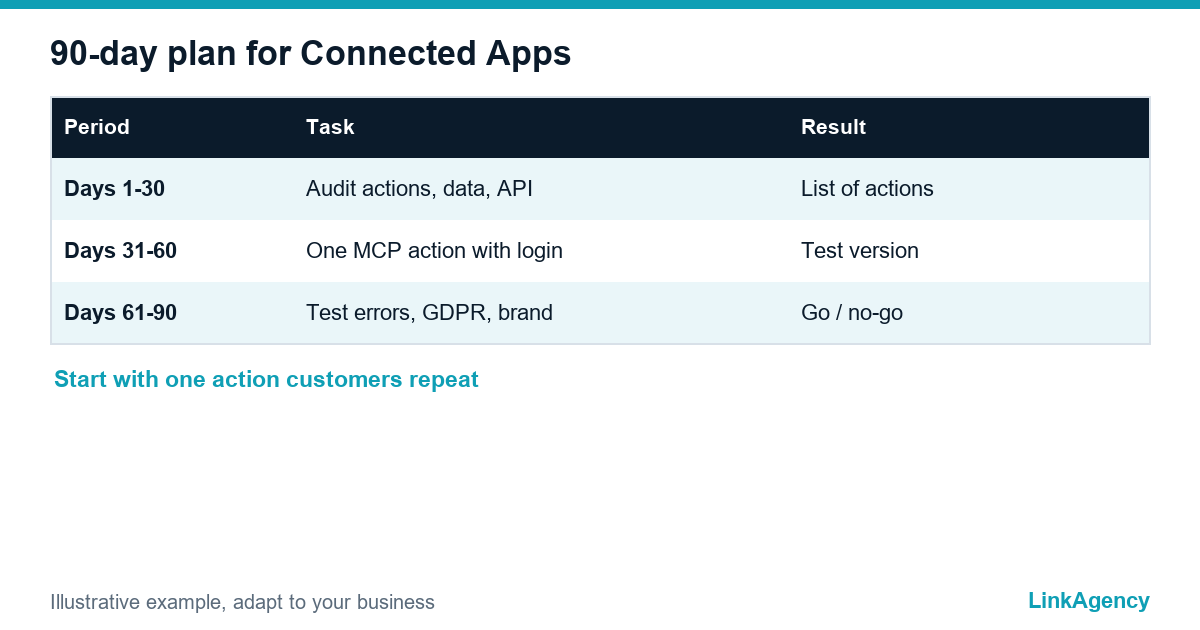
| Period | Task | Result |
|---|---|---|
| Days 1–30 | Audit actions, data and API | List of actions to open |
| Days 31–60 | Build one MCP action with login | Working test version |
| Days 61–90 | Test errors, GDPR and brand | Go or no-go decision |
A 90-day plan to prepare connected apps for your business
Start with one action your customers repeat often. Measure it before and after, and ask which of your apps connected to Gemini customers already use. Use the first month to document the action, the data behind it and who owns it. In the second month build a small test version, ideally on the same back end your site uses. In the third month test wrong answers, permissions and personal data, then decide whether to apply for access. Our web application development service often covers the API and login work this plan needs.
Order help with AI agent development
If you want a second opinion before spending a budget, our AI agent development team can review which actions of your service suit an assistant and what the API needs. You can also order an AI readiness review as a short, separate task.
Free readiness review for Google Connected Apps
We look at your service and tell you which actions could be opened to AI assistants and what the API and data need first. You receive a short pilot plan with no obligation, and you can order an AI readiness review as a separate project.
- a map of actions, data sources and login options;
- a one-page pilot plan for the first 90 days.
Leave a request and we reply within one business day.

Frequently Asked Questions (FAQ)
What is the Connected Apps Platform?
It is Google’s platform for bringing a service into Gemini and Search, so users link the service once and then take actions in it from the assistant. It opened in preview on 28 October 2026.
Who can join the preview today?
Google describes a public preview for developers in the United States who sign up on a waitlist. It has not announced eligibility rules, costs or a general availability date.
Do I need an MCP server?
Google names two paths: a cloud-hosted MCP server or Android MCP with AppFunctions. For most web businesses the MCP server is the relevant route, with OAuth 2.1 for customer authorisation.
Is it only for Google?
MCP is an open standard, so the same design can in principle serve other assistants, but each platform has its own rules. Check the terms of every assistant before you plan around it.
Should a small business act now?
Only if customers repeat a simple action in your service. Otherwise tidy your data, documents and customer login first, and watch for eligibility and pricing details.
What are the main risks?
Wrong permissions, personal data of EU customers, and errors that carry your brand name. Test each action and limit what an assistant is allowed to change.
How do I order a readiness review from LinkAgency?
Leave a request and describe your service. We check actions, API, data and login, then send a short pilot plan and a quote for the work you choose.