The SEO report looks good: more impressions, more visits, better positions. Yet the sales team sees the same number of enquiries. This usually means the site is found for questions, not for purchases. The fix starts with understanding search intent: what people want when they choose a supplier, a clinic, a lawyer or a product. This guide explains the idea without jargon, shows examples for four industries and gives you a one-hour check with free tools.
Commercial intent keywords: why more traffic does not mean more leads
A lead appears where three things match: what the person searched for, what the page says and what the next step is. If the query is a question and the page is a sales pitch, the visitor leaves. If the query is “who should I hire” and the page is a long article, the visitor also leaves. As one Russian-language analysis of this problem puts it, 500 visitors from informational queries can bring fewer enquiries than 30 visitors who came ready to choose.
Another common cause is a mismatch between the query and the page. Google may show a blog post where you wanted the service page to appear, so the right visitor sees the wrong page. Google’s own guidance on helpful, people-first content says the same thing in other words: write for the person and the task they have.
Three types of queries: learn, compare, buy
How they look in four industries
| Industry | Learn | Compare | Buy |
|---|---|---|---|
| Law firm | how does a trademark work | trademark lawyer vs online service | trademark registration lawyer price |
| Clinic | why does my back hurt | best spine clinic reviews | book spine MRI near me |
| B2B SaaS | what is a CRM | CRM A vs CRM B | CRM for 20 users pricing |
| Online store | how to choose a mattress | best mattress for back pain | buy orthopedic mattress |
The middle column holds most keywords with commercial intent: searches with words such as best, vs, review, alternative or “is it worth it”. A commercial intent keyword like these is a buying signal in progress. People there are still comparing, so they respond to proof, prices and honest trade-offs. The last column is closer to a transaction and usually has more competition. Buyer intent keywords there are costly to win.
A one-hour check with Search Console and your CRM
- Open Search Console, go to the Performance report, set three months and export queries and pages.
- Label each of the top queries as learn, compare or buy. Do it by hand. It takes fifteen minutes.
- Add a column with the page Google shows for each query, and mark queries where two of your pages appear.
- Ask sales or check the CRM which pages and sources the last 20 enquiries came from.
- Compare the pages with most traffic and the pages with most enquiries. A large gap points to intent, not to the size of the audience.
After an hour you will have a short list of gaps: wrong page for a query, two pages for one query, missing proof, or form submissions that no one tracks. Start there. Not with new links or more text.

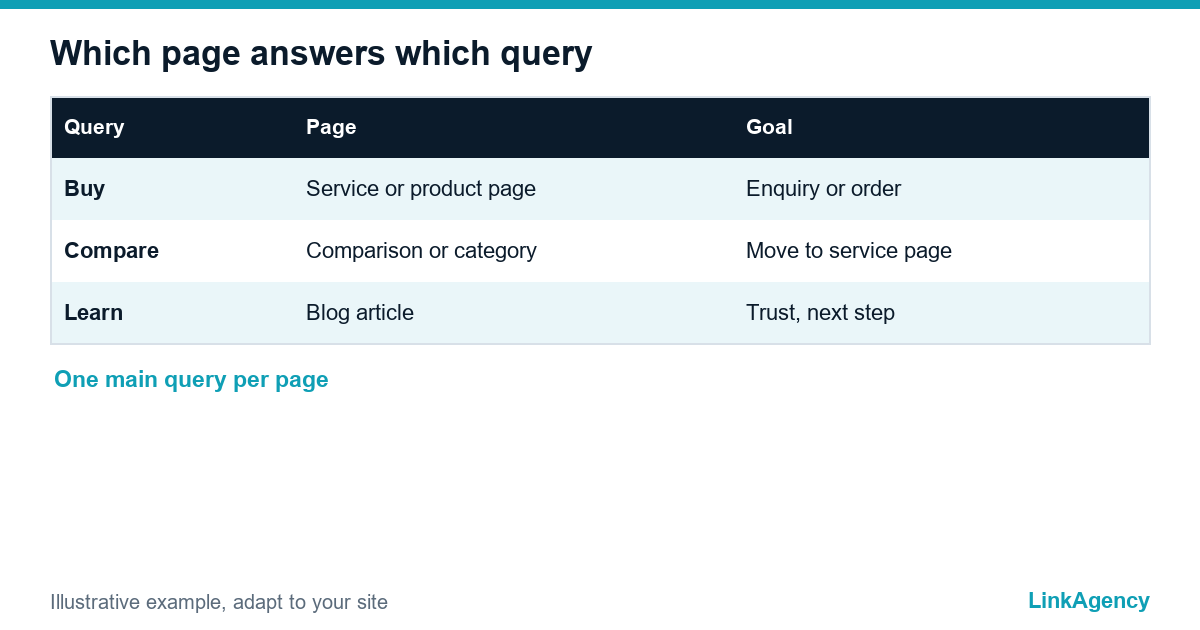
Which page should get which query
| Query type | Page that should answer | Main goal |
|---|---|---|
| Buy | Service or product page | Enquiry or order |
| Compare | Comparison or category page | Move to the service page |
| Learn | Blog article | Trust and a next step |
This keyword mapping is simple: one main query per page, and the page type follows the intent. Keywords are a symptom; the intent behind them, often commercial, is the cause. A blog post should not compete for a buying query, and a service page should not try to explain a basic term. When you decide how to split work between a blog and service pages, our SEO services start from exactly this map.
Signs that your pages compete for one query
Commercial keywords draw the most overlap, because every page wants them.
- In Search Console two URLs alternate for the same query from week to week.
- Several articles target almost the same phrase.
- The page that ranks is a blog post, while the service page sits lower.
- Traffic rises on the blog and does not move on the service page.
Keyword cannibalization is a quiet leak. Merge the weaker article into the stronger one, redirect it and point internal links to the page that should win.
How to rebuild a service page for a buying query
Start with the first screen. It should name the service, the audience and one clear result, so the visitor knows in seconds that this is the right page. Then add the things buyers look for before they write: a price or at least the way the price is formed, proof such as cases and reviews, and several ways to get in touch. Do not make the call to action too large too early. For comparison queries, offer a short next step, such as a quote request or a checklist.
Metrics to watch instead of visitors
Pick four numbers and look at them monthly.
- Share of clicks that come from commercial intent keywords.
- Enquiries per landing page, not per site.
- Click-through rate for buying queries.
- Share of enquiries with a known source in the CRM.
For a wider set, see our guide to six metrics that measure SEO success.
Order an SEO review for buying queries
If you do not have the hour or the CRM data, we can run the check for you. Our SEO audit services map your queries to pages and show which buying queries are missing, and you can order an SEO audit as a separate, fixed task.
Free express review of your commercial intent keywords
We take the queries from your Search Console and show what share of your traffic comes from buying searches and which pages are missing. If you want us to fix them, you can order an SEO audit with a page-to-query map.
- a split of your traffic into learn, compare and buy queries;
- a one-page list of pages to build, merge or rewrite.
Leave a request and we reply within one business day.

Frequently Asked Questions (FAQ)
What does commercial search intent mean?
It describes searches where people compare options before buying, often with words like best, vs, review, alternative or price. The searcher has not chosen yet, so pages need proof and clear trade-offs.
Why do I get SEO traffic but no leads?
Often the traffic comes from informational queries, or Google shows the wrong page for a buying query. Check which queries and pages bring visits and compare them with the pages that bring enquiries.
Can I find buying queries without paid tools?
Yes. Export queries from Search Console, add modifiers to your service names, use autocomplete and People Also Ask, and check the search results by hand to see what kind of pages rank.
Should every query get its own page?
No. Group close queries on one page and give each page one main query. Separate pages only when the intent differs, for example a comparison page and a service page.
How do I know two pages compete?
In Search Console filter by query and look at the pages tab. If two URLs alternate for the same query, they compete. Merge, redirect or differentiate them.
What should I track instead of visitors?
Enquiries per landing page, the share of clicks from buying queries, click-through rate for those queries and the share of enquiries with a known source.
How do I order an express review from LinkAgency?
Leave a request and give us read access to Search Console. We split your queries by intent, map them to pages and send a short list of fixes and a quote.