The domain is picked in ten minutes before the site launches, and then it sits on business cards, in ads and in every email signature for years. A weak name, the wrong zone or a registration in a contractor’s account can cost you recognition, your email and sometimes the site itself. This guide shows how to choose a domain name for your business with seven checks in one list, written for an owner who is launching a site or renaming the company. It covers what other guides skip: who owns the domain and who holds the passwords.
How to choose a domain name for your business: why it is an asset, not a detail
A business domain name works every day, and a domain name for a business that is chosen in a hurry works against you: customers type it, search engines read it, and your email depends on it. Changing it later means redirects, lost links and reprinted material. Treat the name like a brand decision, because it is one, and spend an hour on the checks below before you pay.
Seven checks before you buy: a domain name checklist
| Check | The question | Passed when |
|---|---|---|
| 1. Say it aloud | Can someone type it after hearing it once? | No hyphens, digits or odd spellings |
| 2. Zone | .com or a country domain for your market? | The zone fits where your buyers are |
| 3. Availability | Are the lookalikes, socials and trademarks free? | No clash found, lawyer informed |
| 4. Room to grow | Will the name survive a new product or city? | Not tied to one item or place |
| 5. Owner | Is the company the registrant? | Not a contractor or an employee |
| 6. Renewal | Is auto-renew on with a backup contact? | Payment and notices reach two people |
| 7. Account | Is the registrar login protected? | Two-factor on, access list kept |

Pronunciation, length and spelling
Say the name to a colleague over the phone. If they ask how to spell it, the name has failed the first check. Pick a name people can pronounce, keep it short, avoid hyphens and digits, and avoid two words that run together into a third word. A typo of your own name is a lead for a competitor, so register the most likely typo too.
Zone: .com or a country domain
How to choose a domain name for your business when you sell in two countries? Start from the buyers. The .com zone is the default for international buyers, and a country domain signals that you serve one market. Pick the zone by where your customers are, not by price, and note that a country domain is known as a ccTLD. If you serve one country, a country domain builds local trust, and a .com that redirects to it protects the name. Some country zones require a local presence, so read the registry rules.
Availability: socials, lookalikes and trademarks
Before you buy, search for the same name in the social networks you plan to use and for near copies in other zones. Then check trademarks: the WIPO Global Brand Database is a free starting point. A trademark clash can force a rename after launch, so show the shortlist to a lawyer, because this guide is not legal advice.
Room to grow: a name that does not pin you to one product
A name built on one product or one city becomes a problem when the business adds a second. Choose a brand word with room, and keep the product in the page titles. A name that fits the company’s positioning is easier to carry across ads, packaging and email.
Who should own the domain and who holds the access
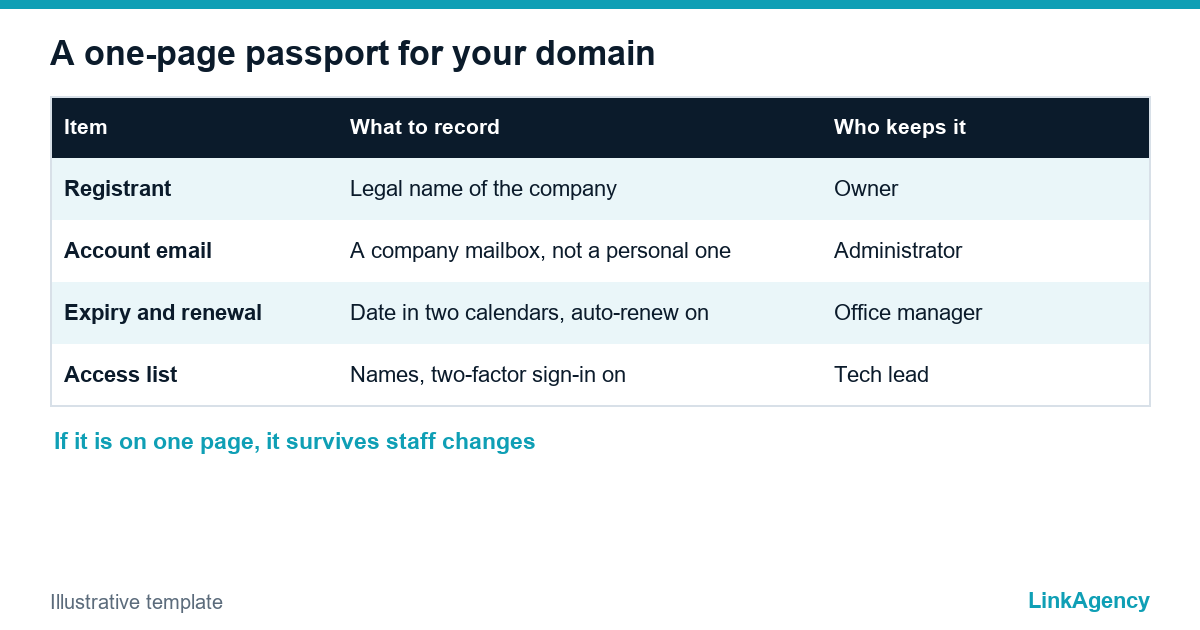
This is the check most guides skip. The registrant should be the company, with a company email that will still exist in five years. If a contractor registers the domain in their own account, they own your address, and a dispute becomes your emergency; the same ownership question applies to people you add to the team, see staff augmentation vs dedicated team. Keep a short note of the registrar, the account email and who has access, and see our guide to a safe handover between web developers for the rest.
Renewal, account security and what to do when you rename
Renewal and the registrar account
Domain registration for business is four steps.
- Register it in the company name, with a company email as the contact.
- Turn on auto-renew, add a backup contact and put the expiry date in two calendars.
- Point the DNS records at the site only after the name is final.
- Switch on two-factor sign-in at the registrar and use WHOIS privacy for personal details.
The owner should register the domain under the company name, never under a personal one, and a transfer between registrars should need the unlock code held by the company. Whoever controls the account controls the domain and the email on it. A domain that is allowed to expire can be registered by someone else, and typo copies of your name appear within hours.
If the company changes its name
Keep the old domain and redirect it to the new one. Google describes the steps in its guide to a site move with URL changes. Update email, ads and profiles, and keep the old domain registered for years.
Choosing a domain name for a business is part of branding, so our branding services help to tie the name to positioning, and our web development services and SEO services carry it into the site.
How to choose a domain name for your business: a free check of your name and access
Send us the name you are considering or the domain you already own. We will check the zone, the lookalikes, who is the registrant and how renewal is set up, and tie the name to your positioning and site plan. If you want the work done, our branding services and web development services handle it.
- a short report on the seven checks;
- a list of access and renewal gaps to close first.
Leave a request and we will answer within one working day.

Frequently Asked Questions (FAQ)
How do I choose a domain name for a business?
Pick a short name that is easy to say and spell, choose the zone by your market, check socials and trademarks, and register it in the company’s name. Turn on auto-renew and protect the registrar account.
Should I use .com or a country domain?
Use .com for an international audience and a country domain when you serve one market, and choose the business domain name with the same care for both. Many companies register both and redirect one to the other.
Who should own the domain name?
The company, with a company email as the contact. If a contractor registers it in their name, they hold your address. Keep a note of the registrar and the people with access.
What does domain registration for business involve?
You choose a registrar, pay for one or more years and enter the registrant data. Add a backup contact, switch on auto-renew and two-factor sign-in at once.
Is a domain name checklist enough to avoid trademark trouble?
No. A checklist finds obvious clashes, but a lawyer should review the final names. A trademark dispute after launch can force a rename.
Can LinkAgency check my domain and name?
Yes. Send us the name or the domain you own. We check the zone, lookalikes, the registrant and renewal, and link the name to your positioning and site plan. The first check is free.