A contractor misses a third deadline, goes quiet or simply stops answering. The site still brings in leads, so the decision to switch web developers feels risky: the domain, the hosting and the only copy of the code may sit in someone else’s account. Here is a safe order of steps, a table of what your company must own and the contract points that keep the handover legal under GDPR.
How to switch web developers: start by checking who owns what
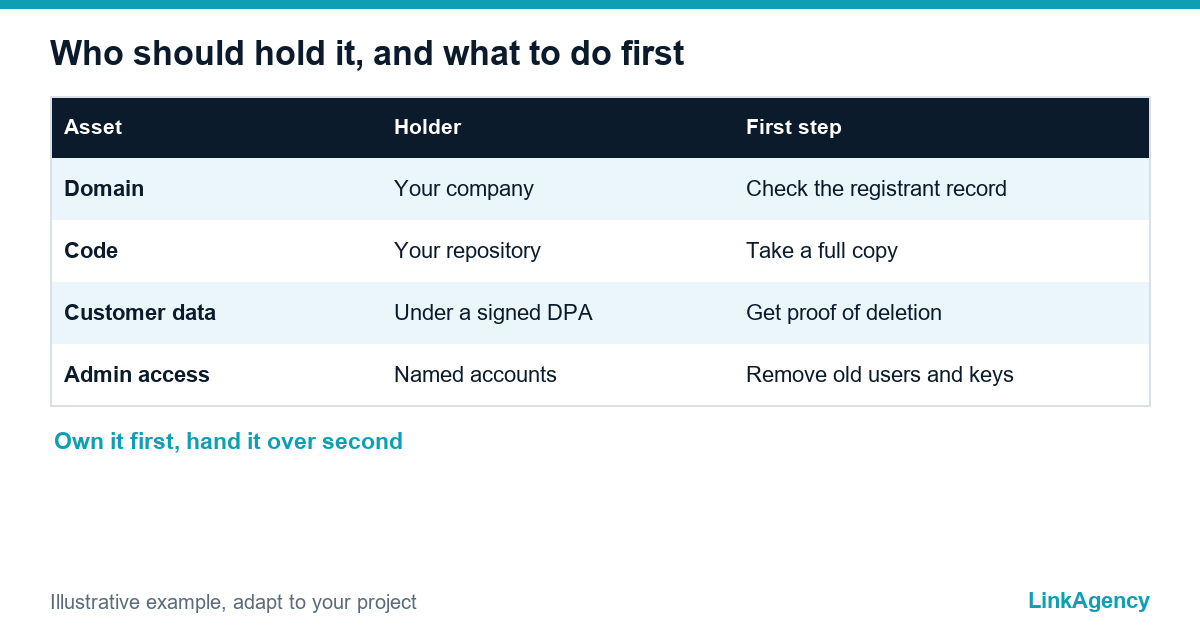
Most handover disasters begin the same way. The agency registered the domain in its own name, pays for the hosting from its own account and keeps the repository to itself. Before you write to anyone, open each item below and note whose name or email it sits under.
| Asset | What to check | Safe state |
|---|---|---|
| Domain | Registrar login and registrant record | Registered to your company, login on your email |
| Hosting and DNS | Who pays and who holds the admin login | Your account, the old team added as a user |
| Code | Repository access and the latest backup | Repository in your organisation, full copy in your storage |
| CMS and database | Admin users and a database export | You hold an administrator account and a recent dump |
| Analytics and ads | Owner role in Analytics, Search Console and ad accounts | You are the owner, the agency is a user |
| Licences and plugins | Paid licences, fonts and API keys | Licences in your name, keys in a password manager |
An asset that sits under the contractor’s name is not yet yours, whatever the invoices say. Any row that fails goes to the top of your list. Website ownership decides how much leverage you have in every later conversation with the agency.

Signs that you should switch to a new web developer
- Deadlines slip and nobody gives a new date in writing.
- Bugs return after every fix, because there is no staging site or testing.
- Only one person knows how the project works.
- You get no access, only “we will do it for you”.
- Invoices grow while the roadmap stays the same.
One sign is a conversation. Three together mean it is time to switch web developers. Settle the rest of the questions, such as whether to hire a web development team or find another agency, after you hold your own copies. To compare candidates, the 12 questions for choosing a software development company give you a neutral checklist.
A website handover checklist that keeps the site online
Changing web developers goes best in this sequence, because the live site never depends on a single hand-off. If you decide to switch, the web developers who built the site must still hand over every login, so ask in writing.
- When you switch, ask the web team for a written inventory of accounts, servers, plugins and integrations, because developers rarely volunteer one. A missing list is information in itself.
- Take your own full backup of files and database before any access changes.
- Create administrator accounts for yourself and for the new contractor, and never reuse the old team’s password.
- Move the registrar login and, if needed, the hosting into your company’s name; the ICANN transfer policy explains how a domain moves between registrars.
- Let the new team restore the site on a staging copy and compare it with the live version.
- Switch deployments to the new team only after the copy matches production.
- Remove the old team’s users, keys and tokens, then change every shared password.
This list is short on purpose. Someone who does not write code can verify each step.
Why the new team will not name a date before the audit
A fair contractor will not promise a timeline for code they have not read. An audit of structure and dependencies turns a guess into an estimate and shows whether to repair or rebuild the project, and it also reveals security gaps that no one has noticed yet. Larger rebuilds usually begin the same way, as our custom software development services do. Ask for it as a bounded, paid step.
Code, content and licence rights: what the contract must say
Paying for a site does not automatically transfer the copyright in its code. Before you switch your web developer, check that the old agreement assigns intellectual property in writing, lists third-party components and gives you the repository on request. If the contract is silent, ask for a short signed addendum before the next team receives the code. The same applies to texts and images, because a licence bought by the agency may not cover your company.
GDPR Article 28: the data your old developer can still reach
Agencies often reach customer data through forms, orders and server logs. Under GDPR Article 28, a contractor who handles personal data for you must work under a written data processing agreement. At handover it should state which data the agency holds, how it returns or deletes it and which sub-processors it used. The ICO guidance on controllers and processors explains the split. Ask for written confirmation of deletion after the export, and sign a fresh agreement with the new contractor before they touch the database, because an informal promise leaves you exposed.
How to avoid website ownership problems next time
- Keep the repository, hosting and domain in your own accounts from day one.
- Require a short README and release notes with every delivery.
- Agree a handover clause with a notice period and a named person.
- Put the ownership assignment and data terms into the contract.
- Review who holds admin rights every quarter.
If you want extra hands inside your own repository, staff augmentation services keep the code and the access in your company while specialists do the work. Switching web developers then stops being an emergency and becomes a routine step.
Free consultation on a safe handover plan
Send us your current setup and we will map the steps to switch web developers without downtime: who owns what, what to copy first and what the new team needs. If you decide to hire a web development team, we agree access and ownership in writing before any work starts.
- an inventory of accounts, code and licences;
- a handover order for your project;
- contract clauses to request from the old contractor.
Leave a request and we reply within one business day.

Frequently Asked Questions (FAQ)
Can I take my website from a developer who refuses to cooperate?
Start with what you can prove: the registrant record, your payment history and the contract. If the domain and hosting are in your name, restore from your own backup. If not, a written request citing the contract usually moves things, and a lawyer helps when the contract is silent.
How much of the site should the new team rebuild?
Decide after a code audit, not before. Code that is clean but undocumented can be kept, while code with no structure, tests or security updates is cheaper to rebuild in stages. The audit result should say which parts stay.
Will switching developers hurt my SEO?
Not if URLs, redirects, metadata and tracking stay the same. Keep Search Console and Analytics under your website ownership, test the new build on a staging site and compare the key pages before the switch.
What access should I ask the old developer for?
The registrar and DNS login, hosting access, the repository, the CMS admin account, a database export, analytics and ad accounts, and a list of paid plugins and API keys. Ask for one written list so that nothing is forgotten.
Do I need a data processing agreement when I change developers?
Yes, if the contractor touches personal data such as form entries, orders or logs. GDPR Article 28 requires a written data processing agreement, so close the old one with confirmed deletion of data and sign a new one before the new team gets database access.
Can LinkAgency take over a project from another contractor?
Yes. We start with an inventory of access and a short code audit, take your own backup, and restore the site on a staging site before anything changes in production. You get a written plan and the main risks before work begins.