You have plenty of happy customers and a handful of reviews, most of them old. A buyer compares you with a rival who has a hundred fresh ratings and picks the rival. The tempting shortcuts are a discount for a five-star review, asking only satisfied people, or deleting the bad ones. Those are exactly the practices regulators now target. This guide shows how to get customer reviews in volume, when and how to ask, what is banned in the US, the EU and the UK, and how to turn reviews into content for your site, ads and B2B sales.
How to get customer reviews: why they decide the choice and your visibility in search and maps
Reviews do two jobs. For a person, they replace trust you have not yet earned. For search and maps, a steady flow of recent, genuine ratings and the text inside them helps a business profile look active and relevant. Our local SEO checklist covers the profile basics that reviews build on. A happy customer will rarely write anything unless the way to get reviews is short and obvious, so the system matters more than the plea.
When and how to ask: moments, channels and message templates
Ask right after a clear result, not right after payment. The customer who just received a finished repair, a signed contract or a solved problem is the one with something to say. If you wonder how to ask customers for reviews, keep the message short, personal and one tap away.
- Pick the moment: the result is delivered and the client has said thanks.
- Send a direct link to one platform, by SMS, email or a QR code on the receipt.
- Name the person who served them, so the request feels human.
- Ask every client, not only the ones you think are happy.
- Send one gentle reminder, and then stop.
A template that works
“Hi Anna, thanks for choosing us. If the work met your expectations, would you share a short review here: [link]? Honest feedback of any kind helps other customers and us.” The last sentence matters, because it does not steer the rating.
What is banned: the FTC rule, the EU Omnibus Directive and the UK DMCC Act
In the United States, 16 CFR Part 465, the FTC rule on fake reviews, has applied since 21 October 2024. It prohibits fake or AI-generated reviews, paid reviews that depend on a positive or negative sentiment, undisclosed insider reviews, company-run sites posing as independent, review suppression through unfounded threats and fake social media indicators. The FTC can seek civil penalties from knowing violators.
In the EU, the Omnibus Directive, Directive (EU) 2019/2161, requires sellers who display reviews to say whether and how they check that the authors are real buyers. In the UK, the consumer provisions of the DMCC Act have applied since 6 April 2025 and ban fake and concealed incentivised reviews.
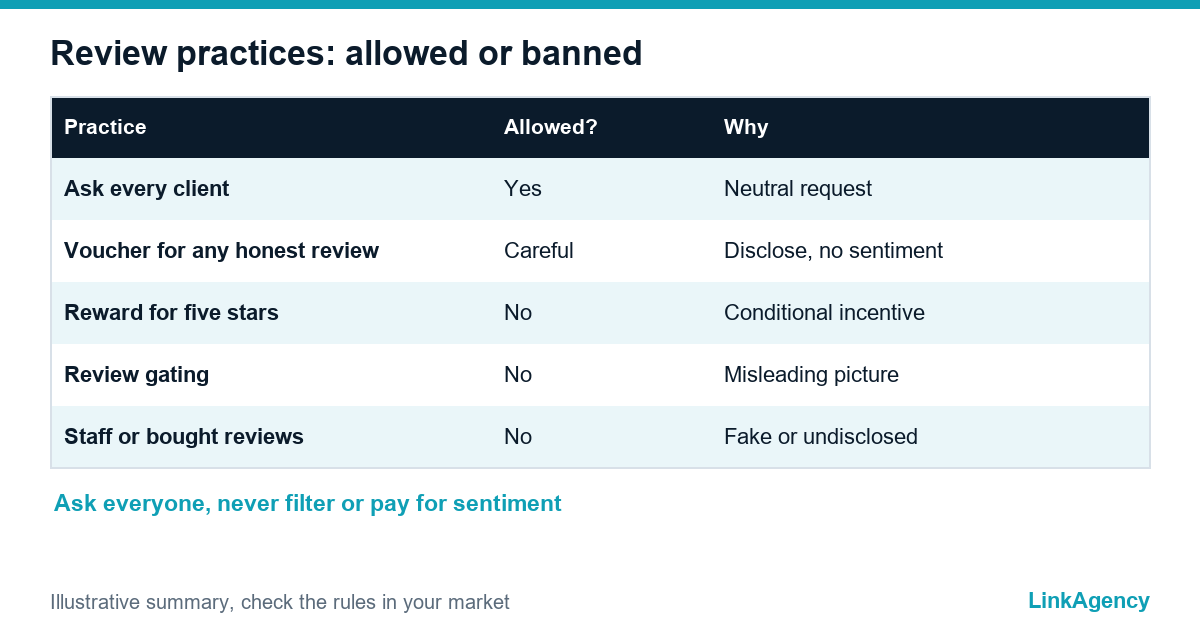
| Practice | Allowed? | Why |
|---|---|---|
| Asking every client for a review | Yes | Neutral request, no filter |
| Voucher for any honest review | Careful | Disclose it, avoid conditioning on sentiment |
| Reward for five stars | No | Conditional incentive |
| Review gating | No | Misleading picture for shoppers |
| Staff or bought reviews | No | Fake or undisclosed insider reviews |
- Never buy or write reviews, or ask staff to post them without disclosure.
- Never reward only positive reviews. A voucher for a five-star rating is a conditional incentive.
- Never run review gating, where unhappy people are sent to a private form and happy ones to the public page.
- Never delete or hide negative reviews you are not entitled to remove.
Whatever the market, the safe way to get more customer reviews is a neutral request to every client. Rules differ by country and platform, so check wording with a lawyer before you launch a campaign.
How to answer negative reviews so they work for your brand
How to ask customers for reviews matters, but how you answer them matters just as much. A calm answer is read by many more people than the author. Reply within a day, thank the person, state the facts without argument and offer a way to fix it offline. Do not ask for the review to be removed in exchange for a refund. A mix of ratings with sensible replies looks more honest than a perfect score.
Reviews on your site and in ads: consent, markup and honest captions
Using customer testimonials in marketing needs permission, and getting customer reviews does not give you the right to quote them anywhere. You need permission from the person quoted. Keep the original text, show the real name or a clear label such as “verified client”, and do not edit meaning. Review markup on a page should reflect reviews that are actually displayed. Show the average and the total number, including mixed ratings, so the caption does not suggest more than the data supports.
Reviews in B2B: how to get a reference when the client is under an NDA
B2B buyers rarely post public ratings, so getting customer reviews in B2B means a different route. Ask for an anonymised quote, a named reference by phone, a joint case study or a short video where the client controls the wording. Our guide to a B2B case study shows how to turn a project into proof without exposing confidential details.
A one-month process: automatic request, control and report
- Week 1: choose platforms, write the request, and fix who answers reviews.
- Week 2: connect the request to the moment a job closes in your CRM or booking tool.
- Week 3: train staff on how to get reviews from clients and what they may not do, including review gating and incentives.
- Week 4: report on volume, rating, response time and which reviews you reused in content.

Free reputation audit and a plan to get more customer reviews
We look at where and how often your clients write, how you answer and how reviews appear on your site, then give three to five steps to get more reviews within the rules. Our branding services turn this into a consistent message across site and ads.
Free reputation audit: how to get customer reviews and stay within the rules
We check where clients leave reviews, how often, how you reply and how reviews appear on your site, then give three to five steps to get more reviews without breaking platform rules or the law. No obligation.
- review sources, frequency and replies;
- three to five steps and a compliance check.
Leave a request and we will reply within one working day.

Frequently Asked Questions (FAQ)
How to get customer reviews without breaking the rules?
Ask every client, right after a clear result, with a direct link and a neutral request. Do not pay for sentiment, fake reviews, filter who is asked or delete reviews you may not remove.
What is review gating and why is it risky?
It means steering happy customers to a public review page and unhappy ones to a private form. It distorts the picture shoppers see and is a practice platforms and regulators treat as misleading.
Can I offer a discount for a review?
Only if it does not depend on what the review says and the connection is disclosed where required. A reward for five stars is a conditional incentive. Many platforms forbid any incentive, so read their policy.
What does the FTC fake reviews rule ban?
Fake and AI-generated reviews, reviews bought for a set sentiment, undisclosed insider reviews, company-run sites posing as independent, review suppression by unfounded threats and fake social indicators.
Can I use customer testimonials in my ads?
Yes, with the person’s permission, the real text and honest labelling. Do not edit the meaning or present a handful of praise as the typical result.
How do I get reviews in B2B when clients are under NDA?
Ask for an anonymised quote, a phone reference, a joint case study or a short video the client approves. Agree the wording in writing.
How can LinkAgency help with reviews and reputation?
Leave a request with your profile links. We run a free reputation audit, show how reviews appear on your site and give three to five steps to get more reviews within the rules.