Your sales team says the work speaks for itself, yet the cases page holds three vague paragraphs and a logo. A buyer about to sign a large contract wants proof from a company like theirs and finds none, so the competitor with a detailed story takes the shortlist. This guide shows how to write a B2B case study that a sceptical reader finishes: the structure, four ways to tell the story when the client will not be named, how to get approval, and how to use the finished piece on your site, in sales and on LinkedIn.
How to write a B2B case study: why buyers ask for proof and why most cases fail
A B2B purchase rarely rests on one person. The buyer must defend the choice to a finance director, an IT lead and sometimes a lawyer, so the question is not “are they good” but “who like us has done this, and what happened”. During a long sales cycle, a case answers that before the first call.
Most fail for the same reasons: they praise instead of showing, hide the numbers, skip what went wrong and read like an advertisement. Fix the order of thinking first. The client is the hero, you are the guide, and the result is the headline. Choose the project with care, too: take the one that resembles the clients you want next, which depends on a clear positioning, as the guide to a brand positioning statement for a small business explains.
A case study structure that works: result first, then task, solution and quote
A B2B case study that sells opens with the result in the headline and in a three-line summary, because readers decide in seconds whether the story concerns them. Here is how to write a B2B case study body that a buyer can scan, section by section.
| Section | What goes in | Typical mistake |
|---|---|---|
| Headline and summary | Result with a number or a clear outcome, plus the client type | Starting with the company history |
| Client and task | Industry, size, the problem in the client’s own words, what was at stake | Describing your product instead |
| Solution and process | What you did, why this option, steps, timeline, what changed on the way | A list of services with no reasoning |
| Result | Metric, period, how it was measured, what remains open | Round numbers with no source |
| Quote | One or two sentences from a person with a role | A generic compliment |
Use the same case study template for every project, so the sales team can compare cases and spot gaps.
Length and format
Readers of B2B pages accept a case without a name, though you must write down who approved each figure. Roughly 600 to 1,000 words are enough, with one chart or table and a pull quote. Keep a case study template for the team, a second client testimonial block, a PDF for sales and a short card for the list on your website.

When the client will not be named: four formats that respect the NDA
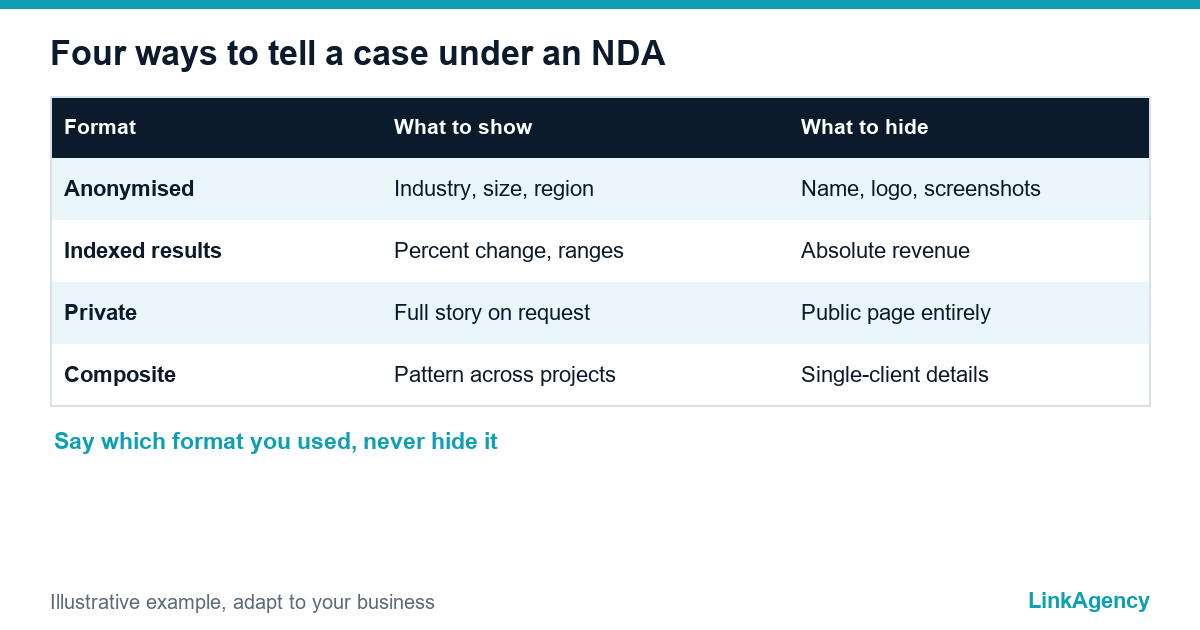
Many strong projects sit under a confidentiality clause, and B2B case studies built on them often sell best. Do not drop them: choose one of four formats and say plainly which one you used.
- Anonymised case study: describe the client by industry, size and region, and remove names, screenshots and unique details.
- Indexed results: show change as a percentage or a before-and-after range, not absolute revenue.
- Private case: keep the full version for sales calls and share it with the client’s agreement.
- Composite case: combine several similar projects and label it as such, so no reader assumes it is one client.
An anonymised case study still needs numbers, so agree early which metrics may appear. A quote with a role instead of a name, such as “head of operations, regional logistics firm”, keeps trust without breaking the NDA. Label composites honestly: the EU directive on misleading and comparative advertising also applies to B2B advertising.
How to write a B2B case study with the client’s approval: five steps
To write one that works in B2B, start from the buyer’s question, which any good case must answer. The client’s help then makes writing a B2B case study straightforward.
- Ask right after a good milestone, when the client is pleased, and explain what the case will contain and where it will appear.
- Run a 20 to 30 minute case study interview with open questions: what was the situation, what did you try before, why us, what changed.
- Send the draft with every number highlighted and ask the client to confirm each against their own records.
- Allow one round of edits, then take written approval by email.
- Agree a review date, so the case is refreshed or removed when facts change.
The question that gives you a quote
Record the case study interview and quote from the transcript, not from memory. Ask: “What would you tell a colleague who is choosing a supplier?” The answer is usually the best line on the page. A named person is personal data, so get consent for a name, photo or quote in line with GDPR and keep the written reply.
Honesty and the law: do not stretch the numbers
Writing a B2B case study without a source for each number invites doubt. Learning how to write a case study for B2B means accepting that every claim needs a source. A buyer will check one figure, and if it fails the whole page fails. Confirm each number against invoices or analytics, compare like periods and say what else changed, such as a price cut or a seasonal peak. Do not claim that your work alone caused the result when other factors were involved.
Ask for a client testimonial only after the numbers are confirmed. In the United States, the FTC’s Endorsement Guides require that endorsements reflect honest opinions and that material connections are disclosed, which matters when a client testimonial was rewarded with a discount. Ask a lawyer to review the final text in your market.
The case study page on your website: filters, calls to action and links to services
A B2B case study that sells needs a home that is easy to browse. List cases as cards with the result in the title, an industry tag and a filter by industry and service, so a visitor finds a story about their own situation within two clicks. End every case with a short call to action and a link to the relevant service. A web project case, for example, should lead to your web development services page, and the cases page itself must load fast and read well on a phone. If your team has no time, a case study writing service can draft the page while you keep control of the facts, and you can order a case study for the most important project first. Well organised B2B case studies also give visitors more pages to explore.
One case, many uses: sales, LinkedIn and newsletter
Good B2B case studies work harder when you reuse them, and writing a B2B case study once gives you material for every channel.
- Sales deck: one slide with the result and the quote, placed before the price.
- LinkedIn: three posts from one case: the problem, the turning point, the result.
- Newsletter: a 100-word summary with a link to the full page.
Keep one voice across all of them. Our branding services cover that voice and visual system, so cases look like the same company everywhere.
Free site audit: do your cases build trust?
Send us your cases page and we will show, in writing, how to write a B2B case study from projects you already have and what makes a visitor trust the site. If you would rather hand the writing over, you can order a case study from our team as a separate project, run like any case study writing service.
- a list of your projects ranked by how well each would sell;
- a trust check of the cases page and the main service pages.
Leave a request and we reply within one business day.

Frequently Asked Questions (FAQ)
How long should B2B case studies be?
Roughly 600 to 1,000 words with one table or chart and a pull quote is enough for most buyers. Keep a shorter card for the list on your site and a PDF version for the sales team.
Can we publish a case without naming the client?
Yes. Use one of four formats: anonymised, indexed results, private version for sales calls or a composite, and state which one you chose. Never present a composite as a single client.
What should the headline of a case say?
The result and the type of client, in plain words. Leave the history of your company and the name of your method for the body, because readers decide in seconds whether the story is about them.
How many case studies does a company need?
Start with three that cover your main services and industries, then add one after each finished project that the client is happy to share.
What if the client refuses to approve the text?
Offer an anonymised case study or a private version and a quote with a role instead of a name. If the client still declines, do not publish: an unapproved case damages the relationship and trust in your site.
Can LinkAgency review our cases page?
Yes. Send the page and we will return a written trust audit of the cases and main service pages, with a ranking of your projects by selling power. We also explain how to write a case study for B2B from your own projects.