The ads bring clicks, but few enquiries. Click through from the ad yourself and you land on the homepage, with a menu, news and ten services, and a visitor cannot tell what to do next. The question of a Google Ads landing page vs website is one of the cheapest to fix and one of the most expensive to ignore. This guide shows how to choose a landing page for Google Ads by situation instead of repeating that a landing page is always better. It gives a table for the choice, a rule of one ad, one page, one action, a minimum of five page elements, and checks for cookie consent, speed and mobile before you launch.
Google Ads landing page vs website: why the page you choose changes the cost of a lead
The ads promise something, and the page they land on, the landing, must deliver it. A PPC landing page does one job. When the promise and the page match, more visitors act, and the same budget buys more enquiries. When they do not match, you pay for clicks that leave in seconds. The platform also reads the page: Google’s help on landing page experience describes how relevance and usability feed into ad quality. So page choice affects both what you pay per click and what share of clicks become leads.
When you need a landing page for ads
A landing page for Google Ads works when one campaign sells one clear offer to people who are ready to act, and the page converts better than a general site. It strips away everything that distracts, and it can be built to say exactly what the ad said.
- A single service or product with a clear price or next step.
- A short decision cycle, where the visitor can decide from one page.
- A campaign with its own audience, offer or discount.
- A need to test headlines and offers without touching the main site.
When a service page or the website is better
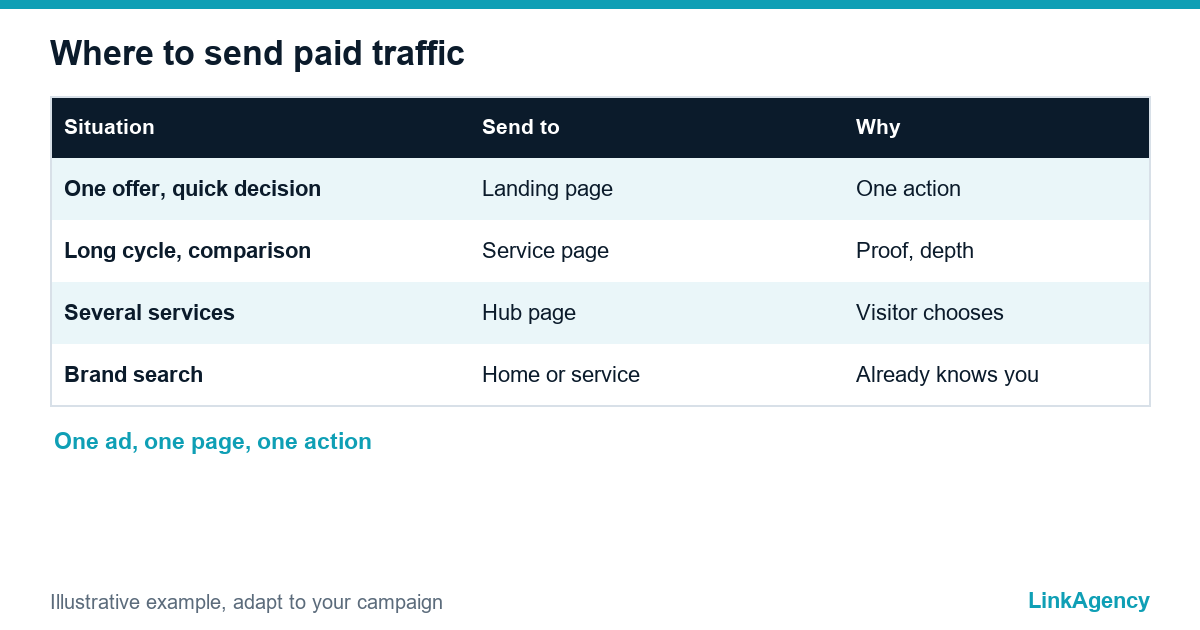
If buyers compare suppliers over weeks, they want to see who you are, your work and your team. The landing page vs website decision then favours a strong service page or a few connected pages. There is no universal answer for landing vs multi page website. See the difference in the table.
| Situation | Better target | Why |
|---|---|---|
| One campaign, one offer, quick decision | Landing page | One ad, one page, one action |
| Long cycle, buyers compare suppliers | Service page or site section | Needs proof, cases and depth |
| Many services under one campaign theme | Hub page with clear paths | Lets the visitor choose |
| Brand search | Homepage or main service page | The visitor already knows you |
Do I need a landing page for ads? Only when a Google Ads landing page serves one offer better than your existing page. That is the test. Otherwise improve a service page first, and keep the landing page for campaigns that need it.
Why the homepage is almost always a poor choice
A homepage serves many visitors with many goals, so it tries to say everything. For a paid click that has one intention, this is noise. The menu invites exploring, the news distracts, and the one action you want is lost among others. A landing page or homepage test usually shows that a focused page wins for cold traffic. Our guide to why a good-looking site brings no leads explains the same problem from the site side.
Five elements of a page built for ads
- A headline that repeats the promise of the ad in the visitor’s words.
- One clear offer and one main action, such as a form or a call.
- Proof: a short case, a result described honestly or a client logo you may show.
- Answers to the two or three questions that stop people, such as price range and timing.
- A short form with only what you need, and a visible phone number or messenger button.
These five are the minimum, and they work as an ad landing page checklist before launch. Add more only if tests show they help. Short.
Cookie consent, speed and mobile: what to check before launch
The pre-launch check
- Cookie banner: in the EU, consent rules under the ePrivacy Directive and the GDPR affect which tags fire, so test that the page works and measures correctly with consent given and refused.
- Speed: slow pages lose visitors before the headline appears. Google’s Core Web Vitals are a practical yardstick.
- Mobile: most paid clicks come from phones, so check the form, the buttons and the text on a real phone.
- Tracking: confirm that a submitted form and a click on the phone number are counted as conversions.
For the free review of your landing page for ads, confirm details of consent with a lawyer for your market, and test the page in the same way a visitor would use it.
How to test headlines and offers without breaking the main site
A PPC landing page can be tested separately, which is one of its main benefits. Change one thing at a time, such as the headline, the offer or the form length, and compare qualified leads, not clicks. Keep each test long enough to collect a fair number of leads, and keep the old version for comparison. If the page is part of your main site, make a copy of it for the test so a mistake does not touch the rest.
A hybrid scheme: a landing page per campaign and a full website for everything else
Most businesses do best with a landing page vs website split, using both. A landing page for each campaign handles paid traffic, and the full website supports brand searches, people who want depth and your search rankings. Link the two sensibly: the landing page can point to a case study or an about page for visitors who need more, without turning into a menu. If you need pages built or rebuilt, our web development services cover both landing pages and full sites, and our Google Ads management team can connect each campaign to the right page.

Free review of the pages your ads lead to
We look at the pages your ads send traffic to, show what gets in the way of enquiries and say whether you need a separate landing page.
Google Ads landing page or website: a free review of your ad pages
We review the pages your ads lead to, show what blocks enquiries and tell you whether a separate landing page is needed. No obligation.
- review of the pages behind your ads;
- what to fix first and whether you need a landing page.
Leave a request and we will reply within one working day.

Frequently Asked Questions (FAQ)
Do I need a Google Ads landing page, or can I send traffic to my website?
Use a landing page for ads when one campaign sells one clear offer to people ready to act. Use a service page or the site when buyers compare suppliers for weeks and need proof and depth. Landing page vs website is a choice by situation, not by habit.
Why is the homepage a poor target for ads?
It serves many goals at once, with menus and news around the one action you want. A paid click has one intention, so a focused landing page for Google Ads usually beats the homepage.
What should a page built for ads contain?
A headline matching the ad, one offer and one action, proof, answers to the main objections and a short form with a visible phone or messenger button. Treat it as an ad landing page checklist.
Does cookie consent affect ad landing pages?
In the EU, consent rules decide which tags fire, so test that the landing page for Google Ads works and conversions are measured with consent given and refused. Confirm details with a lawyer.
How do I test a landing page safely?
Change one element at a time, compare qualified leads rather than clicks and keep the old version. Test a PPC landing page on a copy so the main site is not touched.
Is a hybrid scheme better than choosing one?
Often yes. A landing page for ads per campaign handles paid traffic, and the full website supports brand searches and visitors who want depth. That settles landing vs multi page website for most firms.
How can LinkAgency help with landing pages and ads?
Leave a request with your ad account and page links. We run a free review of the pages your ads lead to, show what blocks enquiries and say whether you need a landing page for ads.