Your European site converts well, a few US prospects have written to you, and the board asks when the American revenue will start. The usual answer is “translate the site into English and turn on ads”. It rarely works, because US buyers, US law and US working hours differ from yours. This guide turns US market entry into one digital checklist across five blocks: site, trust, requirements, promotion and processes. Expanding to the US is cheaper when you know what to finish before the first ad dollar and what can wait for the first leads.
US market entry is more than translating your site into English
A translated site is a starting point. Buyers in Texas or Ohio judge you on small signals: American spelling, prices in dollars, a US phone number, familiar payment methods and proof that other American companies already work with you. That buyer sees the market through those signals, so the entry plan must fix them in a clear order. The legal side differs too, from accessibility claims to privacy rules that change from state to state. Check the legal points with a US lawyer, and use this text as a map of the digital work around them.
Block 1. Site: a US version, localization and technical structure
What to change on the page
US website localization starts with spelling and ends with forms.
- US English with American spelling, not British.
- Prices and currency in dollars, units in inches and pounds where buyers expect them.
- Dates in month-day-year order.
- Forms that ask for a state and a ZIP code, not a postcode and a region.
Where the US version lives
Choose one structure before you enter the US market and keep it. A subdirectory such as /us/ is the simplest to maintain and keeps authority with the main domain. Whichever you pick, set hreflang for en-us so search engines do not mix the versions, and do not redirect visitors by IP address alone. Our SEO services can set this structure up before the pages go live.
Block 2. Trust: what a US buyer checks first
A US buyer wants to know that a company without an American office is real and reachable. US website localization also covers trust pages. Show a US contact route, a case study with a named American client or a clear industry fit, reviews on platforms they know, and payment methods they use. If you cannot yet show a US case, say what you did for similar clients in Europe and give a concrete result. Companies that enter the US market with proof, not promises, win the first meetings.
Block 3. Requirements: ADA website compliance, state privacy laws, cookies and opt-out
Entering the US market brings two topics that surprise European teams most. The first is ADA website compliance. Lawsuits over inaccessible sites are common in the US, and the Department of Justice publishes guidance on web accessibility and the ADA for businesses open to the public. Our explainer on accessibility requirements under the EAA and the ADA shows what carries over.
The second is privacy. There is no single GDPR for the whole country, so state privacy laws decide what you owe each visitor. California, for example, gives residents rights to know, delete and opt out of the sale or sharing of their data, as the California Attorney General’s CCPA page explains. In practice you need a clear privacy notice, a working opt-out link and a cookie banner that lets visitors refuse tracking. Ask a lawyer which states apply to you. Each US state has its own rules, so the market plan needs a clear entry order.
Block 4. Promotion: a test ad launch and a US SEO section
US market entry often begins with paid search. Start with a narrow geography: Google Ads location targeting lets you pick states or cities, so test two or three of them with a small budget and one offer. If you need help, our performance marketing agency team runs such tests.
Alongside ads, build an SEO section on the new version of the site, with pages written for American queries rather than copies of the European ones. Expanding to the US through search takes months, so start it in parallel with the first campaign.
Block 5. Processes: time zones, CRM and an AI helper for night leads
Most US leads arrive when your office is closed. Set a response rule, route US requests to one CRM pipeline with a source field, and add an AI assistant that answers the first questions and books a call in the visitor’s time zone. A human reply the next morning is fine. Silence for a day is not. Each US lead is a small market test, and a night reply is part of the entry process. Entering the US market is a service business as much as a sales one.
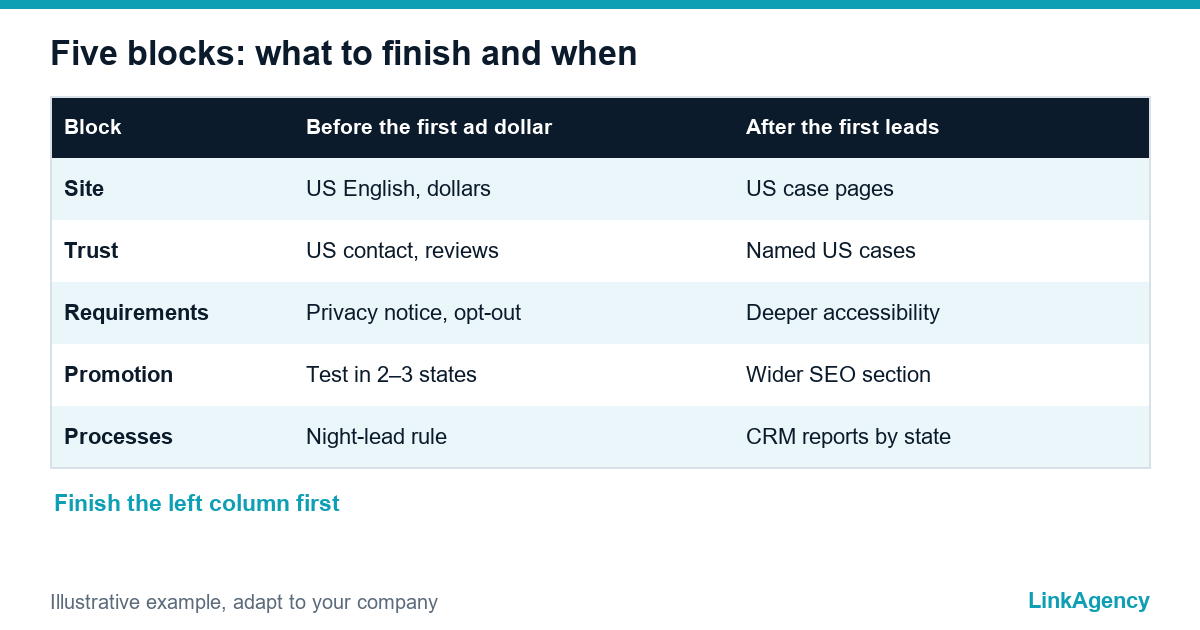
Order of work: before the first ad dollar and after the first leads
| Stage | What to finish |
|---|---|
| Before the first ad dollar | US English, dollar prices, US contacts, privacy notice, cookie banner and opt-out, basic accessibility check |
| During the test launch | Two or three states, one offer, source tracking, response rule for night leads |
| After the first leads | US case pages, a wider SEO section, deeper accessibility fixes, CRM reports by state |
Five steps in order
- Fix the US version of the site and the contacts.
- Add the privacy notice, opt-out and a basic accessibility check.
- Launch a small test in two or three states.
- Answer every lead fast, including night ones, and record its source.
- Scale only what brought qualified leads.
This order keeps the budget small and the risk low. It is not the same as multilingual SEO in Europe, where several languages sit side by side. A clean entry into the US market means building one market well before you add another, and US market entry works best as a chain of small checks.

Get a US readiness review of your site and ads
If you want an outside view before spending on ads, our business services consulting team can check the site, trust signals and ad setup, and you can order a US readiness review as a short, separate task. The same team handles the site, ads, SEO and automation, so the task list does not fall apart between vendors.
Free review for your US market entry
We look at your site, trust signals and ad plan and send a prioritised task list: what to fix before the first dollar and what can wait for the first leads. You can also order a US readiness review as a separate task.
- a short list of fixes for the site, trust and requirements blocks;
- a launch order for ads, US SEO and the night-lead process.
Leave a request and we reply within one business day.

Frequently Asked Questions (FAQ)
Is a translated English site enough to sell in the USA?
Rarely. US buyers expect American spelling, dollar prices, a US contact route and proof from similar clients. Translation is the first step, not the whole plan.
Do I need a separate domain for the American version?
Not necessarily. A /us/ subdirectory is easier to maintain and keeps authority on one domain. A separate domain needs its own team.
Does the ADA apply to my European website?
It can apply if you serve customers in the US. Rules and risks depend on your business, so use the DOJ guidance as a starting point and ask a US lawyer for a specific answer.
Is GDPR enough for American visitors?
No. The US has privacy rules set by each state, such as California’s CCPA, with their own rights and opt-out rules. A GDPR-style notice helps but does not replace a state-by-state check.
How big should the first test ad budget be?
Small enough to lose without pain: two or three states, one offer and a few weeks, to learn lead quality.
How do I answer US leads outside European working hours?
Set a response rule, route US requests into one CRM pipeline and add an AI assistant that answers the first questions and books a call in the visitor’s time zone.
How do I order a US-readiness review from LinkAgency?
Leave a request with your site link and target states. We send a short prioritised task list and a quote for the work you choose.