Most About pages are written to tick a box: a founding story and a few general words. Yet clients open that page before they write to you, and they leave without a reason to trust you. These about us page best practices start from the questions a buyer asks before sending an enquiry: who you are, what you do, what proves it, how the work goes and what happens next. Below is a structure you can reuse, with the mistakes to avoid and the legal details for the EU and the US.
About us page best practices: why clients open it before they contact you
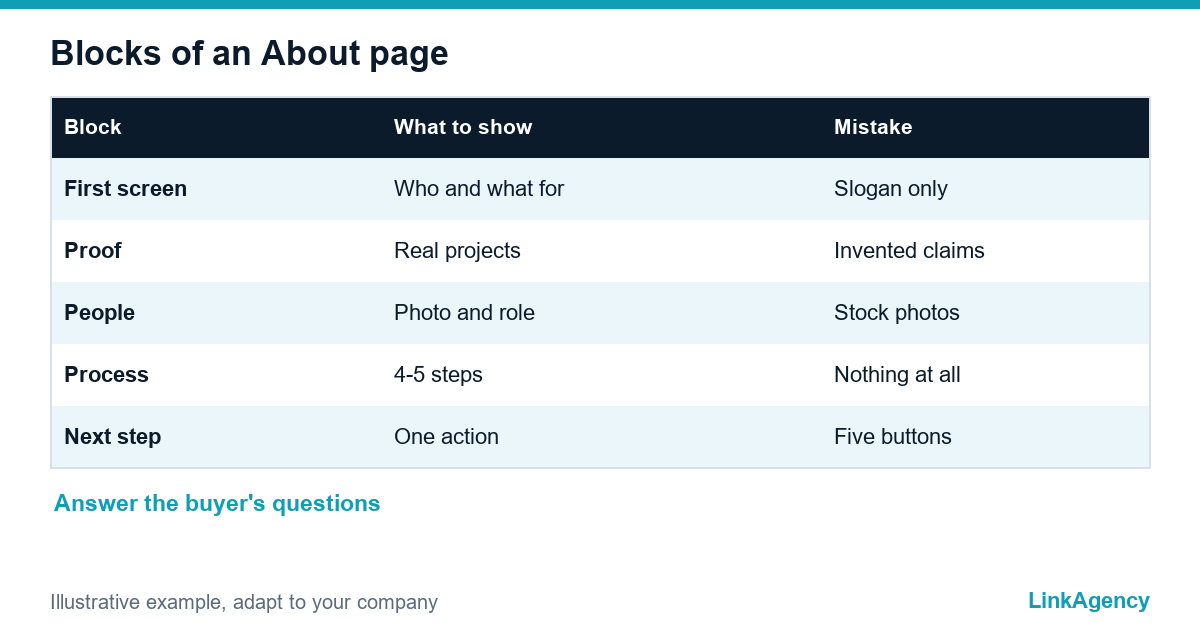
A visitor who reaches your About page is usually close to a decision. They have read a service page and now check who stands behind it. Nielsen Norman Group has long advised that a good About Us summary should tell the story from the first screen and lead with a few concrete facts. In other words, the page should answer questions, not narrate your history. A case study or a short result in the first lines does more than a slogan. That is the core of about page best practices for any B2B company.
| What the client asks | What to show on the page |
|---|---|
| Who are you? | Company name, country, years in business, what you do |
| Can I trust you? | Real projects, certificates, partners, reviews |
| Who will work with me? | Photos, roles and areas of responsibility |
| How does the work go? | A short process in four or five steps |
| What do I do next? | One clear action: a form, a call, a booking |
The first screen: who you help and with what
Open with one sentence that names the client and the result: “We build online stores for European retailers that want fewer abandoned carts.” Add the country, the number of years and one proof point. This is the part of how to write an about us page that most owners skip, and it decides whether the visitor scrolls.
Keep the founding story short. Move it lower. Clients care about it. But only after they know what you do for them, and not a minute earlier.
Proof: projects, certificates and partners, only real ones
Trust grows from things a visitor can check, and the best practices for an about us page all follow that rule. Show two or three real projects with a clear task and result, certificates you actually hold and partners who agree to be named. Do not use invented figures, stock reviews or logos of companies you did not work with. If you browse about us page examples, notice that the strongest ones show fewer claims and more evidence. If you have no public cases yet, say what you do and how you work instead of filling the page with claims. Facts first.
People: photos, roles and areas of responsibility
Show the people a client will meet. A photo, a name, a role and one line about what the person is responsible for are enough. An about us page for a B2B company that hides its team feels like a risk, while a short team block lowers it. Use real photos, not stock images, and keep them up to date. Clients read about your team first, and the best page answers who stands behind the work. One of the simplest about us page tips is to name the person who will answer the enquiry.
How the work goes: a process in four or five steps
Buyers fear the unknown. That is normal. A simple process answers that fear before the first call. Write it in plain steps and give the client a role in each one. This detail is a quiet driver of about page conversion, because it removes the fear of the unknown.
- We discuss your task and goals.
- We agree on scope, timing and the price range.
- We do the work and show results at fixed points.
- You approve the result and we launch.
- We support the project after launch.
Legal and contact details: what is required in the EU and the US
In the EU, a service provider must make certain details easy to reach. The e-Commerce Directive asks for the provider’s name, address, email and registration data, and in Germany this is usually shown on a page called Impressum. Requirements differ by country and by business type, so confirm the exact list with a lawyer. In the US, no single rule covers every site, but a clear company name, address and contact method are standard and build trust. The legal part of about us page best practices is short. Put the details on the About page or link to them from its footer.
Call to action and the next step
End the page with a single next step, not five. Good about page best practices keep one button above the fold and one at the end. Say what happens after the click: who replies, how fast and what the first conversation covers, so that a busy director understands in one glance what the first step will cost in time. If the visitor needs more, link to a related page, for example our half-day brand positioning plan, which helps you decide what to put on the first screen.
Five mistakes that kill trust
What to remove from an About page
Reading about an about us page for a B2B company that works, you will meet the same five problems again and again. Cut them first.
- A long founding story with no information about what you do.
- Big words without proof, such as “leading” or “innovative”.
- Stock photos instead of real people.
- Missing contact and company details.
- No next step, so the visitor leaves.
Treat this as an about us page checklist when you review your current text, and apply the best practices for an about us page one block at a time. If the page needs a new structure, our branding services help with positioning, and our web development services rebuild the page together with the rest of the site.

About us page best practices: free review of your About and home pages
We will look at your About page and home page, show what raises trust and what gets in the way. No obligations.
- review of the first screen, proof and next step;
- list of five changes ranked by effect.
Leave a request and we will reply within one working day with a free review plan.

Frequently Asked Questions (FAQ)
What should an About page include?
A first screen that says who you help and with what, real proof, your people, a short process, legal and contact details and one next step. These about page best practices and about us page tips fit most B2B companies.
How do I write an about us page without a long story?
Open with one sentence that names the client and the result, add a proof point, then move the founding story lower. Treat how to write an about us page as answering questions, not narrating history.
Do I need legal details on an About page in the EU?
In the EU, providers must make some company details easy to reach, and in Germany that is often an Impressum. The list differs by country, so confirm it with a lawyer.
What proof is acceptable if I have no public cases?
Describe your process, your team and the type of tasks you handle, and show certificates you hold. Never invent figures, reviews or client logos. Honest information, as in the best about us page examples, beats big claims on an about us page for a B2B company.
How long should an About page be?
Long enough to answer the buyer’s questions and no longer. A short first screen, a proof block, a team block, a process and a call to action are usually enough.
What are the worst mistakes against about us page best practices?
A long story with no facts, big words without proof, stock photos, missing contact data and no next step. An about us page checklist helps you find them quickly.
How can LinkAgency help with an About page?
Leave a request with the address of your site, and if you wonder how to write an about us page for your team, ask for our best practices for an about us page applied to your text. We give a free review of the About page and home page, show what raises trust and what blocks it, and say whether you need help with positioning or with the site itself.