Open ten websites in your sector and you will read the same promise: quality, an individual approach, years of experience. A buyer cannot choose between those pages, so the choice falls to price. Nobody wins that race. A brand positioning statement fixes that in one sentence, and a first version takes half a day. Below are the five steps of the session we run, the test that catches empty claims and the places where the sentence has to travel afterwards.
Brand positioning statement: one sentence that settles four things
A positioning statement is an internal sentence, not a slogan. It tells your team who the buyer is, what they need, which category you compete in and why you win. A common positioning formula reads: for [segment] who [need], [brand] is the [category] that [difference], because [proof]. The tagline may change every year; the statement should not. It also differs from a rebrand, which changes how the brand looks, and from a style guide, which records how it is used. If you doubt which one you need, our article on when to rebrand or refresh a business will settle it.

Brand positioning for small business: the half-day plan
| Step | Time | Output |
|---|---|---|
| 1. Customer interviews | 60 min | Five reasons clients chose you, in their words |
| 2. Lost deals review | 45 min | Why you lose, and to whom |
| 3. Segment and statement | 75 min | One segment, one draft sentence |
| 4. Proof | 30 min | Three claims a buyer can verify |
| 5. Transfer plan | 30 min | List of pages and scripts to change |
Run it with the owner, the sales lead and whoever answers client questions. Small business brand positioning needs no research budget. It needs real material: ten won deals, ten lost ones and any reviews.
Steps one and two: how to differentiate your business from competitors
Customer interviews
Ask five recent clients three questions: what were you using before, what almost stopped you, what do you tell colleagues about us? Record their words. Do not paraphrase. The phrases that repeat are your raw material, because they are the language buyers use when they search.
Lost deals
Open your CRM notes and list why each deal was lost and to whom, including the deals that simply went quiet, because silence is usually a price objection nobody said aloud. If you lose on price to larger firms and win on speed with small ones, the segment has chosen itself. Differentiation then becomes a data problem, not a creative one.
Step three: write the statement of brand positioning and run the replaceability test
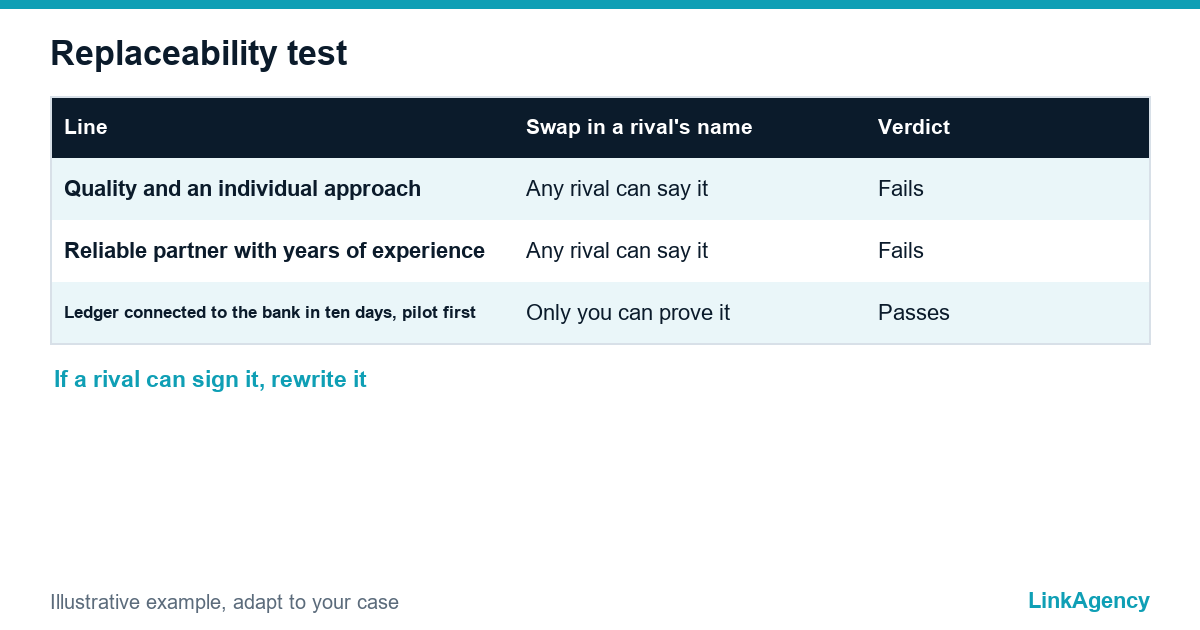
Pick one segment and write the positioning statement for your brand with the formula. An illustrative example: for regional accounting firms that lose weeks to month-end close, Ledgerline is the finance-automation studio that connects the ledger to the bank in ten days, because every project starts with a fixed-scope pilot. Then test it:
- Swap your name for a competitor’s. If the sentence still reads true, it is not positioning.
- Remove every adjective a competitor also uses, such as “quality” or “reliable”.
- Ask three clients to finish the line “We chose you because…”. If their answers differ from yours, rewrite.
- Check that the sentence names a segment you can reach and a reason you can prove.
A statement that fits every brand is not positioning. Good positioning statement examples are specific enough to lose some buyers.
Step four: proof that a buyer can verify
A claim without proof is the same adjective again. Collect three kinds of evidence and keep them next to the statement:
- Numbers from your own work, such as delivery times or renewal rates.
- Named cases and reviews, with permission.
- Process facts: fixed scope, a named senior contact, a guarantee you honour.
The Harvard Business Review framework of elements of value lists saving time, reducing risk and simplifying alongside price, which makes a useful checklist for choosing what to prove. A value proposition for service business buyers usually rests on two of them.
Step five: carry your brand positioning statement into site, sales and ads
A statement that stays in a slide deck changes nothing. Move it into five places in order: the homepage first screen, the sales deck and call script, ad headlines, the proposal template and the email signature. Rewrite the messaging on the first screen first, since most buyers see it first. Our website copywriting services turn the statement into page text, and a brand style guide keeps tone and visuals consistent afterwards. The statement belongs to the brand, and positioning only works when the whole team repeats it. Check the effect after a quarter: win rate, the share of leads that match your segment and the number of price-only objections.
When positioning is not enough
If the statement is clear but the identity contradicts it, such as a discount look for a premium promise, the next job is visual. Then branding services make sense, because the logo and site now have a strategy to follow. The SBA guide to competitive analysis gives a simple template for the groundwork. B2B brand positioning needs one more rule: write for the buying committee, not for one person.
Free review of your first screen and key message
Send us your homepage and one lost proposal. We will tell you in writing whether your first screen and key message separate you from three competitors, and draft a brand positioning statement for you to test. If you decide to order a positioning session, we agree scope and dates first.
- a read of your first screen against three competitors;
- a draft statement and a replaceability test;
- a list of pages and scripts to change first.
Leave a request and we reply within one business day.

Frequently Asked Questions (FAQ)
What is a positioning statement and how long should it be?
It is an internal one- or two-sentence summary of who you serve, what they need, your category, your difference and the proof. It should fit on a card in your sales team’s hands. Taglines and slogans are separate, shorter and may change often.
How is a value proposition for a service business different?
The value proposition is the promise shown to a buyer, such as the headline on your first screen. Brand positioning for small business is the decision behind it: which segment, which rivals and which proof. Write positioning first and derive the promise from it.
Is there a positioning statement template I can reuse?
Use the positioning formula as scaffolding: segment, need, category, difference, proof. Fill it from interviews and lost deals, not from brainstorming. Public positioning statement examples from big brands rarely fit a small business.
How long and how much does a positioning session take?
The working session takes about half a day with the owner and sales lead, plus a few days for interviews beforehand. For B2B brand positioning add a week to interview several members of the buying committee. Price depends on how many segments you test.
How do I know the positioning works?
Watch win rate, the share of leads that match your chosen segment and price-only objections over one quarter. If clients start repeating your wording back to you, the sentence is landing.
How can I order a brand positioning statement from LinkAgency?
Send us your homepage and one lost proposal. Within one business day we reply with a first read of your key message, then agree scope, dates and who attends the session before any work starts.