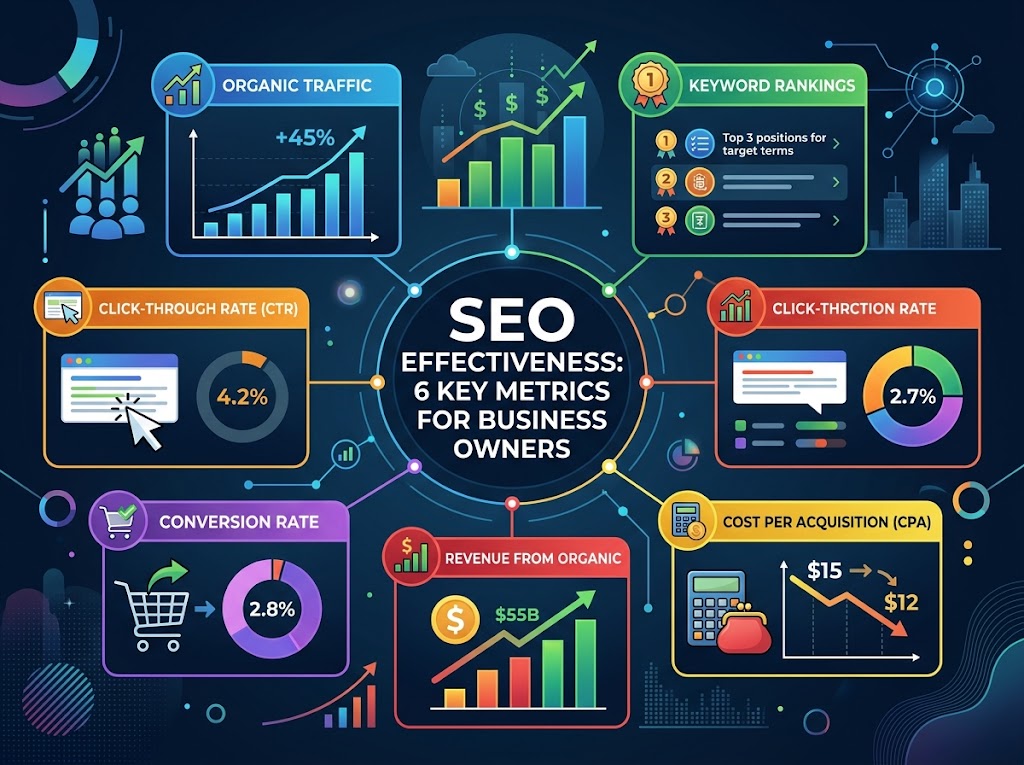
The monthly report arrives, the charts point up, and still nobody can say whether the work pays. Positions improved, traffic grew, yet the sales team sees the same number of leads. Below is how to measure SEO success with six indicators an owner can check without a specialist: what each one answers, where to find it and how to read it.
How to measure SEO success when rankings and traffic do not answer
Rankings show where a page stands for a query and traffic shows how many people arrived, but neither says whether those people became customers, and a page can win both and sell nothing at all. Most SEO reporting stops at positions and traffic, and those SEO metrics are only signals. They are easy to polish: pick queries you already lead for, and the chart rises, while sales stay flat. So measuring SEO success begins with a different question: did organic search bring enquiries and revenue that would not have come otherwise? Our SEO services are reported against that question. Six indicators ask it. Here they are.

Indicators 1 and 2: enquiries and sales from organic search
The first is the number of qualified enquiries that arrive from organic search each month. Qualified means a real prospect, not spam, and the second is how many of them became sales and what those sales were worth. Both come from your CRM, not from the traffic tool, so tag every enquiry with its first source. Without that tag, even the cleanest SEO reporting is decoration.
| Indicator | Question it answers | Where to find it |
|---|---|---|
| Organic enquiries | Does search bring prospects? | CRM |
| Organic sales | Do they pay? | CRM |
| Non-brand traffic | Do strangers find us? | Search Console |
| Key query visibility | Do buying queries show us? | Search Console |
| Landing pages | Which pages convert? | Analytics |
| Cost per enquiry | Is it cheaper than ads? | Finance, CRM |
Indicators 3 and 4: non-brand traffic and key queries
Visits from people who typed your company name prove only that they already knew you. Growth shows in non-brand queries, where a stranger describes a problem and finds you. Split branded from non-branded queries in the Search Console performance report and watch impressions and clicks for the second group. The fourth indicator is visibility on ten to twenty buying queries, not the average position of everything; a local business adds local SEO with a map listing. Vanity SEO KPIs do not belong here. Skip them.
Why SEO metrics start with impressions
New pages gain impressions weeks before clicks, so rising impressions are the earliest honest sign that the work takes hold.
What to ignore
One day of movement.
Indicators 5 and 6: landing pages and cost per enquiry
The fifth is which landing pages bring enquiries and how many visitors one takes. A page with strong traffic and a weak conversion rate is a page problem, and our article on why a good-looking site gets zero leads explains the repair. The sixth is cost per enquiry from search: spend on SEO in the period divided by the organic enquiries it produced. Set it beside the cost from paid ads, and the choice of channel stops being opinion. That is how to measure SEO success per channel. We measure each client’s SEO by one rule: success is a sale.
Analytics setup: events, source and one dashboard
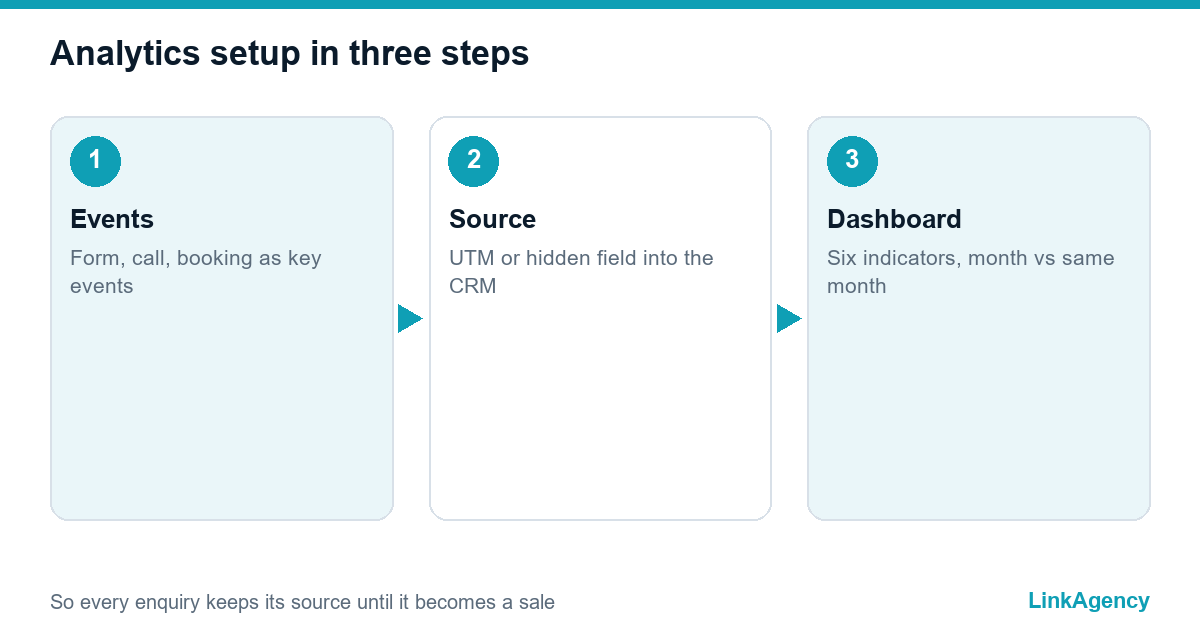
None of this works without tracking, and this is how to measure SEO success in practice. Mark a form submission, a call click and a booking as key events, following the Google Analytics guide to key events. Pass the source into the CRM with UTM tags or a hidden field, so that every lead can be followed from the first click to the signed contract without guessing. Then check each quarter that forms still deliver, because a redesign often breaks them quietly.
- Agree what a qualified enquiry is.
- Mark the events that represent it.
- Send the source to the CRM.
- Build one dashboard with the SEO success metrics.
Reading SEO KPIs: seasonality and delayed effect
Compare a month with the same month last year, because demand follows the season. Expect a delay too, because new content from a content marketing plan needs weeks or months before it earns steady traffic, and a flat first quarter is not a failure if impressions and non-brand queries rise. A falling line after a Google update is another case, covered in our guide to organic traffic drops after an update. Judge direction over six months, never over a single week. Owners who measure their SEO this way see success earlier than any rank chart shows.
Questions for the contractor and signs of a report made for show
Ask three questions, since you cannot measure the success of your SEO from a chart alone. Which enquiries and sales did search bring last month, and how were they tracked? Which non-brand queries bring visitors? What did you change, and what happened next? A report made for show is full of positions, has no CRM data and never names a failed page. A guaranteed top place is another warning sign. Measuring SEO success honestly means admitting that nobody controls the results page. If you cannot tell whether your SEO is working, an independent SEO audit will check the tracking and the report. The same questions apply when you hire an SEO consultant.

How to measure SEO success: a free review of your reporting
We will look at your report and tracking and show which of the six indicators you can see. Ask about our SEO services too.
- A short list of gaps in analytics and CRM.
The consultation is free. We reply in one working day.

Frequently Asked Questions (FAQ)
How long before SEO results become measurable?
Impressions and non-brand queries usually move first, within weeks. Enquiries and sales follow later, often after three to six months, depending on competition and how new the site is.
What is the most important SEO metric for a small business?
Qualified enquiries from organic search, followed by the share that becomes sales. Rankings and traffic are useful only as early signs of that outcome.
Do I need Google Search Console and Analytics?
Yes, both are free and cover different questions. Search Console shows how you appear in search, while Analytics and your CRM show what visitors did afterwards.
How often should I review SEO reports?
Look at the dashboard monthly and compare with the same month a year earlier. Weekly checks are useful only for technical problems such as a broken form or a page blocked from indexing.
Can a contractor guarantee a top position?
No honest contractor can, because search results depend on factors nobody controls. Treat a guarantee as a warning sign and ask for a plan with indicators instead.
How do I order an SEO review from LinkAgency?
Send us a request through the form on this page, and we will review your report, tracking and CRM setup. You get a short list of gaps within one working day.