On 24 October 2026, Apollo’s chief economist Torsten Slok wrote that outside the big technology companies AI has not yet delivered a visible financial payoff: revenue per employee and margins across the rest of the S&P 500 are not rising. Model prices keep falling, and one developer’s analysis says two major providers cut theirs by up to 80% within a few months. Cheaper AI is not the same as profitable AI, and an owner who pays for subscriptions, tokens and integrations every month needs an answer to “what did we get”. This guide shows how to measure AI ROI before you invest: full cost, three kinds of effect, a two-week baseline, a one-page business case, stop rules and a monthly report.
How to measure AI ROI: why cheap AI is not the same as profitable AI
Measuring AI ROI honestly means counting every cost line, not only the subscription. Falling token prices shrink one line of the bill. Integration, data preparation, training and the time people spend reviewing AI output stay where they were. The Apollo note frames the gap at the level of the whole economy, and the same gap shows up inside a single company.
Disappointing projects share the same patterns: nobody recorded a baseline, only the subscription was counted, saved hours never turned into money, and the pilot never ended. With prices falling, the token bill is rarely the hard part. If your data and processes are not ready, start with the AI readiness checklist before you spend anything.

Full cost of AI: subscriptions, tokens, integration, support and people’s time
Any AI ROI calculator is only as good as its inputs. Measuring AI ROI starts with total cost of ownership (TCO) for a full year, not with the price list. A pilot with ten users costs little, and the same tool rolled out to the whole company can cost many times more.
| Cost line | What it includes | Often forgotten |
|---|---|---|
| Subscriptions and tokens | Seats, API calls, model fees | Usage growth after rollout |
| Integration | CRM, mailbox, databases, workflows | Change requests after launch |
| Data | Cleaning, access, storage | Staff time to fix documents |
| People | Training, review of AI output, supervision | Internal hours at a full hourly rate |
| Support | Quality checks, updates, incidents | Who owns it after the pilot |
Cost per outcome
The cost-management team at AWS suggests dividing AI cost by a business metric to get a cost per outcome, for example the cost of one resolved request. It is a unit figure you can track every month, and it is the building block of ROI.
Which effects to count: hours, money, errors, response speed
- Time: hours of routine work the AI takes over.
- Money: extra margin or recovered leads, not extra revenue.
- Quality: fewer errors, rework and refunds, priced at their real cost.
- Speed: faster answers to customers, linked to conversion from your own history.
To measure the ROI of AI, start with a simple rule. Saved hours are not savings until they remove overtime, a hire or a contractor, or move to paid work. Count each effect once, and keep soft benefits in a separate line. Pick AI pilot success metrics from this list before the pilot starts. A process that is already automated with AI workflow automation is easier to price because each step leaves a record.
Baseline before launch: what to measure in the two weeks before the pilot
Before you learn how to calculate AI ROI, collect the numbers it needs. Nothing else counts.
- Pick one process with a clear owner and a link to money.
- Time ten to fifteen people on that task for one to two weeks, instead of trusting a manager’s estimate.
- Record monthly volume, error rate and average response time.
- Price one working hour at a full rate, including taxes and equipment.
- Write down who will use the tool, so adoption can be tracked.
To measure the payoff before launch, treat AI as one more investment whose ROI must be proven. Keep these numbers unchanged, since the pilot will be compared with them. Someone has to measure the result of each AI task, and the ROI should be read by the same person every month.
One-page AI business case: template for the owner and the finance director
The business case fits on one page. Use it as a simple AI ROI calculator in a spreadsheet and show three scenarios: conservative (confirmed effects only), base and optimistic.
| Field | Question it answers |
|---|---|
| Process and owner | What changes, and who is accountable |
| Baseline today | Hours, volume, errors, response time |
| Full yearly cost | Every line from the TCO table |
| Value in money | Time, money and quality effects |
| Result | ROI = (value minus cost) divided by cost, plus payback |
| Stop rule | What result ends the pilot, and on which date |
Here is how to measure AI ROI on one page: fill the baseline first, estimate cost honestly, then take only the effects you could defend to a finance director. A business case for AI is a decision tool. The AI ROI framework matters less than the discipline of writing the assumptions down.
When to stop a pilot and when to scale
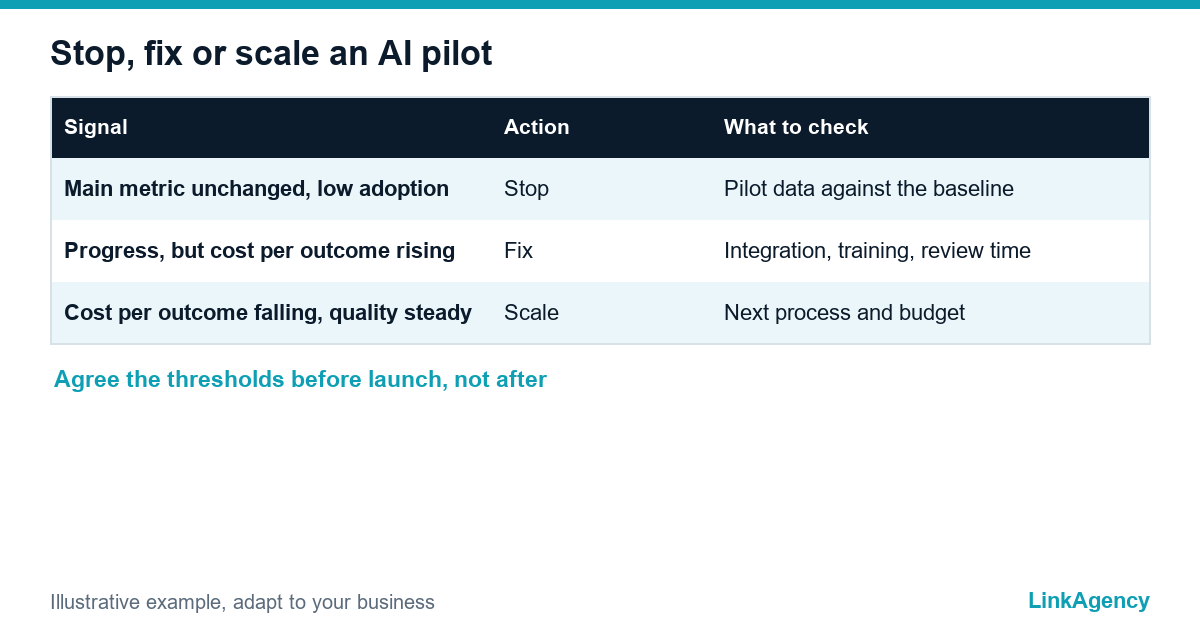
AI ROI measurement works best when thresholds are set before launch, with the review date. Compare AI pilot success metrics with the baseline after the agreed period, not in the first weeks.
- Stop if the main metric has not moved and adoption stays low.
- Fix if progress is visible but cost per outcome is rising.
- Scale if cost per outcome falls and quality holds.
A short business case for AI also tells you which pilot to drop first. If you want an outside view, AI consulting services can run the review and write the stop rule with you.
Monthly AI report: five numbers an owner should see
- Total AI spend for the month, by process.
- Cost per outcome against the previous month.
- Adoption: who actually uses the tool.
- Change in the main metric against the baseline.
- Decision: keep, fix or stop.
Whichever AI ROI framework you choose, report it monthly. One page every month beats a long report once a year, and measuring AI ROI becomes routine instead of an argument.
Free review of your AI spend: how to measure AI ROI in your case
Send us your AI subscriptions, API bills and one process you plan to automate. We will show how to measure AI ROI for it and prepare a one-page business case with a baseline and success criteria. If you prefer a written result, order an AI cost review as a separate project; our AI consulting services can also keep the monthly report going.
- a map of your AI spend by process;
- a draft business case with a stop rule.
Leave a request and we reply within one business day.

Frequently Asked Questions (FAQ)
Is AI worth it for a small business?
It can be, where a process is repeated often, costs real money today and can be measured. A small pilot with a baseline and a stop rule shows the answer faster than any forecast.
What counts as a good AI ROI?
There is no universal figure. Compare the payback with the period you would accept for any other investment, and test it in a conservative scenario first.
Which AI costs do companies forget?
Integration, data cleaning, training, the time people spend reviewing output and ongoing support. Together they often outweigh the subscription or token bill.
Can saved hours count as savings?
Only when the hours remove overtime, a hire or a contractor, or move to work that earns money. Otherwise show them as freed capacity in a separate line.
How long should a pilot run before judging it?
Agree the period before launch. Early weeks carry setup cost and low adoption, so judge the pilot on the date you set, using the baseline you recorded.
Can LinkAgency help build our AI business case?
Yes. We review your AI spend and one process candidate, then prepare a one-page business case with baseline, scenarios and stop rule before you commit to development.