The project is delivered and paid for, and then it turns out that the domain, the hosting and the code are registered to the contractor. Changing the team is impossible without rebuilding the site, and the owner learns this at the worst moment. Who owns website code is a question to settle in the contract, not after a dispute. This guide is not about legal subtleties. It covers four things an owner can check personally: rights, accounts, files and exit terms. It also gives a checklist for the contract. Your lawyer must confirm the final wording for your country.
Who owns website code: why owners learn the answer only when they switch
While the relationship is good, nobody asks for logins or source files. The question appears when the contractor raises prices, stops answering or disappears. At that point the owner discovers that the site runs on the developer’s hosting account, with the developer’s domain registration and a repository the company cannot open. Today’s short check costs far less than a rebuild later, and it answers who owns your website code before a dispute does. The same problem is covered from the exit side in our guide to a safe handover when you switch web developers.
Rights to the code: what happens if the contract says nothing
In many countries the author of a work owns the rights to it by default, and a client who paid for the work does not automatically receive them. The U.S. Copyright Office explains this logic in its circular on works made for hire, where the result depends on the type of relationship and on the written agreement. Rules differ between countries, so treat this as a reason to write the answer into the contract. The developer writes the code for your website, and the contract decides who owns it. A clear IP assignment in a web development contract, or at least a clear licence, closes the gap. Website code ownership then stops being a guess.
Who should own the domain, hosting, analytics and repository
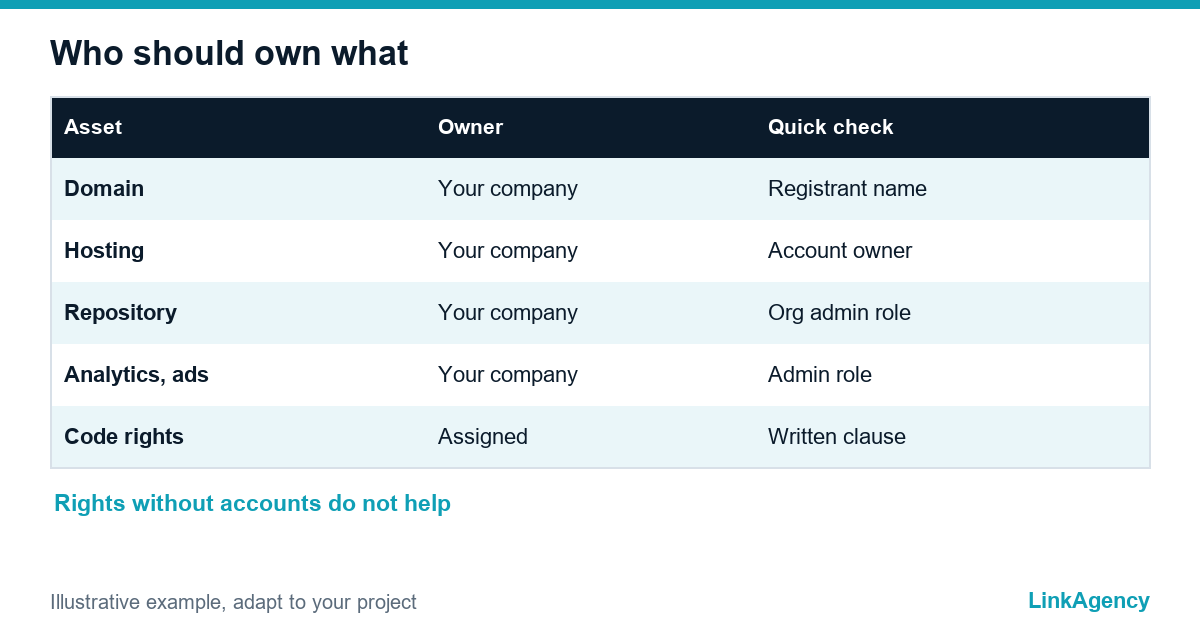
Rights to the code are only one layer. The accounts around the site matter just as much, and they should be registered to your company from the first day. The contractor can have admin access, but the owner of the account should be you. That is the practical answer to who owns your website code, because rights without accounts do not help.
| Asset | Should be registered to | How to check it |
|---|---|---|
| Domain name | Your company | Look up the registrant in the registrar account |
| Hosting and server | Your company | Check the billing and the account owner |
| Code repository | Your company account | Confirm you are the repository owner or organisation admin |
| Analytics and ad accounts | Your company | Confirm you hold the admin role |
| Email and DNS | Your company | Confirm who can change the records |
ICANN describes the rights and responsibilities of a domain registrant, and the registrant is the person listed as the holder of the name. If that person is the developer, the domain is formally theirs.
Third-party themes, plugins and libraries: whose licences you receive
Few sites are written entirely from scratch. They use themes, plugins and open-source libraries, each under its own licence. Ask the contractor for a list of every third-party component with its licence and who pays for renewals. One paid plugin licensed to the agency may stop updating when the agency leaves. Any site that depends on such a licence is only half yours, and source code ownership on paper does not fix it.
The handover package: source code, database and run instructions
Proper handover is more than a zip file. It is a package that lets another team start the project without calling the first one. Treat it as a website handover checklist, with access to the code repository from the developer as the first line.
- The full source code, including the build files.
- A copy of the database and the uploaded media files.
- A short instruction for running and deploying the site.
- A list of environments, access details and who holds them.
- The list of third-party components with licences.
Ask for a test run. Another person should be able to launch the project from the package, and that proves who owns the code in practice. If you plan to bring in extra engineers, our staff augmentation services can take over from a clean handover.
Exit terms: how fast files and access are returned
An exit clause describes what happens when the cooperation ends. Agree a date by which the contractor returns files and access, who covers the cost of the transfer and what the contractor must delete afterwards. Without these terms, every ownership question turns into a negotiation with a party that no longer needs you. Keep the clause short and measurable. It should also say again who owns the code after the exit.
A 30-minute self-check: what is already registered to your company
You can test your own position today. Take thirty minutes and answer each step with proof, not with trust.
Six steps, one proof each
- Find the domain registrar login and read the registrant name.
- Open the hosting account and see who is the owner.
- Ask for read access to the repository and check where it lives.
- Check that you hold admin roles in analytics and advertising.
- Ask the contractor for the last backup and the component list.
- Write down every item that is registered to someone else.
Your last line is your list of questions. Short, clear, factual. Fix it while the relationship is friendly. If the developer owns my website on paper, now is the time to learn it.

What to put in the contract and the brief: a copy-ready list
Ask your lawyer to confirm the exact wording. This list is a starting point for website code ownership and delivery, and a clear answer to who owns website code.
- Assignment of rights to the code and design to the company on payment, or a clear licence.
- Domain, hosting and repository registered to the company from the start.
- A list of third-party components with their licences.
- A handover package and a test run before the final payment.
- Exit terms with dates for returning files and access.
For work with an outside team, our rules for outsourced software development describe how a non-technical owner keeps control, and our custom software development services start from a contract where ownership is clear.
Who owns website code: free consultation on your current site
Together we review the ownership and access scheme of your site or app and prepare a list of questions for the contractor. No obligations.
- review of domain, hosting, repository and accounts;
- list of questions for the contractor and contract points.
Leave a request and we will reply within one working day with a free consultation plan.

Frequently Asked Questions (FAQ)
Who owns website code if the contract says nothing?
In many countries the author owns the rights by default, and a client who paid does not automatically receive them. Rules differ, so write the answer into the contract and have your lawyer confirm the wording. Source code ownership and website code ownership should never be left to assumption.
Does paying for a site mean I own it?
Not necessarily. Payment buys the work and not always the rights, but rights, accounts and files depend on what the contract and the registrations say. Check both, since who owns your website code can differ from who paid for it.
Who should hold the domain and the hosting account?
Your company. Whoever owns the code should own the accounts too. The contractor can have admin access, but the registrant of the domain and the owner of the hosting account should be you, from the first day.
What is a handover package?
It is the source code, a copy of the database and media, run and deploy instructions, a list of environments and access, and a list of third-party components. A website handover checklist like this, with access to the code repository from the developer, lets another team start without the first one.
How can I check what I already own today?
Take 30 minutes: read the domain registrant, open the hosting account, ask for read access to the repository and confirm your admin roles. Write down every item registered to someone else and ask in writing who owns the code.
What if the developer owns my website and refuses to hand it over?
Start with the contract and the registrations, and ask a lawyer in your country before any action. If the developer owns my website in the paperwork, the fix is a written agreement, not a rebuild in a hurry. Website code ownership is the first thing to confirm.
How can LinkAgency help?
Leave a request with the address of your site or app. We run a free consultation on who owns your website code, review the ownership and access scheme, and prepare a list of questions for the contractor.