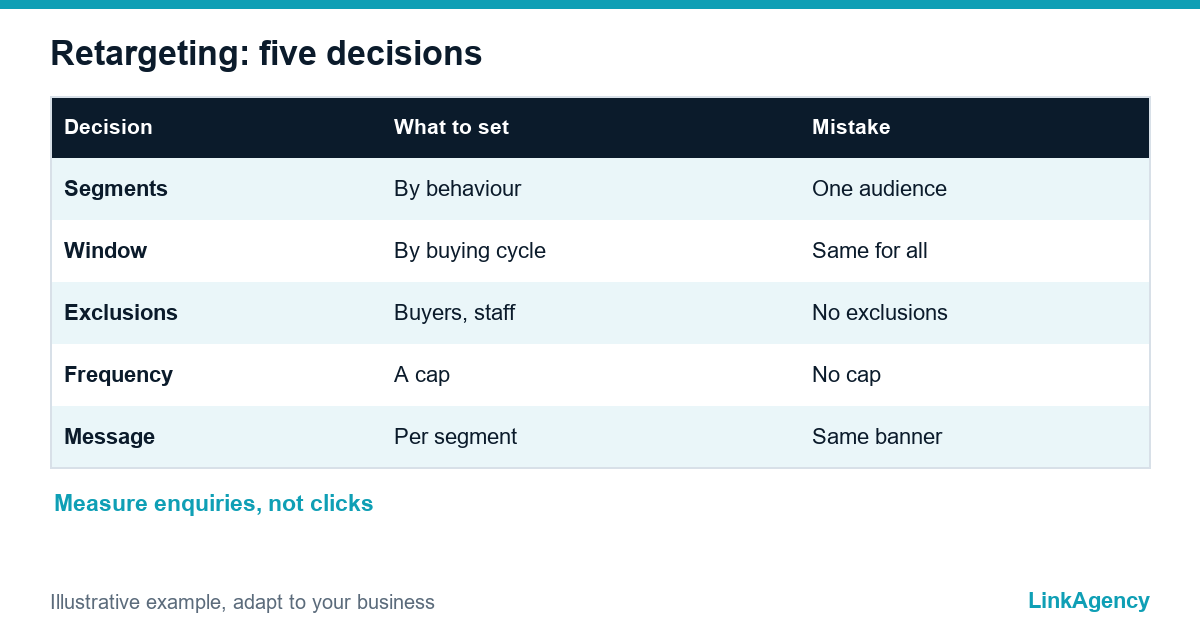
Most visitors leave a website without leaving a request, and the money for bringing them there is already spent. Ads meant to win them back are either not set up at all or set up so that they annoy people and spend the budget on those who have already bought. This guide treats retargeting for small business as a system of five decisions, not a tick box in an ad account: segments, window, exclusions, frequency and message. It also covers cookie consent in the EU and the UK and how to judge the result by enquiries, not clicks.
Retargeting for small business: why most visitors leave and why bring them back
A visitor who read a service page and closed the tab is not a lost cause, and small business retargeting exists for exactly this person. They showed interest, and a reminder at the right moment costs less than finding a new person. Small teams run retargeting like a checkbox, and the business pays for clicks nobody needed. The purpose of good retargeting for a small business is simple: remind the right people, with the right message, for a limited time, and stop when the job is done.
Retargeting and remarketing: the difference and where each is set up
In practice the words are used as synonyms. Retargeting usually means showing ads to people who visited your site through a pixel or cookie, while remarketing is often the name Google uses for the same idea. Google’s own help says that remarketing now sits under “your data” segments, and lists website visitors, dynamic remarketing, search ads for past visitors and customer lists. The article on remarketing in Google Ads describes these types. For Google it is the audience segments in the account, and for Meta it is custom audiences, so remarketing Google Ads and Facebook retargeting ads are configured in different places, though the logic of the five decisions is the same.
| Question | Retargeting | Remarketing |
|---|---|---|
| Meaning in practice | Ads to past visitors | Same idea, often Google’s term |
| Where it is set up | Platform audiences and pixel | Google Ads audience segments |
| What it needs | Tracking and consent | Tracking and consent |
Segments by behaviour: service, form, cart
One audience of “all visitors” wastes money. Split people by what they did.
- Viewed a service or product page and left.
- Started a form or a booking and did not finish.
- Added to cart and did not pay.
- Already sent a request or bought, a group you must exclude or treat differently.
Each segment needs its own message, and that is where retargeting ads for small business win or lose. Someone who abandoned a form needs reassurance, while someone who only read a blog post needs a reason to come back to a service page.
Window, exclusions and frequency cap
These three settings decide whether retargeting helps or annoys. The window is how long a person stays in the audience, and it should match the buying cycle: short for impulse purchases, longer for a service chosen over weeks. Exclusions remove people who already converted, so you stop paying to remind customers about something they have bought. The frequency cap limits how often one person sees the ad. Without it, a visitor meets the same banner everywhere for weeks, which is how retargeting campaigns for small businesses turn into an irritation.
What to exclude first
Start with people who sent a request or bought, then add your own staff and the visitors who left within seconds. Google notes in its help that exclusions work with your data segments, so build these lists before you launch.
What to say to someone who already knows you
The message should continue the conversation, not restart it. Do not repeat the generic pitch. Answer the doubt that stopped the person: price range, timing, proof or a clear next step. A reminder with a useful detail, for example a short checklist or a free review offer, works better than the same banner again. Keep the offer honest and the page behind the ad consistent with it, and send people to the landing page that matches their behaviour, as explained in our guide on where to send paid traffic.
Cookie consent and GDPR: keeping the audience without breaking the rules
In the EU and the UK, retargeting depends on consent for cookies and similar technologies. The UK regulator explains the rules in its guidance on cookies and similar technologies, and the EU rules sit in the ePrivacy Directive. In practice, remarketing audiences under GDPR include only people who agreed to tracking, so the size of your audience depends on how clear and fair your banner is. Check that the banner works on mobile, that refusing is as easy as accepting, and that tags fire only after consent. Confirm the details for your case with a lawyer.
How to measure: enquiries, not clicks, and when retargeting only takes credit
Retargeting reaches people who were already close, so it often gets credit for sales that would have happened anyway. Judge it by qualified enquiries and by what happens when you pause it for a test group, not by clicks or cheap views. Compare enquiries from the audience with a similar group that sees no ads. Same numbers mean retargeting only takes credit. Different numbers show its real value.
A minimum launch plan for two to three weeks
This is the shortest safe version of retargeting for small business, and it needs no big budget.
- Week one: check tracking and consent, build two or three segments and the exclusion lists.
- Week two: launch with a modest budget, one clear message per segment and a frequency cap.
- Week three: compare enquiries with the control group and adjust the window and message.
If you need help, our Google Ads management sets up audiences and consent checks, and our performance marketing team connects them with enquiries.

Retargeting for small business: free audit of your audiences and ad accounts
We will check how audiences are collected, whether cookie consent is set up and where the ad budget goes. No obligations.
- review of audiences, exclusions and frequency;
- consent check and a plan for measuring enquiries.
Leave a request and we will reply within one working day with a free audit plan.

Frequently Asked Questions (FAQ)
What is retargeting and how does retargeting work?
It shows ads to people who already visited your site, using a pixel or cookie, and retargeting campaigns for small businesses use the same mechanics. Small business retargeting works best when you split visitors by behaviour and stop the ads when they convert.
What is the difference between retargeting and remarketing?
In practice they mean the same thing. Retargeting vs remarketing is mostly a matter of platform wording, and remarketing Google Ads and Facebook retargeting ads are set up in different accounts.
How long should people stay in a retargeting audience?
For retargeting for small business, match the window to the buying cycle: short for impulse purchases, longer for a service chosen over weeks. Retargeting ads for small business should stop when the cycle ends.
Do I need cookie consent for retargeting?
In the EU and the UK, yes. Remarketing audiences under GDPR include only people who agreed, so a clear banner matters. Confirm the details for your case with a lawyer.
How do I measure retargeting?
By qualified enquiries and by a comparison with a group that sees no ads, not by clicks. If the numbers match, retargeting for a small business only takes credit for sales that would have happened anyway.
How do I avoid annoying visitors?
Set a frequency cap for small business retargeting, exclude people who already converted, and change the message by segment. Retargeting campaigns for small businesses fail mainly through repetition.
How can LinkAgency help with retargeting?
Leave a request with access to your ad accounts or screenshots, and ask for a proper small business retargeting setup. We run a free audit of audiences, consent and budget, and say what to change first.