Ideas are plentiful, budget and time are not. Most founders fear two opposite mistakes: shipping too little to learn anything, or spending months on features nobody asked for. This guide to MVP development for startups gives one test for every feature and shows how to scope your first version so the budget goes into learning, not decoration.
MVP development for startups: what an MVP is and what it is not
An MVP is the smallest version that answers one business question with real users. It is not a cheap, buggy copy of the final product, and it is not a demo. Early on, MVP development for early startups is limited mostly by budget, so scope is the cheapest lever you have. Atlassian describes the minimum viable product as a way to test a product idea with the least effort, and the useful word there is test. A version that cannot test anything is not an MVP, whatever it costs. Startups often find during development that the MVP they planned is three times bigger than the one they can afford.

Which hypothesis does your first version test?
Write the hypothesis first. One sentence, before any feature list: who has the problem, what they will do with your product, and what number proves it. For example: “Small clinics will book through our app instead of the phone, and at least a third of them will return in a month.” Every feature either helps test that sentence or waits. Startups that skip this step pay during development for features the MVP never needed. A founder planning MVP development for a startup should treat this sentence as the contract with the team.
MVP development for startups: must-have, nice-to-have and later
Startup MVP development works best when you take the long feature list and sort it with one question: does the first user need this to complete the main task? If the answer is no, the feature moves out. Doing this together with the team that will build it also keeps the estimate honest, and mobile app development services can run the workshop in a day, and before you sign with any team, vet it with 12 questions on how to choose a software development company.
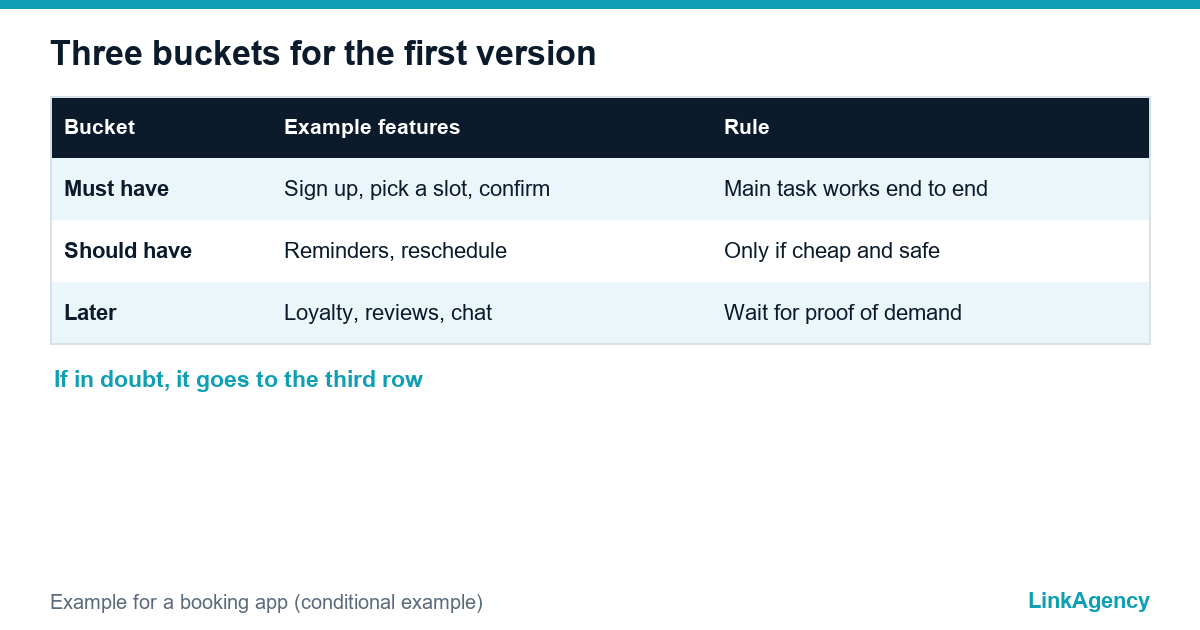
Three buckets: must-have, nice-to-have, later
- must have: without it the main task cannot be completed;
- should have: it helps, but users can live without it for now;
- later: everything else, parked in a backlog so the idea is not lost.
Keep the MVP features to the first bucket and test the rest with user feedback after launch. Mark MVP requirements that depend on other systems, such as payment or maps, because they often hide the largest delays. Keep it small.
Prioritisation methods: MoSCoW, RICE and story mapping
If sorting by one question is not enough, use a named method. MoSCoW splits features into must, should, could and won’t have. RICE scores each idea by reach, impact, confidence and effort, so a cheap idea with wide reach beats an expensive niche one. User story mapping lays the user’s journey out as a row of steps and lets you cut a thin slice across it, which is the closest picture of a first version. Pick one method, apply it with the whole team and write the result into the brief.
What you cannot postpone: security, GDPR and analytics
Some items are not features and cannot wait. Basic security comes first: choose a standard such as the OWASP Application Security Verification Standard and agree which level the first version must meet. When you handle personal data of people in the EU, Article 25 of the GDPR asks for data protection by design, so consent and deletion belong in version one. Add basic analytics too. Otherwise you will launch and learn nothing about MVP features that matter.
Prototype, MVP or full version: which fits your situation
Each stage answers a different question, so pick by what you do not know yet. In MVP development for startups, that is usually demand. The comparison below shows MVP vs prototype and MVP vs full product.
| Stage | Question it answers | Typical output |
|---|---|---|
| Prototype | Do people understand the idea? | Clickable screens, no real data |
| MVP | Will people use and pay for it? | Working core flow with real users |
| Full version | Can it grow and run reliably? | Complete features, support, scale |
When you are still unsure whether the product should be web, mobile or both, read which format to build first before you scope.
Ways to run an MVP without building everything
Not every MVP needs full code. A landing page with a sign-up form tests interest in days. In a concierge MVP you deliver the service by hand to a few customers, so you learn what they value before you automate anything, and once the same client requests keep repeating, customer portal development is a natural next step. The “Wizard of Oz” version looks automated to the user while people work behind the scenes. Single-feature products build only the function that solves the main problem. Choose the lightest way that still answers your hypothesis.
What to put in the brief for the development team
A short brief saves weeks in MVP development for startup teams. Treat the list below as an MVP checklist before sign-off:
- the hypothesis and the number that proves it;
- the one main user scenario, step by step;
- the must-have list and the “later” list;
- security, privacy and analytics requirements;
- budget, deadline and who decides on changes.
Modern AI tools shorten some build stages, as we describe in AI MVP development with Claude Code, but they do not replace the scoping decisions above.
Common scoping mistakes and what they cost
- Starting with a feature list instead of a hypothesis, so nothing can be proved wrong.
- Copying a competitor’s full product, which multiplies the cost and hides what is really needed.
- Leaving payments, maps or CRM links for the end, when they are often the slowest part.
- Skipping security, consent and analytics, which costs more to add after launch, as does mobile app maintenance.
- Changing the scope every week without one named owner who decides.
How to judge the first weeks and decide what next
Fix the success number before launch. Review it weekly, and compare MVP vs prototype results only after real users have tried the flow. Follow these steps:
- Release to a small group of real users.
- Watch what they repeat, not what they praise.
- Compare the numbers with the hypothesis.
- Decide: continue, change direction or stop.
Order MVP development services from LinkAgency
Let us help you scope MVP development for startups and product teams: one workshop turns your idea list into a minimal feature set, a plan and an estimate.
- hypothesis and must-have scope in one session;
- security, privacy and analytics requirements;
- a launch plan with effort for each step.
Send a request and we reply within one working day. If you need extra hands, you can hire MVP developers for your team.

Frequently Asked Questions (FAQ)
What should an MVP include?
Only the MVP features that let a first user finish the main task, plus basic security, consent handling and analytics. Everything else goes on a written “later” list.
How is MVP vs prototype different?
A prototype shows how the product might look and behave. An MVP is a working version that real users can use, so you can test demand with real behaviour.
How long does MVP development take?
It depends on the scope, the platform and the integrations. A tight scope with one main scenario is faster, and the brief and the workshop usually take days, not weeks.
How do I choose between web and mobile for the first version?
Pick the format where your first users already are and where the core task works best. If unsure, test the idea on the web first and add a mobile app once you see demand.
Do I need GDPR compliance in the first version?
If you process personal data of people in the EU, yes. Consent, privacy information and a way to delete data are far cheaper to build early than to add later.
Can LinkAgency scope and build my MVP?
Yes. We start with a scoping workshop, agree a minimal feature set and estimate, then build the first version through our MVP development services. Send a request and we reply within one working day.