The website is built by one person, the social media posts by another, the slides and banners by a third, and the company looks like three different firms. Customers do not recognise you. Every new contractor invents the style again, and nobody notices until the third version of the logo appears on a banner. Brand guidelines fix this, but small business branding does not need a glossy PDF of eighty pages. This article shows a compact brand style guide of eight sections that people actually open.
Brand style guide for a small business: why it pays off and when
It is a working document that answers one question: how do we look and sound? Style comes first, and a guide that no one opens does not protect the brand. It pays off the moment a second person starts producing materials. It saves hours of back-and-forth with designers, keeps freelancers on the same page and protects your logo from careless use. Adobe describes a brand style guide as the place that holds the mission, the voice and the visual identity together, and that is the right scope for a small firm. A brand without a written style looks different each month, so one guide per company is enough. Unsure whether you need a mini version? Use the checklist at the end.
Brand guidelines for small business: positioning and voice in words
Begin with words, because every visual choice follows from them. Write who you serve, what you promise and what makes you different, in three or four sentences, which is exactly what a brand positioning statement captures. Then write brand voice guidelines, the base for your content marketing plan, as pairs of traits with a short example of each: friendly but not casual, precise but not cold. Add words you always use and words you avoid. This page is what small teams need most, since it settles tone for emails, ads and the website at once.
Logo, colours and fonts: rules and accessibility
Show the logo in its main and compact versions. Add logo usage guidelines: minimum size, clear space and approved backgrounds. Choose one colour palette and one typography set for the whole brand. List the colours with exact codes for screen and for print, and name one primary and one accent colour. For text, choose two fonts at most and say where each is used. Accessibility belongs in the same section: normal text needs a contrast ratio of at least 4.5 to 1 against its background under WCAG contrast guidance, so check every text and background pair before you fix it in the guide. A free tool such as the WebAIM contrast checker does it in seconds.
The eight sections of a mini guide
| Section | What it holds | Length |
|---|---|---|
| 1. Positioning | Who you serve, your promise | Half a page |
| 2. Voice | Traits, words to use and avoid | One page |
| 3. Logo | Versions, size, clear space | One page |
| 4. Colours | Codes, pairs that pass contrast | One page |
| 5. Fonts | Two fonts, sizes, usage | Half a page |
| 6. Photos | Style, subjects, what to avoid | One page |
| 7. Do and don’t | Right and wrong examples | One page |
| 8. Templates | Website, social, slides | Links to files |
Photos, illustrations and icons
Describe the look you want in plain terms: real people or studio shots, warm or cool light, flat icons or line icons. Add three good examples and three to avoid. Keep it simple. State who owns the licence for each stock image and where the originals are stored. Name the photography style and the stock images you may use. Include rules for alt text, because images without it fail screen-reader users and weaken the page in search.
Brand guidelines examples: “right” and “wrong”
This page does more for consistency than any other. Show the logo on a busy photo, stretched, recoloured or squeezed, and mark it as wrong. Show a headline in the wrong font and a button in an off-brand colour. People copy examples faster than they read rules. Keep the words short. Keep the pictures large, because brand style guides that look like legal text stay closed. A brand book that shows usage rules next to the assets is easier to follow.
Templates for the website, social media and presentations
A rule that nobody can apply in two minutes will be skipped, so turn the rules into files: a slide deck, a social post frame, an email signature, a banner set. When a site is rebuilt, the guide becomes the brief for designers, which is why website redesign services start by reading it. If the brand itself must change first, read when to rebrand or refresh.
How to roll the guide out and check that people follow it
Plan the rollout in one place that everyone can open, and name an owner who answers questions. Then follow these steps:
- Send the guide and the template folder to every person and contractor.
- Review the website, social profiles and last presentations against it.
- List the differences and fix the biggest three first.
- Check again each quarter and update the guide when the business changes.
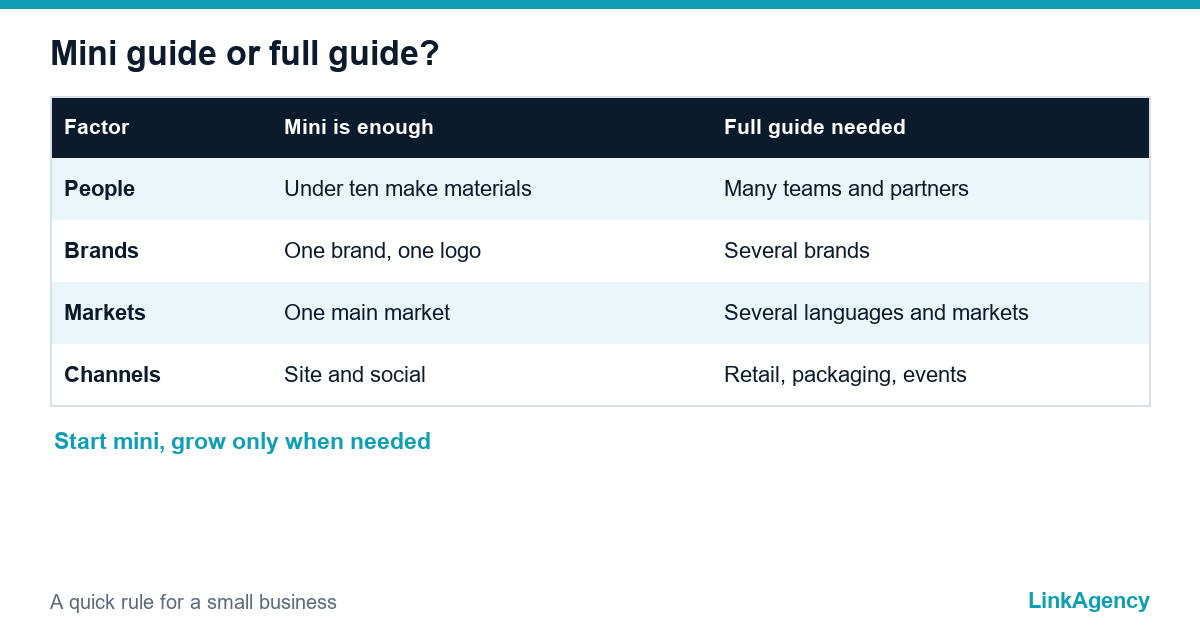
Is a mini version enough for you? Answer yes if you have fewer than ten people making materials, one main market and one logo. Answer no if you run several brands or sell through partners who reuse your assets. The same rules apply on your site: our web development services team builds pages from the guide so the design stays consistent.
Get a free audit of your brand style guide and brand consistency
We review your website and social profiles for visual and text consistency and tell you what to fix first. If you do not have a guide yet, our branding services team can build a compact one.
- a review of logo, colours, fonts and tone across channels;
- contrast and accessibility checks;
- a priority list for the first month.
Send a request and we reply within one working day.

Frequently Asked Questions (FAQ)
How long should a brand style guide be for a small business?
Ten to fifteen pages are enough for most small firms. Keep each section to a page or less and put long files, such as logo packs and templates, in a linked folder.
Do small businesses really need brand guidelines?
You need them as soon as more than one person produces materials. Before that, a one-page version with colours, fonts and tone is already useful.
Who should create the guide?
A designer or branding agency can build it, but the owner or marketing lead must supply the positioning and approve the rules. A guide written without the business owner rarely gets used.
How often should I update brand guidelines?
Review them once a year or when the business changes, for example a new product line or a new market. Update the templates at the same time.
What colour contrast should I follow?
For normal text, aim for a contrast ratio of at least 4.5 to 1, and 3 to 1 for large text, following WCAG. Check each text and background pair before adding it to the guide.
Can LinkAgency build a brand guide for my company?
Yes. We audit your current materials, build a compact guide with templates and apply it to your website. Send a request and we reply within one working day.