On 22 October 2026 Google announced three changes to customer lifecycle goals: high value mode in Shopping, retention modes in Performance Max, Search and Shopping, and percentage multipliers for customer value. For an online store the point is simple. Google Ads new customer acquisition settings decide whether your budget buys new buyers or re-sells to people who would have come back anyway. This guide covers what to prepare before touching any button: customer lists, consent, the right goal for your growth stage and a check in your own CRM.
Google Ads new customer acquisition: what changed in October 2026
Google’s announcement, summarised by Search Engine Roundtable, lists three updates rolling out this month. High value mode, which favours new customers expected to be worth more, reaches Shopping campaigns. Retention goals (Re-engagement, Loyalty and Retention only) arrive in Performance Max, Search and Shopping. Percentage multipliers from 1.1x to 5x join flat amounts in Search, Shopping, Performance Max and Demand Gen, in Google Ads and SA360. Availability can differ by account, so check yours first. Customer retention goals follow the same logic as acquisition, only aimed at the other end of the customer base.
New customer acquisition in Google Ads: which goal fits your growth stage
| Goal | Use it when | Watch out for |
|---|---|---|
| New customer value mode | You have repeat buyers and want growth without losing volume | Reported value includes the bonus |
| New customer only mode | Acquisition is the priority and margin allows a higher cost | Less data for Smart Bidding in small accounts |
| High value mode | Lifetime value differs a lot between buyers | Needs a clean value signal |
| Re-engagement | Many buyers have gone quiet | Needs a lapsed-buyer segment |
| Loyalty or Retention only | Members and repeat segments matter most | Narrow reach by design |
Start with value mode. It protects volume while you learn. Switch to the only mode when lifetime value clearly outweighs a higher cost per first order, and never on an account with thin conversion data.

How Google tells a new customer from a returning one
Google needs three kinds of evidence, and the best setups combine them:
- Your conversion history, with a look-back of about 540 days in several agency write-ups.
- Customer Match lists of people who already bought.
- A new_customer parameter on the purchase tag, sent from the order confirmation page.
What a good customer list contains
Define “customer” as everyone who purchased in the last 12 months, and attach up to five lists. Segments used to identify existing customers need at least 1,000 active members. No method is perfect, because switching devices and missing consent leave some existing buyers marked as new, so check Google’s help page on customer lifecycle goals for current limits. The same lists later seed lookalike segments in Demand Gen. Our performance marketing agency team starts every audit with this definition.
GDPR and consent: what to check before uploading customer lists
Acquiring new customers in Google Ads with uploaded lists is not free of duties, because Customer Match hashes emails and phone numbers but hashing does not remove them. For users in the EU you need a lawful basis for sharing the data, a privacy notice that mentions advertising partners and consent signals passed through Consent Mode, as the EU user consent policy requires. Ask your data protection adviser to confirm the basis for your case, and refresh lists often so people who withdrew consent drop out.
Percentage multiplier instead of a flat sum: how to pick a sensible value
A flat bonus treats a $50 order and a $1,000 order alike. With a 1.2x multiplier a $100 purchase counts as $120 and a $500 purchase as $600, so bids follow basket size. Start low, around 1.1x to 1.3x, and raise it only while new-customer CPA stays below lifetime value. Do not copy full lifetime value into the field. Use first-year value, or the gap between new and returning average order value, as practitioners suggest.
How to check that the campaign really brings new customers
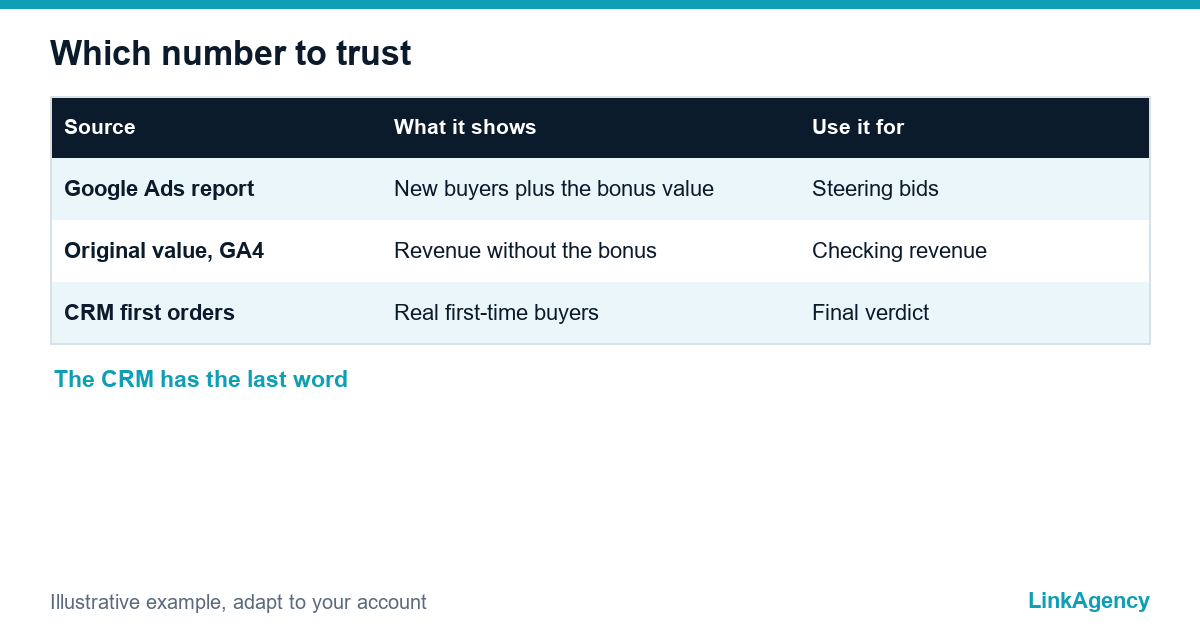
The report can mislead on any new customer acquisition goal. The bonus is added to conversion value, so revenue inside the platform exceeds revenue in your shop; compare it with the original value column and GA4. Then check the customer base itself: export four to six weeks of orders, mark first-time buyers in the CRM and compare their share with the share Google reports. Ads that chase repeat buyers make acquisition look cheaper in Google reports than it is. A small holdout segment shows what would have happened without the goal.
Checklist before the peak season
- Define the customer and refresh the lists.
- Send new_customer from the order confirmation and test it with two orders.
- Check consent and the lawful basis for uploads.
- Pick one campaign, start with value mode and a low multiplier.
- Wait four to six weeks before reacting to a CPA jump on day five.
- Compare the new-buyer share in the CRM before changing budgets.
Keep this next to your Black Friday checklist, since feed accuracy and payment checks matter just as much. Our Google Ads management team can run the setup for you.
Free Google Ads account audit before the peak
Send us read-only access to your account. We will check whether you have working customer lists, whether conversions and consent reach Google correctly, and which goal is worth switching on. If you decide to order a Google Ads account audit with fixes, we agree scope first, so Google Ads new customer acquisition starts on clean data.
- customer lists and the new_customer signal;
- consent and data-sharing check;
- a goal and multiplier recommendation.
Leave a request and we reply within one business day.

Frequently Asked Questions (FAQ)
What is the Google Ads new customer acquisition goal?
It is a setting that tells Google’s bidding to value first-time buyers more than returning ones. You can bid more for new customers or target them only, and the system identifies them from your conversion history, customer lists and tags.
Should a small store use the new customer only mode?
Usually not at first. It removes repeat purchases from optimisation, so conversion volume and learning data fall. With fewer than about 30 conversions a month, start with the value mode and a low multiplier.
Do I need Customer Match to use the goal?
Not strictly, because the new_customer tag parameter can work alone. Customer Match lets Google skip known buyers before the click, so combine both when you can and keep the list fresh.
Does the extra value change my reported revenue?
Yes. The bonus is added to conversion value inside Google Ads, so revenue looks higher than in your shop. Compare it with the original value column, GA4 and your CRM before judging results.
How long should I test before judging the result?
Plan for four to six weeks, longer with low order volume. A cost per conversion that jumps in the first days is expected, because the system stops chasing easy repeat buyers.
How can I order a Google Ads account audit from LinkAgency?
Send us read-only access to the account. Within one business day we reply with a short list of findings on customer lists, tags, consent and the goal worth switching on, and agree any fixes before work starts.