Many small companies run on technology that nobody senior owns. A developer picked the stack, an agency built the site, and every month brings a new tool, a bigger bill and a question nobody can answer: is this the right call? A fractional CTO, short for fractional chief technology officer, is a senior technology leader who works for your company a fixed number of hours a month. They make, and check, the technical decisions an owner cannot judge alone. This guide explains how the role differs from a full-time executive and from an agency project manager, when it pays off, what the first month looks like and what to ask before you sign.
Fractional CTO vs full-time CTO and an agency project manager
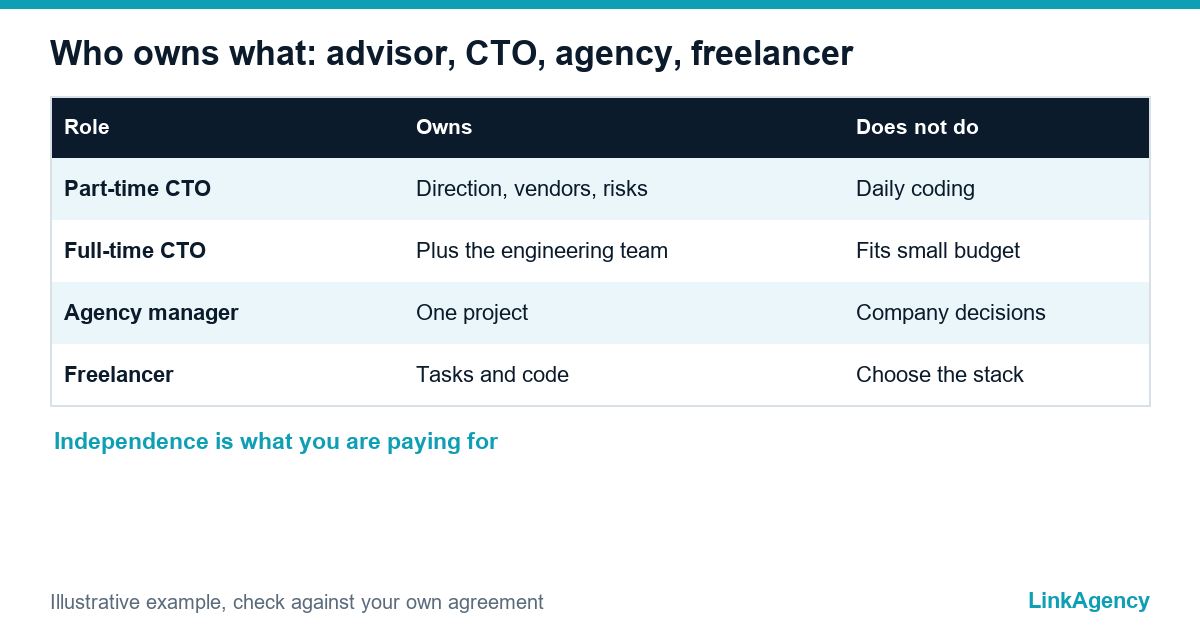
The titles sound alike, but the jobs are different. A part-time CTO owns technical direction, not daily delivery. See who is responsible for what in the table.
| Role | Owns | Does not do |
|---|---|---|
| Part-time technology leader | Direction, vendor oversight, budget and risk advice | Daily coding or selling you development |
| Full-time CTO | The same, plus building and managing an engineering team | Fit a small budget |
| Agency project manager | Schedule and scope of one project | Company-wide decisions or independent review of the agency |
| Freelance developer | Code for agreed tasks | Choose the stack or check other people’s work |
Independence is the key difference. A CTO who is fractional in hours is still full in accountability, and has no interest in which vendor you pick.
Six situations when you need a fractional CTO
- You are not technical and about to sign a large development contract.
- The lead developer left and nobody can explain how the system works.
- Several vendors work on the product and blame each other for delays.
- An investor or a buyer asks for a technical review.
- Cloud and tool bills grow and nobody owns the budget.
- You must hire the first engineers and cannot judge candidates.
Two or more of these usually mean the company is making technology decisions by default. A short engagement with an experienced advisor costs far less than one wrong platform choice.
Four situations when a good contractor is enough
- One project with a fixed scope and clear acceptance criteria.
- A standard website or shop on a mainstream platform.
- Maintenance of an existing system by a team you already trust.
- A short fix or integration with a defined result.
In these cases, managing the vendor well is enough, and typical CTO responsibilities such as architecture and budget do not fit a one-off job. Our seven rules for managing outsourced software development cover that job. The role described here is about the company’s technical position as a whole, not control of one project.
The first 30 days: audit, systems map, budget and risks
Good fractional CTOs spend the first weeks listening and reading, not rewriting. Some sellers call the model CTO as a service, others an outsourced CTO. Hours are fractional here, but the CTO’s duty to the owner is not. Expect a part-time CTO to run interviews with the people who touch the systems, a review of contracts and a look at the code and the cloud account.
What you should hold on day 30
- A map of systems, owners and who has access to what.
- A list of vendors, contracts and renewal dates.
- A technology budget with the largest items explained.
- The top risks, each with a named owner.
- A 90-day plan with priorities.
The access map matters most. For a start, the UK National Cyber Security Centre publishes a small business cyber security guide that is a sensible checklist to start from.
Eight questions for the first meeting
- Which companies at my stage have you worked with before?
- How many hours a month do I get, and how fast do you answer?
- Who owns the documents and access you will receive?
- Do you take fees or discounts from vendors you recommend?
- What will I see every month?
- What will you not do?
- How do you handle personal data and vendor access?
- What does a clean handover look like when we part?
Question seven matters because an outside advisor sees your systems. If they can see personal data, the GDPR expects a written agreement with the processor.
How to combine the role with an in-house team and a contractor
All three work best together. The advisor sets direction and acceptance criteria, in-house developers build and maintain daily, and an external team delivers defined work. Where you need more hands, staff augmentation services add engineers who work under that direction. For a bigger build, custom software development can be scoped from the advisor’s plan. Keep one rule: the person who checks the work should not be the person who is paid for it.

How to start without a long commitment
Begin with a technical consultation and a one-page audit, then decide on hours. If you want to hire a part-time CTO, ask for a trial month with the day-30 list as the deliverable.
Free technical consultation: do you need a fractional CTO
We review your systems, vendors and plans in a short call and tell you whether you need an advisor, a contractor or neither. You receive a list of risks and next steps. No obligation.
- review of systems, vendors and budget;
- risk list and recommendation on the right format.
Leave a request and we will reply within one working day.

Frequently Asked Questions (FAQ)
What does a fractional CTO do?
Sets technical direction, reviews architecture and vendor proposals, owns the technology budget and risks, and helps hire engineers. The work is done in a fixed number of hours a month, not full time.
How is a part-time CTO different from a full-time one?
A full-time executive builds and manages an engineering team every day. A part-time one gives senior judgment on direction, vendors and risks at a fraction of the cost, which suits small companies.
Do I need a CTO if I already have a development agency?
Often yes, because the agency’s interest is to deliver and bill, not to challenge its own estimates. An independent advisor checks scope, price and quality on your behalf.
Can a technical advisor help a non-technical founder?
Yes. This is one of the most common reasons to hire one: translating technical choices into business terms, reviewing proposals and spotting risks before money is spent.
How many hours a month does a part-time CTO usually work?
It depends on the stage. The scope and response time should be written into the agreement, with a short trial month before a longer commitment.
What should I have after the first month?
A systems and access map, a list of vendors and contracts, a technology budget, the top risks with owners and a 90-day plan.
How do I get a technical consultation from LinkAgency?
Leave a request describing your systems and vendors. We run a free call, list the main risks and recommend an advisor, a contractor or neither, with next steps.