You built a chatbot, a CRM assistant or a product feature on one AI model, and it works. Then the vendor changes a price, retires a version or tightens its terms, and the whole feature moves with it. On 21 October 2026 Google Cloud made this risk easier to see, because OpenAI’s models appeared inside its Model Garden. This guide shows how to limit AI vendor lock-in with architecture, your own tests, clear data terms and a short list of contract questions.
What changed on 21 October 2026, and why AI vendor lock-in is not only a big-company problem
Google Cloud now offers GPT-6 Astra, GPT-6.1 Sol and GPT-6 Luna in Model Garden as a private preview for selected enterprise customers, as Techzine reported. They are sold through the Google Cloud Marketplace, so usage appears on one invoice. Google says prompts, context and output stay inside the customer’s data perimeter and are not used to train models, while Zero Data Retention and Confidential Compute are promised later.
The detail that matters for you is simple. The same model can now be reached through several platforms, so the model is becoming a replaceable component and the platform, contract and data location become separate choices. A private preview does not mean you can switch tomorrow. It does show where the market is going.

Where AI vendor lock-in builds up: product, data, processes and contract
Lock-in with an AI provider rarely sits in one place. It grows in layers, and the table shows six of them with a quick test for each.
| Layer | What ties you | Quick test |
|---|---|---|
| Model and API | Endpoints, parameters, response formats | Can a second model answer the same request? |
| Prompts | Instructions tuned to one model’s behaviour | Are they stored in your repository? |
| Data and retrieval | Indexes, embeddings, vector database | Can you rebuild the index elsewhere? |
| Agents and integrations | Tools, connectors, memory | Which parts exist only at one vendor? |
| Evaluation | Quality checks tuned to one model | Do you own the test cases? |
| Contract and billing | Commitments, pricing, notice periods | What does leaving cost? |
The least visible layer is judgement. When a model shapes how a team decides, replacing it changes more than a tool, and BCG calls this cognitive lock-in. A contract protects your data, but it cannot protect your habits. Plan for that.
An architecture where the model can be replaced
Put a thin layer between your product and any model. Your code calls your own interface, and an adapter translates the call for the provider in use. This model abstraction layer turns a vendor change into configuration work instead of a rewrite, and AI provider lock-in drops sharply once it exists. Keep three things outside the vendor: your prompts under version control, your logs of requests and answers, and your documents and indexes. Every AI feature creates some dependence, and a vendor can change terms without asking, so never call a vendor’s SDK directly from business logic. If you build agents, AI agent development should follow the same rule, because tools and memory are the most sticky layer.
What to keep outside the vendor
Prompts, logs and indexes are yours, so store them where a provider cannot hold them hostage, and document every vendor-only feature you decide to accept.
How to compare models on your own tasks, not on advertising
Build a test set from a few dozen real cases in your business, each with an answer your team accepts as correct. Include the awkward ones: incomplete data, angry customers, edge cases. Run every candidate through the same set and score accuracy on critical cases, format compliance and speed, then compare cost per task. Repeat the test whenever a provider ships a new version, because a silent change shows up here before any customer complains. Testing different AI models this way also gives you real evidence in a price negotiation.
Data and GDPR: where requests are processed and who keeps them
Under GDPR the provider that processes personal data for you is a processor, so you need a data processing agreement, a clear answer on where requests are processed, how long they are kept and whether they train a model. Ask which sub-processors take part, because dependence on one AI vendor has a legal side as well as a technical one. EU rules on cloud switching add context: the Data Act aims to remove switching barriers for data processing services, including a ban on switching charges from 12 January 2027. Do not assume a model API falls under it; ask your lawyer and write the answer into the contract. Do it now. An AI readiness checklist helps you map which data you would send.
One provider, two providers or routing: choose a multi-model AI strategy for your stage
| Stage | Setup | Why |
|---|---|---|
| First pilot | One provider, abstraction layer, test set | Fast start, cheap exit later |
| Core feature in production | Primary model and a tested fallback | An outage or price change does not stop the business |
| High volume or mixed tasks | Routing by task type and cost | Each workload gets the right model |
Vendor lock-in in AI is manageable at every stage, and a multi-model AI strategy does not mean using every model. It means being able to switch AI model providers within days, because the fallback has already been tested on your cases.
Eight questions to ask before you sign or switch AI model providers
- Where are prompts and answers processed and stored?
- Are they used to train models, and can that be switched off in writing?
- What notice do we get before a model version is retired or a price changes?
- Can we export prompts, logs, indexes and fine-tuned assets in a usable format?
- Which features exist only at this vendor?
- Which sub-processors are involved, and where are they located?
- What happens to our data and commitments if we leave?
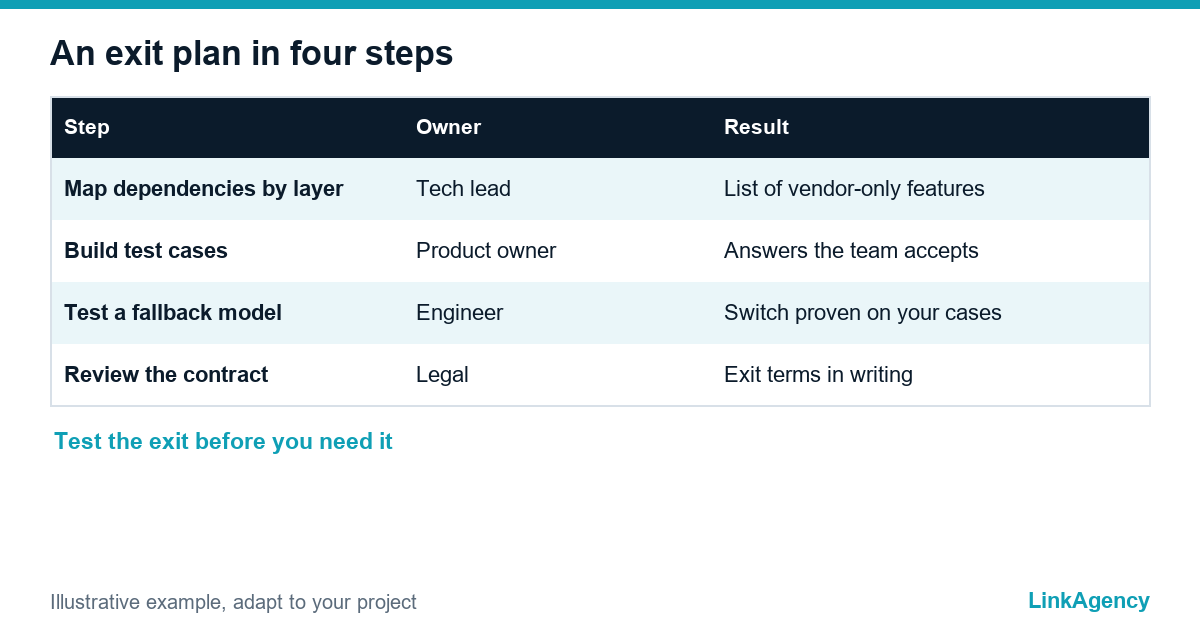
- Who on our side owns the exit plan and tests the fallback?
Free consultation on your current AI integration
Send us a short description of how your product or processes use AI, and if you want to order an AI integration review, we will start from it. We will show how tightly you are tied to one model, where the data goes and what it takes to cut AI vendor lock-in so that switching takes days, not months. Our AI consulting services start with exactly this review.
- a map of dependencies by layer;
- an outline of test cases for your tasks;
- a list of contract points to renegotiate.
Leave a request and we reply within one business day.

Frequently Asked Questions (FAQ)
What is AI vendor lock-in in plain words?
It is the situation where your product or process is so tied to one AI provider’s model, API, prompts or contract that switching costs too much time or money. It grows in layers, so you can have it even when the contract looks flexible.
Do small businesses need a multi-model strategy?
Not always. A small team can start with one provider if it keeps prompts, logs and data in its own storage and adds an abstraction layer. A second, tested model becomes worth it once the feature carries revenue.
Does it mean OpenAI models are now easy to swap with Google’s?
No. The Google Cloud offer is a private preview for selected enterprise customers. It shows that one model can be sold through several platforms, but you still need your own tests before moving any workload.
How do I compare two models fairly?
Build test cases from your own real cases with accepted answers, run both models on it and score accuracy on critical cases, format, speed and cost per task. Repeat the test when a provider releases a new version.
What should a data processing agreement with an AI provider cover?
Where requests are processed, how long they are stored, whether they are used for training, which sub-processors take part, how data is deleted and how you export it when the contract ends.
Can LinkAgency review our current AI integration?
Yes. We map dependencies by layer, check where data goes and outline a test set and a fallback plan. You get the written findings before any development work is agreed.