The blog is updated, the social accounts are active, and the enquiries do not come. In most small companies the reason is simple: topics are chosen by inspiration, publishing is not connected to sales, and nobody agreed what counts as a result. A content marketing plan fixes that by starting from the business and working towards the content, not the other way round. Here is a five-step plan on how to build a content plan in an evening and run it for 90 days, with a content calendar and a content audit built in.
Content Marketing Plan for Small Business: Why a Plan Is Not a Posting Schedule
A posting schedule says what goes out on which day. A content marketing plan for small business says which customer question each piece answers, at which stage of the decision, in which format, who produces it and how you will know it worked. The Content Marketing Institute’s definition stresses a clear audience and a clear action for them to take, and a schedule alone gives you neither. Without a plan for content marketing, a small team publishes a lot and learns little, and a small business content plan removes that waste.

Step 1: Collect Customer Questions From Sales, Support and Search
Do not brainstorm. Interview the people who talk to customers and write down 20 questions buyers ask before they buy. Ask sales what blocks a deal, ask support what people do not understand, and check the queries that already bring visitors to your site. These questions are your topic bank for the content calendar, and they are better than any keyword tool because they come from real money conversations. Group duplicates, and keep the customer’s own wording.
Step 2: Tie Topics to the Customer’s Stage of Decision
Sort each question by stage: just researching, comparing options, or ready to buy. Each stage needs different content and a different next step, which is why good content marketing plans map them one by one, and the thread that ties every stage together is a brand positioning statement. A researcher needs a clear explanation, a comparer needs a decision guide, and a buyer needs proof and an easy way to ask. B2B content marketing and a content marketing strategy for B2B work the same way, only the cycle is longer and more people are involved.
| Stage | Typical question | Format | Next step |
|---|---|---|---|
| Researching | What is the problem and why does it matter? | Guide, checklist | Related article |
| Comparing | Which option fits us? | Comparison, case | Consultation |
| Ready to buy | What will it cost and how fast? | Service page, FAQ | Request form |

Step 3: Choose Formats and Channels Your Team Can Sustain
Marketing without a plan wastes the content a team has already made. Two good formats beat five irregular ones, and a plan for content marketing should say which two. For a service business a deep article plus a short post series and a customer email is often enough. Pick channels where your buyers already are, and be honest about hours: if the plan needs ten hours a week and you have three, cut the plan. Content that follows Google’s guidance on helpful, people-first content tends to hold its value longer than posts written to fill a gap in the calendar.
Step 4: A 90-Day Calendar With Roles
Ninety days is long enough to see a pattern and short enough to change course. Fill the content calendar from the question bank, not from dates, and give every item an owner and a deadline.
- Month 1: publish the three pieces for the “ready to buy” stage first, because they are closest to revenue.
- Month 2: add comparison content and one case, and reuse month-one material in the newsletter.
- Month 3: fill the “researching” stage and update the weakest piece from month one.
- Last week: review results, drop what did not work and plan the next 90 days.
Step 5: What Counts as a Result and How to Read the Report
Content marketing ROI is not reach, which is a vanity number. Count enquiries, their quality and the role content played in deals. In analytics, mark the form submissions and calls as key events so that you can see which pages lead to them. For the wider picture, see our guide to the six metrics to measure SEO success.
What to put in the monthly report
- enquiries from content and the share that match your ideal client;
- pages that appeared in deals or sales conversations;
- the best and worst pieces, with one change for each;
- hours spent against hours planned.
How to Reuse One Piece in Several Formats
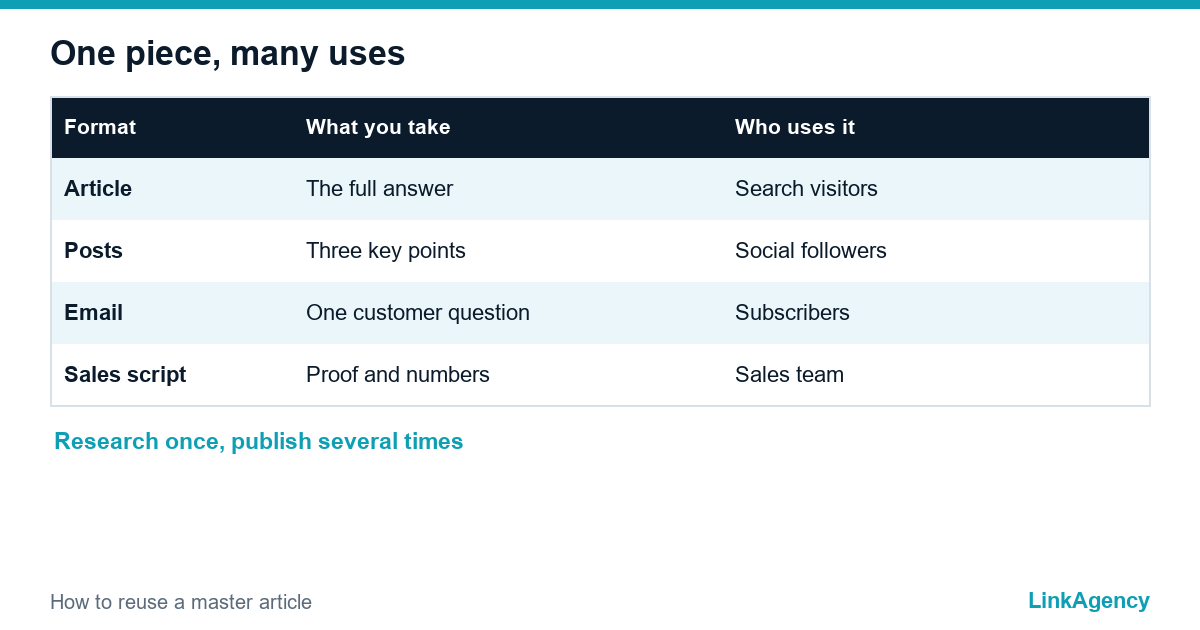
Before you write more, run a short content audit of what you already have. Write one strong article, then turn it into a series of short posts, an email answer to a customer question and a sales script for the team, with the funnel stage and the case study named. The effort goes into research and structure, and the reuse is cheap. Keep the voice consistent by agreeing tone and visual rules once, which is easier with a short branding and content brief, and connect the plan to search with our SEO services and to paid channels with performance marketing once you know which topics convert.
Get a Free Content Review and a 90-Day Plan From LinkAgency
We review your current content, list the customer questions it misses and send a 90-day plan with formats, owners and a simple report. If you want a team to run it, ask about our content marketing services or order the content marketing plan as a project, and start with a free content review.
- audit of your posts, articles and emails against buyer questions;
- map of topics by decision stage;
- 90-day calendar and a monthly report template.
Send a request and we will reply within one working day.

Frequently Asked Questions (FAQ)
How long does content marketing take to bring enquiries?
Expect the first signals in two to three months and a clearer picture after six. Pieces for the ready-to-buy stage tend to work first.
How many articles do I need each month?
Two to four strong pieces are enough for most small teams, plus short posts reusing them. Quality and fit with customer questions matter more than volume.
Do I need a blog, or are social networks enough?
A site gives you pages that stay findable and that you control, while social channels spread them. For services and B2B, a few good pages on your own site usually come first.
What should I measure first?
Enquiries from content, their quality and the pages that appear in deals. Reach and likes help diagnose, but they are not results.
Should I write the content myself or hire someone?
Write what only you know, such as customer stories and opinions, and delegate research, drafting and editing. Keep the final approval, because voice and accuracy are yours.
Can LinkAgency build and run my content plan?
Yes. We review your content, map topics to buyer stages, set the 90-day calendar and the report. Send a request and we reply within one working day.