Two vendors sent proposals for the same project, one at a fixed price and one by the hour, and the numbers cannot be compared. Fixed price feels safer until the phrase “that was not in the scope” arrives, while an hourly rate looks like an endless bill. This guide treats fixed price vs time and materials as a decision tool, not a theory: a matrix of how clear your requirements are, how tight the deadline is and how much time you have to manage the project, then hybrid options, the contract clauses that protect you in any model, and a way to compare two offers side by side.
Fixed price vs time and materials: three ways to pay for software development
Software development pricing models come down to three. Most projects are sold in one of them. In a fixed price contract, scope, deadline and total cost are agreed in writing before work starts. With time and materials (T&M) you pay for the hours the team actually works, usually with a monthly report. A dedicated team is a variation of T&M: named people work only on your product for a long period at a monthly cost.
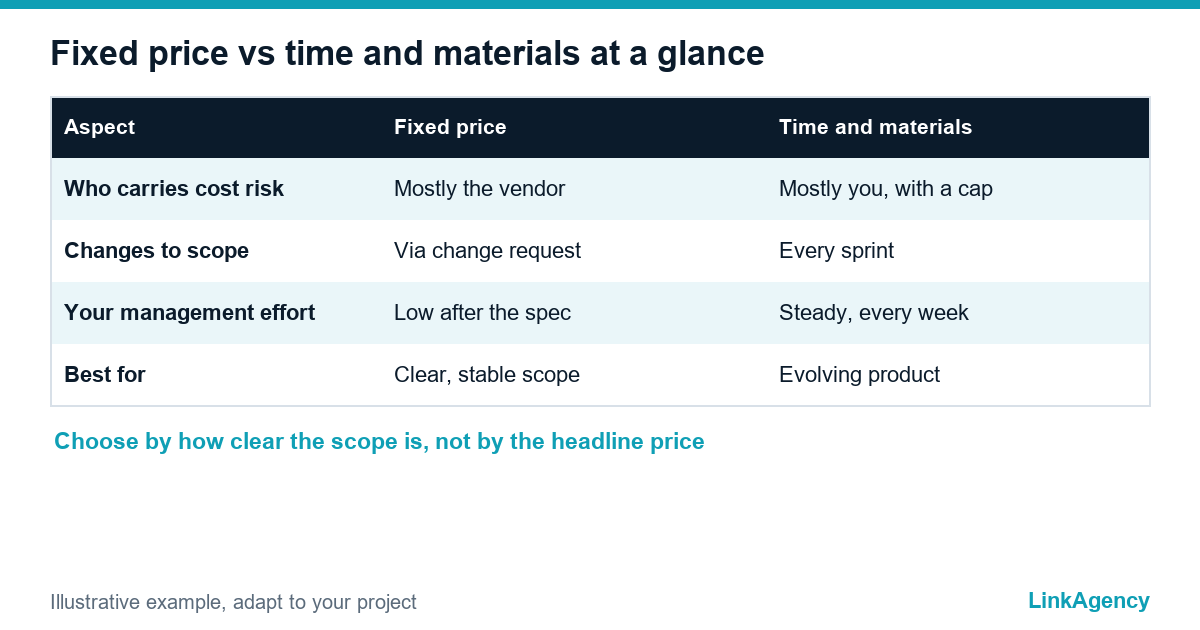
Fixed price or time and materials is first of all a question of who carries the risk. Under fixed price the vendor carries the cost risk and you carry the risk of a rigid scope. Under T&M you carry the budget risk and keep the freedom to change priorities. US federal buying rules say the same in plain words: FAR Part 16 puts maximum cost risk on the contractor in a firm fixed price deal and allows T&M only when the work cannot be estimated accurately, with a ceiling on the price.
When fixed price really works, and when it is an illusion of control
A fixed bid works when the scope fits on paper, changes are unlikely and the vendor has built something similar before: a corporate website, a defined integration, a second phase of a product whose unknowns are already cleared.
- Requirements are written and reviewed line by line.
- Acceptance criteria say how each part is checked.
- The deadline matters more than flexibility.
It turns into an illusion when the scope is still being discovered. The vendor adds a margin for unknowns, every new idea becomes a paid change, and quality gets squeezed in places that are hard to specify, such as testing and error handling. Even with a fixed scope, the final price can move when third-party materials such as licences and hosting are billed at cost.
Time and materials without an endless bill: caps, sprints and reports
A not-to-exceed cap is the most useful clause in any time and materials deal. The T&M model fits products that change as you learn from users. To keep the bill under control, add three things to the contract: a not-to-exceed cap, work in short sprints with a demo at the end of each, and a monthly time report by task.
| Control | What it prevents | How to ask for it |
|---|---|---|
| Cap on spend | A budget that grows unnoticed | Agree an amount and a rule for reaching it |
| Sprint demo | Weeks of work with nothing to see | A working increment every one to two weeks |
| Time report by task | Hours that nobody can explain | Invoices matched to a visible backlog |
| Priority list | Low-value work eating the budget | You reorder the backlog at every planning |
The Agile Manifesto puts it as working software as the measure of progress, and that is the test for any hourly deal.
Hybrid: fixed price for discovery and the first version, flexibility after
Many projects mix fixed price and time and materials. A short discovery phase gets its own fixed price and ends with clear requirements, screens and architecture. The first version, an MVP, can then be priced as a fixed bid, with a dedicated team or hourly work with a cap afterwards. A dedicated team after the fixed phase keeps context and speed. Set a limit on hours per month, and agree in advance how to treat changes. If you need people who stay on the product, you can hire dedicated developers on a monthly basis after the fixed phase.
Decision matrix: requirements, deadline and your time for management
Fixed price vs time and materials depends on three questions: how clear the requirements are, how hard the deadline is and how much time you can give to managing the project.
| Situation | Fixed price | Time and materials | Hybrid |
|---|---|---|---|
| Requirements clear and stable | Best fit | Possible | Not needed |
| Requirements unclear | Illusion | Fits with cap | Best fit |
| Deadline is hard | Fits if scope is small | Risky without cap | Fits, scope by priority |
| You have little time to manage | Fits | Poor fit | Fits, short check-ins |
| Product will keep evolving | Poor fit | Best fit | Fits |
Both fixed price and time and materials fail when the scope is vague. Time and materials vs fixed price is not a vote, so read the matrix by rows and pick the row that matches your biggest worry. If two rows apply, take the hybrid.

Contract clauses that protect the client in any model
A change request process is the clause that keeps a fixed bid honest.
- Change request process: a written request, a priced estimate, approval before work starts.
- Acceptance criteria for every milestone, tested rather than judged by eye.
- Code ownership and design rights transferred to you in writing.
- Limits and reports on hours, with access to time logs.
- Exit terms: how you leave, what you receive and in what format.
A software development brief makes every clause easier to write, so start from a clear software development brief template before you ask for prices.
How to compare two proposals built on different models
In a fixed price vs time and materials comparison, start with one written scope that both vendors price.
Questions to put to both vendors
- Turn the hourly offer into three scenarios: low, expected and high hours.
- Check what the fixed price excludes: testing, support, hosting, changes.
- Compare hourly rates only with the team seniority and the estimate behind them.
- Ask how each vendor handles a request to change scope.
Fixed price versus time and materials looks different once the missing line items are added. The cheaper line is often the one without them. Our custom software development services are quoted with the model that fits the task, not the one that is easiest to sell.
Free project consultation: fixed price vs time and materials for your case
Tell us about your project and we will review the task, suggest the cooperation model that fits and prepare an estimate by stages. If you already have two offers, send them and we will compare them honestly. You can also order a project estimate as a separate piece of work.
- a recommended model with the reasons;
- an estimate by stages with a cap and change rules.
Leave a request and we reply within one business day.

Frequently Asked Questions (FAQ)
Which is better for a startup MVP, fixed price or T&M?
If the idea is still being tested, T&M with a cap or a fixed price for a short discovery phase fits better. A fixed price for the whole MVP works only when the first version is written down in detail.
Does fixed price always cost less?
No. The vendor includes a margin for unknowns, and every change after signing is priced separately. In a fixed price versus time and materials comparison, count a realistic number of changes, not just the headline figure.
How do I keep a time and materials budget under control?
Set a cap, work in short sprints with a demo each time, and ask for a time report by task with every invoice. Review the backlog yourself before each sprint.
What is a change request process?
It is a written way to alter the scope: you describe the change, the vendor estimates its effect on cost and deadline, and work starts only after you approve.
Can I switch from fixed price to time and materials mid-project?
Yes, if the contract allows it. Among software development pricing models, a mid-project switch is common. Agree in advance how the finished part is accepted and how remaining work is estimated, so the switch does not turn into a dispute.
Can LinkAgency help me choose a contract model?
Yes. Send your task or two competing offers, and we will recommend a model with reasons and prepare an estimate by stages before you sign anything.