Sales come through a marketplace, but the fees keep rising, your price sits next to ten look-alikes and the customers are invisible to you. Or the opposite: you opened your own shop, traffic never came and you wonder whether to go to a marketplace after all. Sell on Amazon or own website? That question gets the same generic answer everywhere, a list of pros and cons. Choosing a marketplace or own online store should not be a coin toss. This guide replaces the list with three tests you can run on your own numbers: margin per order after every fee, repeat purchases, and how much of your revenue depends on one platform’s rules. It ends with a working hybrid model and a 90-day plan, so you can decide whether to sell on a marketplace or own website with evidence.
Sell on Amazon or own website: what the owner is really choosing
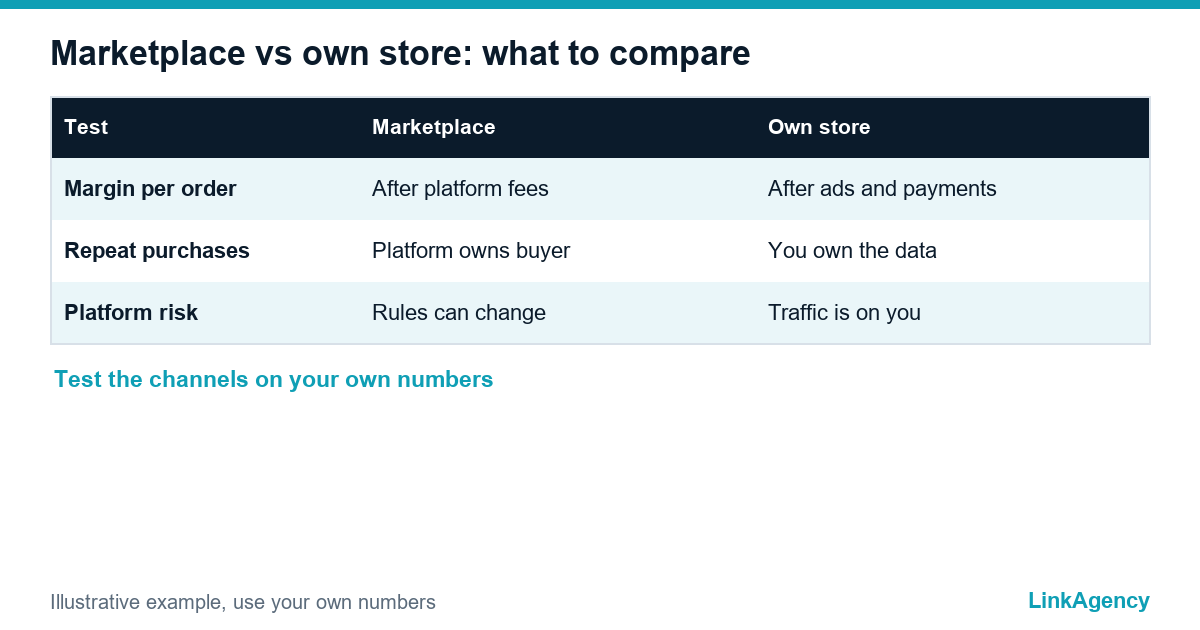
Sell on Amazon or own website is not really a channel choice. You are choosing who owns the customer. On a marketplace, the platform owns the shopper, the search results and the rules, and you rent access. On your own store, you own the data, the message and the repeat purchase, but you also carry the traffic problem. The marketplace vs own online store question is therefore a question about control and cash, not about technology, and own store or marketplace is a call you can revisit each quarter. You can sell the same product on Amazon and on your website, but the numbers differ, so measure each channel separately.
Test 1: margin per order after commission, ads, logistics and returns
List every cost on one real order
Take one real order from each channel and write down everything that came out of it. This short step beats any generic advice.
| Cost line | Marketplace | Own store |
|---|---|---|
| Platform fees | Referral and listing fees from the official fee page | Payment processing and platform subscription |
| Advertising | On-platform ads to stay visible | Search, social, email |
| Fulfilment and shipping | Platform or your own, with platform rules | Your own or a 3PL |
| Returns | Platform policy, often generous to buyers | Your policy |
| Price pressure | Compared with many sellers | Compared on your own terms |
Marketplace fees change often. Take the current fee schedule from the platform’s own page, for example Amazon’s seller pricing, on the day you calculate, because schedules change. What remains per order is your real margin. Marketplace fees vs own ecommerce store cost is only a fair comparison when both columns include advertising and returns. Selling on Amazon or your own website looks very different once ads are counted.
Test 2: repeat purchases and customer data under GDPR
A marketplace shopper is the platform’s customer first. You usually receive the order, not an email you can use for marketing. If your products are reorderable, such as consumables, parts or refills, an owned sales channel, such as an own webshop, lets you bring buyers back at low cost through email and loyalty. Under the General Data Protection Regulation, customer data you collect in your store needs a lawful basis and clear notices, and marketing emails usually need consent. That work is yours, but so is the result. Ask one question: what share of buyers would buy again, and how would you reach them? For many sellers, own store or marketplace comes down to this.
Test 3: dependence on rules and the risk of an account block
When most revenue comes through one marketplace, its rule changes are your risk: a fee increase, a category restriction or an account suspension can cut revenue overnight. In the EU, Regulation (EU) 2019/1150 requires platforms to give reasons for restricting or suspending a business user and to offer a way to complain, which helps but does not replace a second channel. Check what share of revenue one platform brings, because owned sales channel revenue is the only part nobody can switch off, and decide what you would do if it stopped for a month.
When a marketplace is a good main channel
- You sell a commodity or a branded item people already search for by name on the platform.
- You want to test demand for a product before building anything.
- Your margin stays healthy after fees, advertising and returns.
- Repeat purchase is rare, as with durable goods.
In these cases a marketplace is a sensible way to start, and a marketplace or own online store need not be exclusive. Use it as a storefront and a demand test, not as your whole business, and keep the own webshop growing beside it.
When you need your own store and what it must have from day one
Online store development pays off when your own store drives repeat sales. Build your own store when repeat sales, bundles, subscriptions or a brand story drive your margin, or when platform dependence worries you. On day one it needs a fast, mobile-friendly storefront, clear product pages, simple checkout, email capture with consent and analytics. Our product page checklist covers the page elements that decide conversion. To choose the platform, see Shopify vs WooCommerce vs custom. When you sell on a marketplace or own website at once, keep one stock count. If you plan a larger build, ecommerce development services can scope it from your numbers.
A hybrid model: moving bestsellers from the marketplace to your store
- Sell new products on the marketplace to test demand cheaply.
- Find bestsellers with healthy margin and repeat potential.
- Offer bundles, larger packs or subscriptions only on your own store, which is how a marketplace or own online store pair works in practice.
- Include a leaflet or a code inviting buyers to your site, if the platform’s rules allow it.
- Track the share of revenue from your own channel each month.
Read each platform’s rules before you do the fourth step. Short. since many restrict how you may contact marketplace buyers.
A 90-day plan: calculate, decide, launch
- Days 1 to 15: calculate margin per order for each channel and the share of revenue from one platform.
- Days 16 to 30: decide which products stay on the marketplace and which go to the store.
- Days 31 to 75: launch or improve the own store with the day-one essentials.
- Days 76 to 90: compare margin, repeat rate and traffic, and adjust the split.

Free sales model calculation
We compare margin on the marketplace and in your own store with your figures and recommend how to launch or improve your own channel.
Sell on Amazon or own website: a free sales model calculation
We compare the margin on a marketplace and in your own store using your numbers, and recommend how to launch or improve your own sales channel. No obligation.
- margin comparison by channel;
- launch or improvement plan for your own store.
Leave a request and we will reply within one working day.

Frequently Asked Questions (FAQ)
Should I sell on Amazon or own website?
Decide with three tests: margin per order after every fee, repeat purchases and dependence on one platform’s rules. Many businesses use a marketplace to test demand and their own store for bestsellers, bundles and subscriptions. The choice of marketplace or own online store rarely has to be final.
How do I compare marketplace fees with the cost of my own store?
Take one real order in each channel and list every cost: platform fees, advertising, fulfilment and returns. Use the platform’s own current fee page, because schedules change. That is the honest marketplace vs own online store comparison.
Who owns the customer data on a marketplace?
Usually the platform controls most of it, and the rules limit how you may contact buyers. With an owned sales channel you collect data yourself, which needs a lawful basis and notices under GDPR.
What happens if a marketplace suspends my account?
Revenue can stop at once. In the EU, Regulation 2019/1150 requires platforms to state reasons and offer a complaint route, but a second channel, such as an own webshop, remains the real protection.
When is a marketplace the better main channel?
For commodity or branded goods people already search for there, for demand tests and when margin stays healthy after fees. In that case selling on Amazon or your own website is not either-or: start with the marketplace.
What must an own store have from day one?
A fast mobile storefront, clear product pages, simple checkout, email capture with consent and analytics. Add bundles and subscriptions once you see repeat demand. Whether it is your own store or marketplace, this is the baseline.
How do I order a sales model calculation from LinkAgency?
Leave a request with your channels and typical order data. We compare margin on the marketplace and in your own store, with a free sales model calculation, and recommend ecommerce development services or online store development only if they pay back.