A contractor names a date, the site launches months later, and the season, the exhibition or the ad budget has already passed. The delay is rarely about code. It comes from late decisions and missing approvals that nobody put on the schedule. This guide breaks a website development timeline into stages, shows which of them depend on you and gives a list of decisions to make before the start, so the launch date holds.
Website development timeline: the stages from brief to launch
Every serious project passes through the same stages, though some run in parallel. Honest estimates give a range after the brief, not a single date before it.
| Stage | Who moves it | What must exist to finish it |
|---|---|---|
| Brief and goals | You and the agency | One page with goals, audience and success metric |
| Structure and prototype | Agency, your approval | Page list and key screens agreed |
| Content | You | Texts, photos, legal pages, prices |
| Design | Agency, your approval | Approved templates for each page type |
| Development and integrations | Agency | Access to CRM, payment, analytics |
| Testing and migration | Both | Test list, redirect map, backup |
| Launch | Both | Named owner for the first week |
Notice how many rows say “you”. A website development timeline is shared, and the client side is usually the one that slips.

What sets your website build timeline: scope, integrations, content, languages
Four things move the date more than team size. Scope: the number of different templates matters more than the number of pages. Integrations: every link to a CRM, payment service or ERP depends on someone else’s access and documentation. Content: a site cannot be finished while texts and prices are missing. Languages: each version needs its own translation and SEO tags. Plan the steps in developing a website around these four, put the website design process steps inside each, and treat any promise that ignores them with suspicion.
What delays a website project: five reasons sites launch later than planned
- Content arrives during development, so layouts are reworked around real text.
- Several people approve every screen and nobody has the final word.
- Scope grows by “one more page” until the schedule no longer matches the project.
- Access to the domain, hosting or CRM is requested mid-project.
- Redirects, legal texts and analytics are left to the last week.
That is far more common than difficult code, and a short website project plan removes most of it.
What to prepare before the start so the timeline for website development holds
A short list of decisions saves weeks, and none of it needs a developer:
- Name one person with the final word on design and texts.
- Write the goal in one sentence and one number you will check after launch.
- Collect content drafts, photos, prices and legal pages before design begins.
- Prepare access to the domain, hosting, analytics and every system to connect.
- Decide which languages and which integrations belong to the first release.
- Agree a feedback time per review round and write it into the plan.
Leave the “nice to have” list for phase two
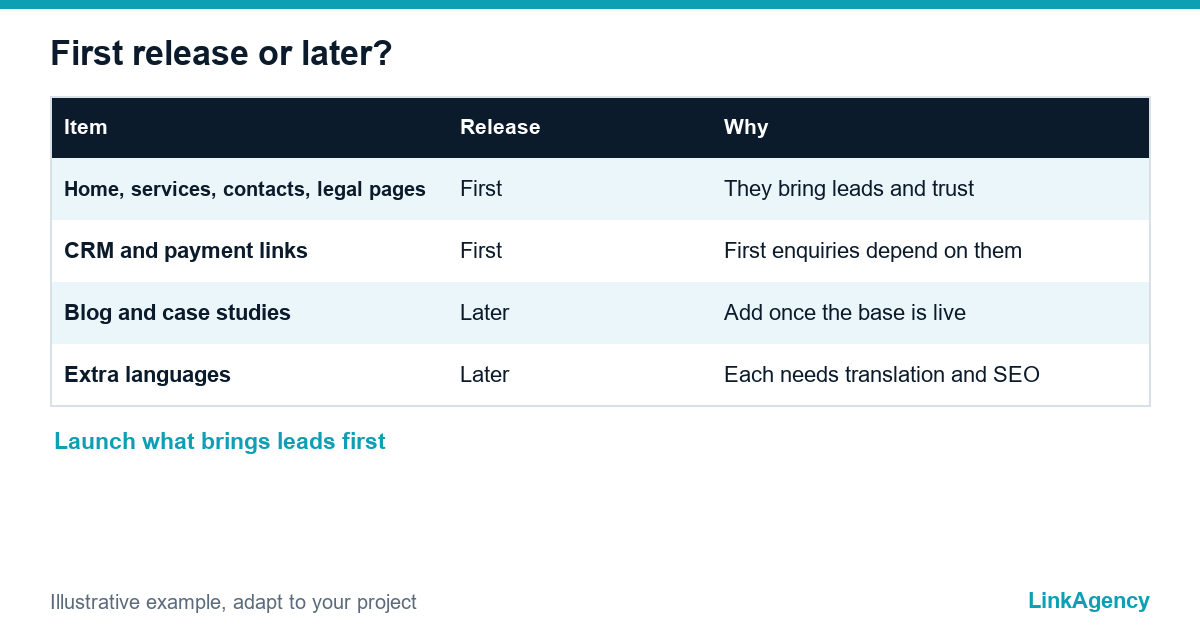
Mark every wish as launch-critical or later. The later list is not lost; it becomes the next release. Our UI/UX design services start with exactly this sorting, so the design stage works on the first release only.
How to speed up the project without losing quality: phased launch and an MVP site
The fastest safe route is a phased launch. Publish the pages that bring leads first: home, services, contacts, the legal set. Add the blog, case studies and extra languages in the next phase. A minimum viable site also lets you test messages on real visitors, and the lessons feed the next phase. How to speed up website development is mostly a question of scope, not of overtime, because compressing design and testing hands the cost to your visitors.
How to read a contractor’s schedule and which questions to ask
A good project timeline for website development names stages and owners, not only dates. Ask these questions before you sign:
- Which stage waits for us, and what exactly do you need from us?
- How many review rounds are included, and what happens after them?
- Where are integrations and migration in the schedule?
- Who tests, and what is the rollback if the launch goes wrong?
A timeline that ignores client approvals makes website development look faster than it is. Our web development services team shares the plan before work starts, and the website launch plan for the first 90 days covers what follows.
Moving the old site: why SEO and redirects belong in the schedule from day one
A redesign that changes addresses without a redirect map can erase years of search visibility, so the website launch timeline must treat migration as a stage, not a favour. Google’s guidance on site moves with URL changes lists the steps: map old to new addresses, redirect them one to one, keep the old pages online until the new ones are crawled and watch Search Console afterwards. Add a quality gate too: check Core Web Vitals on the key pages before the date is confirmed, as web.dev explains.
Free consultation on a realistic stage plan
Send us your brief and your current site. We will draft a plan of stages, mark what depends on your side and show what can launch first. If you decide to order a website project plan with an estimate, we agree scope and dates first, so your website development timeline starts from facts.
- a stage plan with owners and approval points;
- a list of decisions to take before the start;
- a migration and redirect checklist.
Leave a request and we reply within one business day.

Frequently Asked Questions (FAQ)
How long does a website development timeline usually run?
It depends on scope, content, integrations and approval speed, so an honest estimate is a range given after the brief. Be wary of an exact date promised before anyone has seen your content and systems.
What delays a website project most often?
Late content, many approvers, scope growth, missing access to domain or CRM, and redirects left to the last week. Most of these sit on the client side and can be fixed with a short preparation list.
Can we launch in phases to speed up the project?
Yes. Publish the pages that bring leads first and add the blog, case studies and extra languages later. A phased launch also lets you learn from real visitors before the second phase.
Why must SEO and redirects be planned from day one?
Changing addresses without a redirect map can drop pages from search. Redirect mapping, a backup and a post-launch check take time, so they belong in the schedule, not in the last night before launch.
What should I prepare before the project starts?
One approver, a goal with one metric, content drafts, photos, legal pages, access to domain, hosting and analytics, and a list of what goes into the first release and what waits.
How do I order a website project plan from LinkAgency?
Send us your brief and the current site address. Within one business day we reply with a draft stage plan, the decisions we need from you and what can launch first, then agree scope and dates.