Black Friday 2026 falls on 27 November and Cyber Monday on 30 November, so a useful Black Friday checklist has to start now, not on the 20th. Most peak-day failures are calendar failures, not creative ones: a plugin updated on Thursday, a payment limit nobody raised, a sale price that breaks EU rules. Below is a week-by-week checklist for Black Friday for store owners and ecommerce directors, covering technical, payment, data, warehouse and legal checks in order.
Why a Black Friday checklist starts weeks before 27 November
Work that depends on other companies takes longest. Hosting providers, payment gateways and carriers fill up in November, and a request sent in the last week waits behind everyone else’s. Agencies suggest starting 8 to 12 weeks ahead, so with about five weeks left the order of tasks matters more than their number.
| Dates | Focus | Done when |
|---|---|---|
| 22-30 Oct | Load test, speed fixes, payment limits and fallback | Test report; gateway confirms in writing |
| 31 Oct-6 Nov | Product data, feeds, stock buffers, sale prices | Feed matches the site; stock counted |
| 7-13 Nov | Support scripts, carrier cut-offs, rollback plan | Carrier confirms capacity |
| 14-20 Nov | Code freeze and final test orders | Only critical fixes, one approver |
| 21-26 Nov | On-call roster, monitoring, dry run | Everyone knows who decides |
| 27-30 Nov | Sale days: watch the dashboards | Post-mortem date is booked |
One rule applies from today: do not raise prices, because in the EU the reference price for a discount is the lowest price of the previous 30 days. Every line on the checklist needs an owner before Black Friday arrives. A Black Friday ecommerce checklist without owners is only a wish list.

Prepare your online store for Black Friday: load, speed and code freeze
The ecommerce peak season punishes slow carts. Test the whole purchase path, not the home page, using k6 or JMeter and adding users in steps until response times climb. That point is your real limit. Plan for at least double last year’s busiest hour and run the load test in October, so there is time to fix what it finds.
- Put a CDN and page cache in front of the shop, and decide how prices will be purged when the sale starts.
- Check Core Web Vitals for category, product and cart pages on a mid-range phone.
Freeze rules: who approves what
An ecommerce code freeze means no new apps, theme edits or plugin updates for two to four weeks before the sale. Critical fixes need one named approver and a test on staging first. If the platform itself is the limit, ecommerce development services can rebuild the slow parts before the freeze begins.
Payment fallback: what happens when the gateway slows down
A spike can look like an attack to a gateway’s fraud system, and a held payout hurts most when ad budgets are high. Work through these steps while there is time:
- Send your provider the expected volumes and dates, ask about limits and get a priority contact.
- Connect a second gateway and test it, because a single gateway turns an incident into zero revenue.
- Place real test orders with every method, including Apple Pay and Google Pay, and refund them.
- Show the success rate by method on the sale-day dashboard.
Add these tests to the Black Friday readiness checklist. A quiet drop in authorisations costs more than a visible outage, because nobody notices it. Our guide to checkout mistakes that drive cart abandonment lists the common ones to remove first.
Products, prices and feeds: data that must be right on the day
Count stock before you promote it. A simple buffer for the top 20 products is average daily sales times expected uplift times lead time in days. Keep inventory in sync across the site, marketplaces and warehouse, and hide sold-out items from ads automatically.
Prices must match everywhere. Google Merchant Center reads the sale_price attribute together with sale_price_effective_date, and a mismatch with the product page gets items disapproved at the worst moment. Ask your performance marketing team to confirm that the feed and the ads show the same offer.
Warehouse, delivery and support: answering “where is my order”
The costliest mistake is a discount you cannot ship. Estimate how many orders the warehouse can pack per day, compare that with the ads and email plan, and cap the offer if the gap is large. Confirm carrier cut-offs and agree a backup carrier now.
Publish honest delivery dates and warn that peak days may add a day or two. Send automatic status emails with tracking links, since “where is my order” is the top ticket after any sale.
EU and US rules for sale prices and the Black Friday returns policy
In the EU, a price reduction must be shown against the lowest price applied in the 30 days before it, under the Omnibus Directive. Online buyers also keep a 14-day right of withdrawal, so returns keep arriving in December.
- Fake countdown timers that restart on reload are an unfair practice in the EU and a dark pattern in the US.
- In the US, if you state no shipping time, the FTC rule expects shipment within 30 days unless the buyer agrees to a delay.
- Show the previous price, the sale price and the end date the same way on cards, product pages and the cart.
On-call plan and a post-mortem for the sale days
Name who watches what in each shift and who may act without asking. Put orders per hour, payment success rate, error rate and stock on one dashboard. Agree triggers in advance: if a top product sells through more than 20% of its stock in 48 hours, reallocate stock or pause its discount. A written incident response plan for ecommerce turns these triggers into steps.
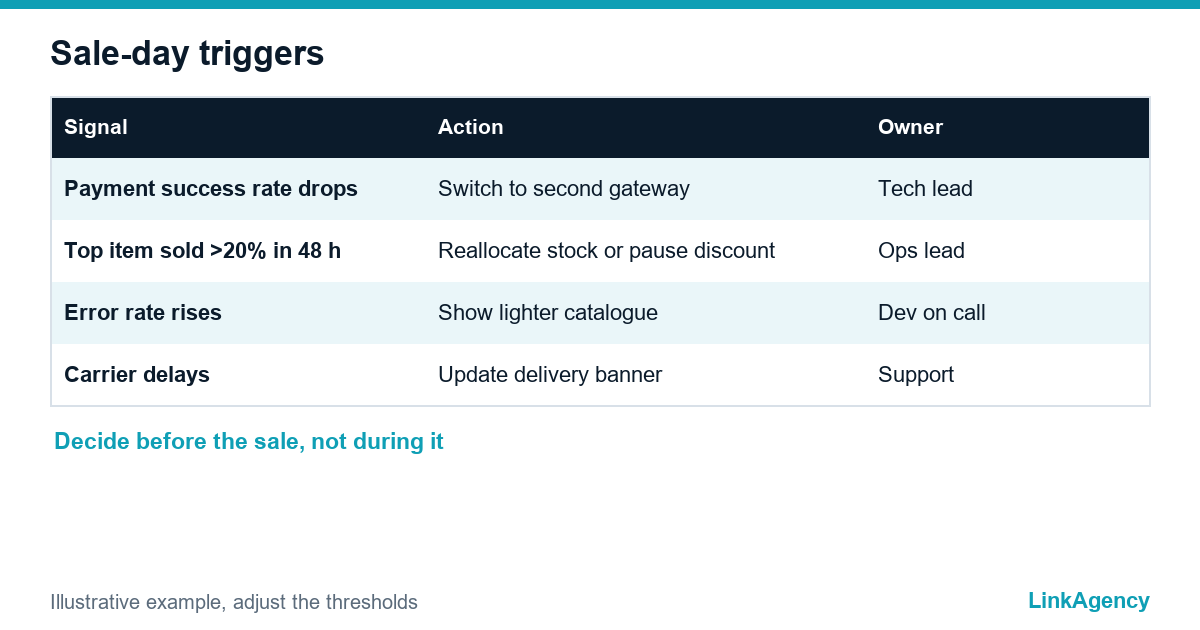
After the sale, hold the post-mortem within two weeks. Count profit after discounts and returns, not revenue alone, and list what broke and how long it took to fix. That document becomes next year’s Black Friday checklist.
Free pre-peak store audit from LinkAgency
Send us the address of your store. We will review speed, checkout, payment setup and product data, and give you a short list of fixes in the order they should be done before 27 November. If you decide to order a pre-peak store audit with fixes, we agree scope and dates first, so the Black Friday checklist is shared with your team from day one.
- load test and speed check of the purchase path;
- payment fallback and feed review;
- a dated plan for the freeze, on-call and post-mortem.
Leave a request and we reply within one business day.

Frequently Asked Questions (FAQ)
How do we prepare our online store for Black Friday and when should we start?
Agencies suggest 8 to 12 weeks ahead. With the sale on 27 November 2026, start now: use a Black Friday checklist that begins with the load test, payment limits and product data, and leave the last two weeks for the freeze and rehearsals.
What is an ecommerce code freeze and how long should it last?
It is a period with no new apps, theme edits or plugin updates, usually two to four weeks before the sale. Critical fixes go through one named approver and are tested on staging first.
What should we do if the payment gateway fails on Black Friday?
Switch to a second gateway that was tested in advance and tell customers through a banner. Put that fallback on the Black Friday ecommerce checklist: without it, an incident means zero orders until the provider recovers.
How do EU rules affect Black Friday discounts?
The reference price for a reduction must be the lowest price applied in the previous 30 days. Raising prices in October to cut them in November breaks this rule, so keep prices stable through the ecommerce peak season.
Can customers return Black Friday purchases?
In the EU, online buyers have a 14-day right of withdrawal from delivery, so returns arrive in December. Publish your policy before the sale.
Can LinkAgency audit our store before the peak?
Yes. We review speed, checkout, payments and product data and give a dated checklist for Black Friday fixes. You can order a pre-peak store audit; send a request and we reply within one business day.