A company sends a contractor one page of text, receives a quote with a generous buffer, and then lives through endless extras and arguments about what was “included”. The fix is rarely a forty-page specification. A short, clear document does the job. This software development brief template fits on two or three pages and is written for people who are not developers.
Software development brief template: why you need one when the contractor “gets it”
Agencies are good at nodding. Without a written brief, each side imagines a different product, and the gap shows up as extra invoices. A software brief template also makes quotes comparable: when three agencies answer the same questions, you can see the real differences in price and approach instead of three different guesses. The brief is not a contract, but it becomes the base for one, so write it before you ask for any estimate, and once it is ready, use it to vet a software development company question by question. Unlike a generic project brief template, it is not a statement of work or a software development RFP, yet it feeds both. Software projects go wrong less often when the brief is written before development starts.

Goal and success metrics: the business result you want
Start with the outcome, not the feature list. Say what should change for the business: more online orders, fewer support requests, a faster quote process. Add one or two numbers that prove success and the date you will check them. “A better website” gives a contractor nothing to aim at, while “cut the time to issue a quote from two days to two hours” lets the team choose the right tools.
What is in the project and what is explicitly not
List the main parts of the work in plain words, then write a short “not included” list. The second list prevents most disputes: content writing, data migration, hosting, support after launch, integrations you plan for later. Every software development brief template worth using has this list, and a project scope document that names the exclusions is as useful as one that names the features. Mark features as must have, should have and could have, so the price can follow the priorities. Use this brief template for software projects with a short column of notes for each item.
A two-page structure you can copy
| Section | What to write | Example |
|---|---|---|
| Goal | Result and number | Cut quote time to two hours |
| Users | Who uses it, what they do | Sales managers create a quote |
| In scope | Main parts in plain words | Quote form, PDF, CRM sync |
| Not in scope | Things you exclude | Data migration, mobile app |
| Integrations | Systems and data | CRM, payment service |
| Acceptance | How you will check | Ten test scenarios pass |
| People | Who decides and how fast | One owner, answers in 2 days |
Users, scenarios and integrations with your systems
Describe two or three real scenarios: who does what, in what order, and what the system must do at each step. Name every system the project touches, such as the CRM, the accounting tool or the payment service, and say who owns the access, which matters most for a client login area, since customer portal development usually depends on those links. Hidden integrations are a common reason a software requirements document grows after the quote, so fill the integrations row of the software development brief template early and attach screenshots of the current process. When you already have a design, add it, but do not fix the technology unless you must. Still choosing between a web or mobile product? Read what to build first before you brief.
Data, security and GDPR requirements, plus accessibility
State what data the product handles and where it must be stored. If personal data of people in the EU is involved, a contractor who processes it for you needs a written agreement, as Article 28 of the GDPR requires. For security, name a baseline instead of “must be secure”, for example the OWASP Application Security Verification Standard. For accessibility, ask for conformance with WCAG 2.2 at a named level. These lines cost little in a brief and a lot when added late.

Timeline, acceptance criteria and who decides
A good template for a software development brief ends with acceptance criteria. Split the work into stages and write acceptance criteria for each, so “done” is a check and not an opinion. Name one person who decides and say how quickly they answer, because waiting for feedback is the hidden cause of many delays.
- Write what will be shown at each stage.
- Define the test: scenarios, devices, data.
- Agree who signs off and within how many days.
- Decide how changes are priced and approved.
Compare how agencies approach this in our guide to outsourcing or building in-house.
Questions a good contractor asks, and what it means if they do not
A good team asks questions before it quotes. Expect these:
- What business result do you want, and how will you measure it?
- Who are the users and who makes decisions on your side?
- Which systems must we connect to, and who owns access?
- What is the budget range and the hard deadline, if any?
- What must not change, and what can wait for version two?
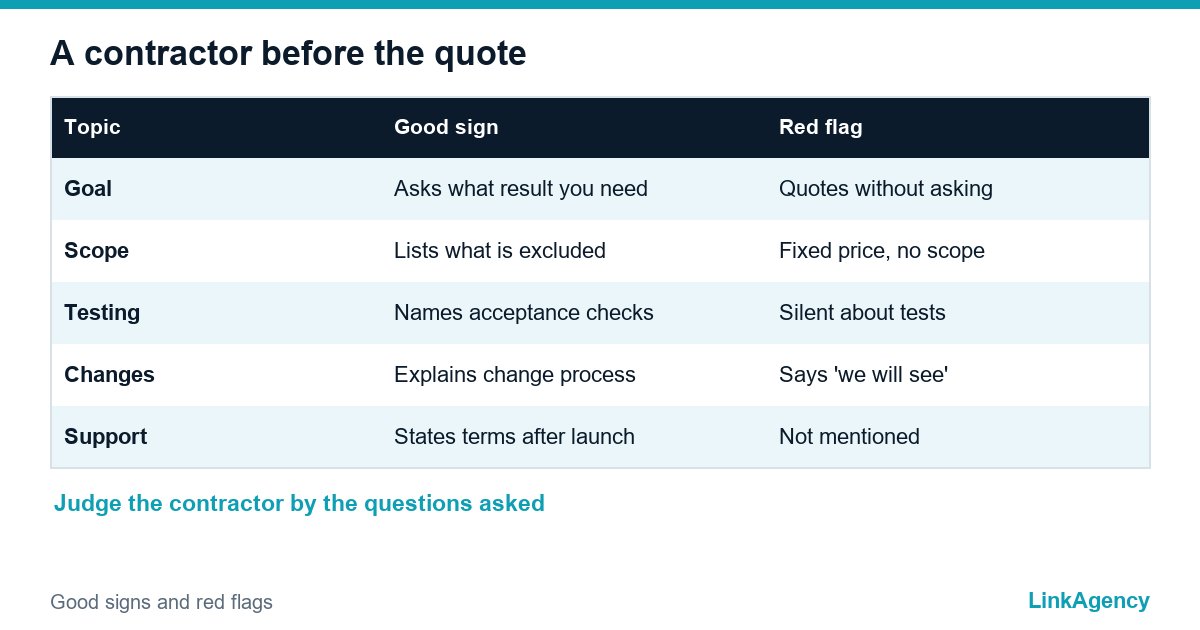
Red flags are a quote within a day without questions, a fixed price with no scope, and silence about testing and support. If the contractor never asks about the goal, the budget will be spent on guesses, and no software brief template can save a project like that. When you want a team that works inside your process, look at staff augmentation services, where you control the priorities directly.
Get a free consultation on your software development brief
Bring the idea in any form. We fill in this software development brief template with you and estimate the scope without obligation.
- goal, scope and exclusions on two pages;
- acceptance criteria and a stage plan;
- data, security and accessibility lines.
Send a request and we reply within one working day. If you need extra hands afterwards, you can hire a software development team through us.

Frequently Asked Questions (FAQ)
How long should a software brief be?
Two to three pages is enough for most business projects. If you need more, put the details into attachments and keep the brief itself readable in ten minutes.
What is the difference between a brief and a specification?
A brief says what result you need and what the limits are. A specification describes how the system works in detail, and usually the contractor writes it with you after the brief is agreed.
Should I include the budget in the brief?
Yes, at least a range. A budget range helps a good contractor suggest options that fit, and it makes quotes comparable instead of being a guessing game.
Who should write the brief?
The person who owns the business result, with input from users and from whoever knows your systems. A contractor can review it, but should not replace your thinking.
Can I change the brief after the project starts?
Yes, but agree how. Write a simple change process: what is requested, what it costs in time and money, and who approves it before work begins.
Can LinkAgency help me write a brief?
Yes. We run a short session, help define goals, scope and acceptance criteria, and give a first estimate. Send a request and we reply within one working day.