
Should you hire developers or hand the work to a vendor? There is no universal answer, but there are clear signposts, and they depend on your situation rather than on fashion. This guide is for CTOs and product owners: when it makes sense to outsource software development, what one engineer really costs, and what to check in the contract so you keep your code and your data.
Outsource software development or hire: start from your situation
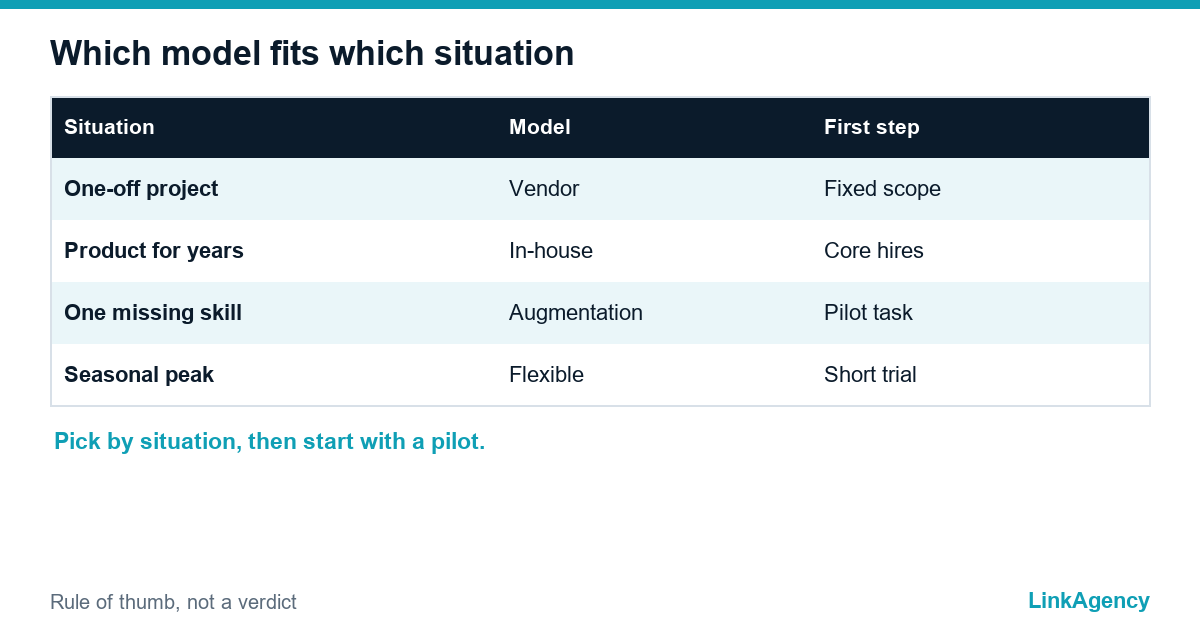
Comparing models in the abstract gets you nowhere, because one vendor suits a one-off project and not a product that grows for years, and once you pick a model, test the vendor with 12 questions on how to choose a software development company. Match your task to the table and the answer becomes obvious. Many companies outsource software development only at the start, then bring the product in-house once it has matured and there is budget for a permanent team.
| Situation | What to choose | Why |
|---|---|---|
| One-off project with a clear outcome | Project-based vendor | You pay for the result, not for a team’s upkeep |
| Product that evolves for years | In-house team | Product knowledge stays inside the company |
| One missing skill: DevOps, mobile, security | Staff augmentation | The expert joins your process and works as part of the team |
| Seasonal workload peak | Flexible model | No point keeping people on payroll all year |
For a one-off project the easiest start is MVP development: a short timeline, a fixed scope and a fast test of your hypothesis.

What a full-time developer really costs
The hidden costs of hiring
Hiring is more than salary, because recruiter time and onboarding, plus retention, all land on top, and these are the lines people forget to count. Finding a strong engineer takes weeks or months, and the task sits idle all that time, then onboarding begins and the newcomer learns your codebase without delivering full output for the first few months. If they leave, part of the knowledge walks out with them. Outsourcing software development removes some of that load, though it cannot fully replace your own people.
What to count when hiring
Hire a full-time developer for the core.
- Recruiting and interview time, including agency fees.
- Salary, payroll taxes, equipment, holidays and sick leave.
- Onboarding and training until the person reaches full speed.
- The risk of attrition and the price of a replacement.
Vendor risks and how to reduce them
An external team has weak spots of its own: loss of control, dependence on one supplier and misunderstood requirements. Clear specifications, regular reporting and a short trial before the big project close most of them. Many leaders fear outsourcing software development, yet the risks are manageable. If you serve European customers, remember the EU rules on personal data protection: the vendor becomes a processor, and that must be written down. When several unconnected suppliers are involved, the risks grow, which we covered in our piece on why joined-up development and AI-driven marketing work better. When a long build drags on, an outside team can look cheaper and in-house hiring dearer, but without management that saving disappears.
Time zones matter: agree on a few hours of overlap with your US or UK working day. A product team that wants to outsource part of the development should check references first, since a software outsourcing company without them is a red flag.
What to check in the contract
The contract decides a lot. Review it before the work starts, not after the first dispute. For information security you can use ISO 27001 as a baseline.
Check who owns the code first.
- Code ownership: all source code and documentation belong to you from the moment of payment.
- NDA and personal data protection: who processes the data and where it is stored.
- Knowledge transfer at the end of the engagement: code, access, architecture notes.
- SLA and reporting: response times, regular demos, clear KPIs.
Start with a pilot task of a few weeks. It shows how the team works and costs far less than a mistake found halfway through a large project.
The hybrid model: when to bring in outside specialists
Outsource software development when speed matters. Often the best answer sits in the middle: your own people build the core of the product, and outside specialists cover peaks or narrow skills. Product knowledge stays inside. Bringing in an expert is faster than hiring, because a specialist starts on tasks within days. When a build is urgent, a team that wants to outsource the next stage of development gains speed, and you skip months of recruiting. A busy team may also outsource a chunk of the development work to a vendor, keeping architecture decisions in-house. Outsourced software development then covers the peak without a permanent hire. Staff augmentation services fit this case: experts join your process, work in your sprints and cover DevOps, mobile or security, or lead a one-off job such as a cloud migration.
Outsource software development: we will match the model to your task
Tell us about your task and we will say what fits: a project vendor, team extension or a hybrid. You can also hire dedicated developers straight away.
- A model chosen for your situation and budget.
- A short trial with a clear outcome.
- A contract with code ownership and data protection.
The consultation is free and we reply within one working day.

Frequently Asked Questions (FAQ)
When is it cheaper to hire in-house and when to use a vendor?
A vendor wins for a one-off project and for seasonal peaks. An in-house team wins for a product that evolves for years. If you lack one skill, an outside expert is simpler.
What makes up the real cost of one in-house hire?
Beyond salary there is recruiting time, payroll taxes and equipment, onboarding, and the risk of the person leaving. These lines usually fall outside the calculation.
How do I reduce risk when working with an external team?
Write the requirements down, agree on regular reporting and start with a trial of a couple of weeks. You will see code quality and communication before handing over a large project.
What must a software development contract include?
Ownership of source code and documentation, an NDA, personal data protection (UK or EU GDPR where relevant), knowledge transfer at the end of the work, plus deadlines, an SLA, and an acceptance procedure.
How does team extension differ from project outsourcing?
In project outsourcing you pay for a result and the vendor manages the work. With team extension the specialists join your team and follow your tasks, so you manage the process yourself.
How do I ask LinkAgency to pick a development model?
Describe your task through the contact form on this page. We will suggest a suitable model for free, propose a short trial and contract terms, within one working day.