
Everyone talks about agents. Business owners hear about AI everywhere, yet few can say what to hand to agents. If a customer-facing agent gets a refund wrong, the invoice lands on your desk, not the vendor’s. This guide is a decision map for a manager: which tasks AI agents for your business can take over, which need a human check, which it should never touch, and how to start without risking your customers or your data.
AI agents for business: how they differ from chatbots and rule-based automation
A rule-based automation follows a fixed script: if X, do Y. A chatbot answers questions in a conversation, and in support that role goes to an AI chatbot for customer service with a human handoff. An agent pursues a goal: it reads a request, chooses steps, calls your tools and acts. That freedom is the value and the risk, and it is the core of the AI agent vs chatbot question. Agents change how a business works, and AI makes them cheap enough to try. In the AI agent vs chatbot comparison, the chatbot talks, while the agent also does. Our AI agent development services start by deciding how much freedom a task really needs.

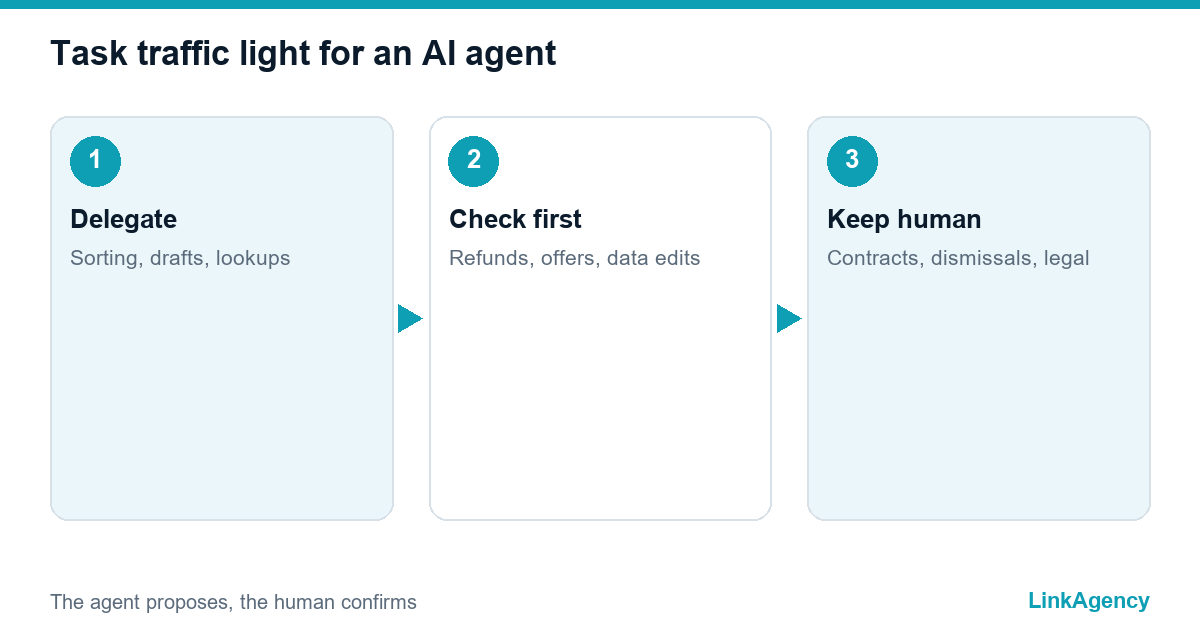
A traffic light for tasks: delegate, check, or keep human
Sort every candidate task into three lanes before you build anything.
| Lane | Examples | Rule |
|---|---|---|
| Delegate | Sorting requests, drafting replies, searching documents, preparing reports | The agent acts; you sample the results |
| Check first | Refunds, discounts, offers, edits to customer records | The agent proposes; a person confirms |
| Keep human | Contracts, dismissals, legal and medical decisions | The agent may prepare material only |
When in doubt, move a task one lane to the right, toward more human control, and revisit it after the first month of real data.
Where AI agents for business already pay off
The best early wins are boring, and AI agents in business shine at boring work. Agents triage customer support tickets, extract details from incoming enquiries and fill CRM fields, and they look things up in internal documents so staff stop hunting, and the same extraction logic drives invoice processing automation. The broader shift from experiments to production is covered in our piece on AI agents moving into real production. Notice what these jobs share. High volume, clear inputs, a cheap mistake. Those are the signs of a good first task.
Limits and control: access rights, sign-off, action log
Good AI agent governance is mostly access, approval and logs. Give the agent the same least privilege you would give a new hire. Read access first, write access later, payment access never by default. For anything touching money or personal data, follow the rule “the agent proposes, the human confirms”. This also helps with law: GDPR Article 22 gives people the right not to be subject to a decision based solely on automated processing that significantly affects them.
What to log
Record every action: the request, the data used, the tool called and who gave human approval.
Why the log matters
When something goes wrong you need to replay it. Without an audit log, you are guessing.
GDPR and the EU AI Act: what to check with customer data
An AI agent for a business that serves EU residents makes the vendor a processor, so sign the contract that GDPR requires. Decide which fields the agent may see and for how long. The EU AI Act adds a transparency duty in Article 50: people must be told they are interacting with an AI system unless that is obvious. The regulation text says it applies from 2 August 2026, but check current deadlines with your lawyer, since timelines can shift.

A pilot in a few weeks: pick one process and measure it
Choose one process, not the whole company. Pick a task from the green lane with a measurable output, such as first-reply time or tickets sorted per day. Treat it as a pilot project with a clear end date. Run it for a few weeks with a human reviewing a sample, and compare against the old way.
- Pick the process and the one KPI.
- Set access, approval and log rules.
- Run with sampling for a few weeks.
- Compare, then widen or stop.
The AI workflow automation we build usually starts as exactly this kind of pilot project. If the numbers do not move, stop. A failed pilot is cheap. A failed rollout is not.
When to bring in an outside team
AI agents for companies of any size hit the same wall: integrations. Call outside help when the process touches several systems, when nobody on your side owns integrations, or when legal review is needed. An AI agent development company should show you the traffic light, the access plan and the log before it writes code. For a neutral view of your options, our AI consulting services begin with a workshop on one process. Ask for the AI agent governance plan in writing. Ask any vendor what happens when the agent is wrong, who is told and how escalation works.
AI agents for business: a free review of one process
We will take one process, sort its tasks through the traffic light and tell you whether it suits a pilot. Our AI consulting services cover this review, and you can then hire an AI agent developer for the build, or keep the plan and run it yourself.
- A task map with delegate, check and keep-human lanes.
The consultation is free, and we reply within one working day.

Frequently Asked Questions (FAQ)
What is the difference between an AI agent and a chatbot?
A chatbot answers questions in a conversation. An agent pursues a goal: it chooses steps, calls tools and takes actions, which is why it needs access limits and human approval for risky tasks.
Which tasks should I never give to an agent?
Decisions with legal or serious personal impact: contracts, dismissals, medical or credit decisions. The agent may prepare material, but a person decides.
Must a person approve every action?
No. Low-risk, high-volume tasks can run on their own with sampling. Anything involving money, offers or customer data should follow the rule that the agent proposes and a human confirms.
What does the EU AI Act require for customer-facing agents?
Article 50 requires that people are informed when they interact with an AI system, unless it is obvious. Check current application dates and your own risk category with a lawyer.
How long should an AI agent pilot last?
A few weeks on one process is usually enough to see whether the numbers move. Define the metric first, keep a human reviewing a sample, and stop if nothing improves.
How do I ask LinkAgency to review a process?
Describe one process in the contact form on this page. We will sort its tasks into delegate, check and keep-human lanes and say whether it suits a pilot, usually within one working day.